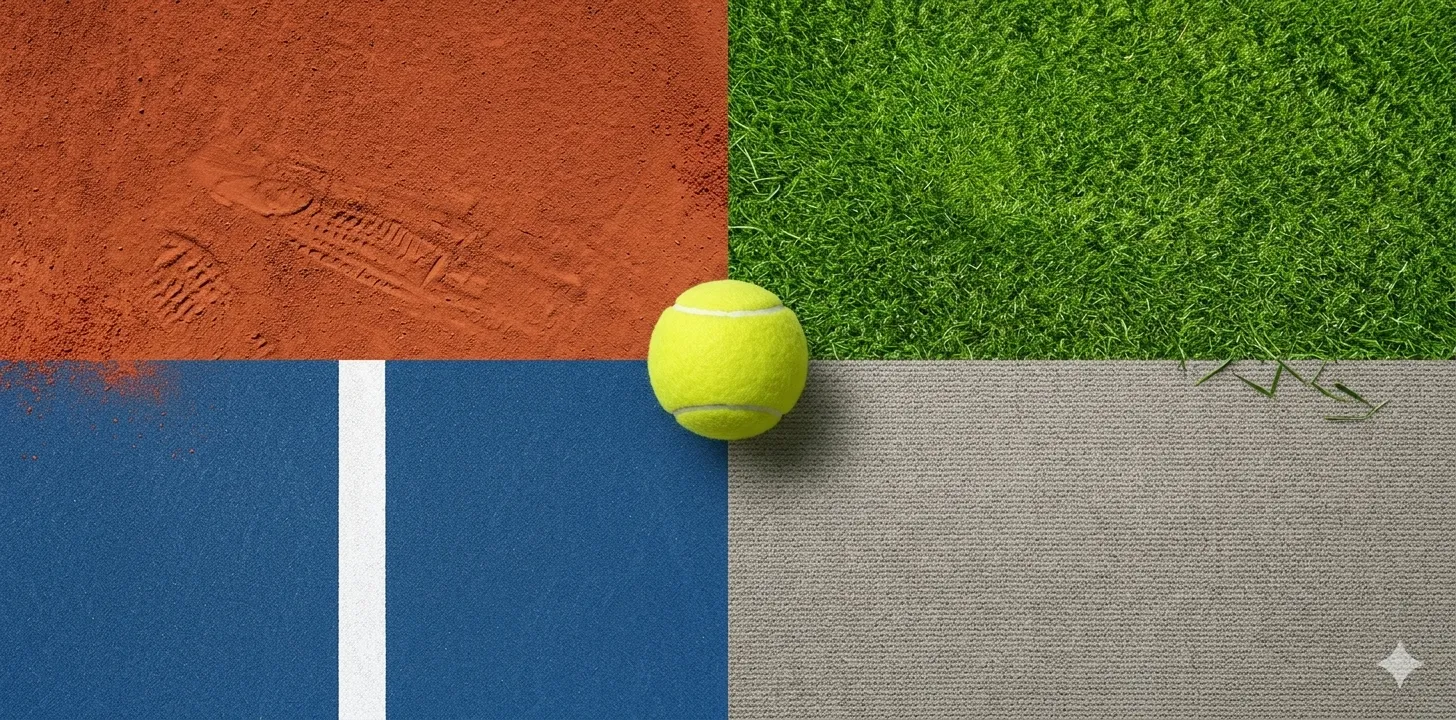
Tennis Court Surfaces: Clay, Grass, Hard Court & Carpet
Four surfaces, four completely different games. In no other major sport does the same event change so dramatically based on where it’s played: clay court tennis at Roland Garros is almost a different sport from grass court tennis at Wimbledon. Understanding why matters beyond trivia — it changes how you train, how you choose your racket, and how you adapt your game.
This guide breaks down every tennis court surface with real data: physical composition, ball behavior, injuries, tournaments, and the secrets most players don’t know. And at the end, a story many have forgotten: the carpet era and why the ATP killed it.
The Court Speed System: Court Pace Index (CPI)
Before diving into each surface, you need to understand the system the ATP uses to measure them. There are two distinct metrics that are frequently confused:
Court Pace Rating (CPR) — This is an ITF lab measurement. A ball is fired across a surface sample and speed is measured before and after the bounce. It assigns a fixed number to each surface product, regardless of match conditions.
Court Pace Index (CPI) — This is the real-time measurement used by Hawk-Eye during tournaments. It calculates ball speed immediately before and after contact with the court, incorporating variables like humidity, ball wear, and temperature. This index fluctuates throughout a tournament. Although both metrics share a name, they measure different things.
The CPI uses five categories:
| Category | CPI Range |
|---|---|
| Slow | < 30 |
| Medium-Slow | 30–34 |
| Medium | 35–39 |
| Medium-Fast | 40–44 |
| Fast | > 44 |
With that in mind, the Grand Slam data is surprising (historical average values measured by Hawk-Eye; CPI varies slightly each year based on conditions):
| Tournament | Surface | CPI (approx.) | Category |
|---|---|---|---|
| Roland Garros | Clay | ~21 | Slow |
| Wimbledon | Grass | ~37–43 | Medium to Medium-Fast |
| US Open | Hard court (Laykold) | ~40–42 | Medium-Fast |
| Australian Open | Hard court (GreenSet) | ~40–45 | Medium-Fast to Fast |
The Australian Open consistently ranks among the fastest Grand Slams, often above Wimbledon depending on the year. This contradicts the popular perception that grass is the fastest surface. We’ll come back to this.
Clay: The Slowest and Most Strategic Surface
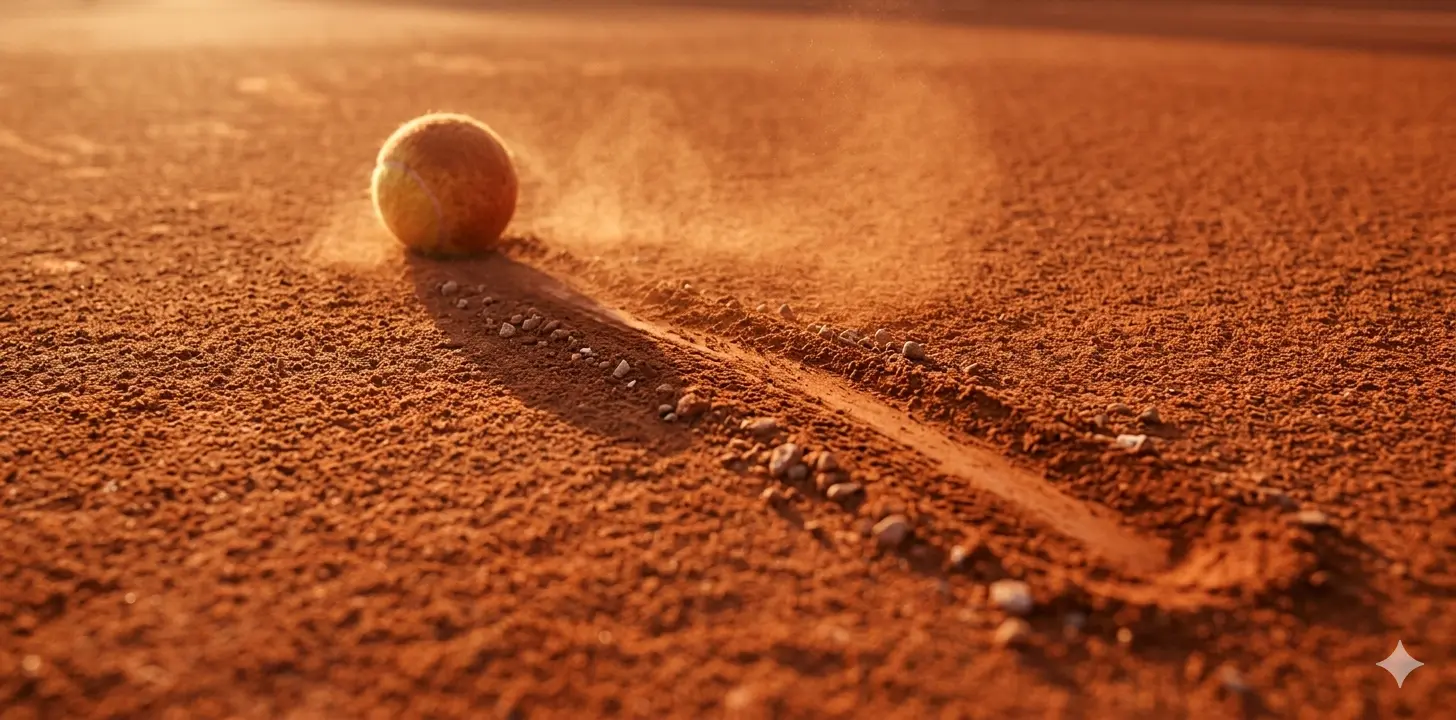
What It’s Actually Made Of
First thing to clear up: “clay” isn’t actually clay. The iconic Roland Garros surface is made from crushed brick dust tinted with iron oxide. The visible red layer is just 2 millimeters thick — less than a coin. All the real engineering is in the layers underneath:
- 2 mm of crushed brick dust (the red layer)
- ~10 cm (4 in) of crushed limestone
- ~10 cm (4 in) of crushed charcoal
- Several layers of coarse gravel
- Stone or asphalt base
Despite being an entirely natural material, the ITF officially classifies it as a slow artificial surface. Go figure.
There’s also an American variant: “green clay” or Har-Tru, made from crushed green limestone. It’s faster and harder than European red clay, though they share the name.
How the Ball Behaves
Clay absorbs ball impact in a way no other surface replicates:
- The ball loses a substantial portion of its horizontal speed on the bounce — bounce physics models estimate a loss of around 35–40%. A shot traveling at 67 mph (108 km/h) comes off the bounce at roughly 40–43 mph (65–70 km/h).
- The entry angle (around 16°) becomes an exit angle of 20° or more — the bounce is noticeably high.
- Topspin is amplified: players generate 20 to 25% more RPM on clay than on hard courts, because the high bounce gives more time to load the stroke.
Rafael Nadal averages 3,200 RPM on his forehand on clay (with documented peaks of 5,000 RPM). His game is, literally, a system engineered to maximize the physics of this surface.
Sliding: The Hidden Advantage
The most underutilized feature of clay isn’t the bounce speed — it’s the slide. Instead of stopping abruptly with their feet, players can slide into the ball, which allows them to:
- Reach balls significantly farther than on non-sliding surfaces
- Drastically reduce joint stress
This isn’t just technique — it’s biomechanics. A study published in the British Journal of Sports Medicine measured that average plantar force is 11.6 to 12.4% lower on clay compared to hard courts, and foot-to-ground contact time during baseline play is 30.3% longer (354ms vs. 272ms). More contact time, spread across more foot surface, means less impact per unit of time.
The result: clay has a lower incidence of ankle sprains, Achilles tendinitis, patellar tendinitis, and plantar fasciitis. The trade-off: higher incidence of muscle strains and injuries from the explosive acceleration and braking movements when sliding.
Major Tournaments
- Roland Garros (Grand Slam, Paris) — CPI: ~21 (the slowest on tour)
- Mutua Madrid Open (Masters 1000) — CPI: ~25
- Internazionali BNL d’Italia, Rome (Masters 1000) — CPI: ~25
- Monte-Carlo Masters (Masters 1000) — CPI: ~27
- Barcelona Open, Buenos Aires, Rio de Janeiro (ATP 250)
Playing Style
Clay favors:
- Baseliners and counter-punchers
- Topspin specialists
- Players with great physical endurance (points last longer)
- Defenders with good court recovery
Clay hurts:
- Big servers (the serve loses effectiveness due to the high bounce)
- Players who seek short, aggressive points
- Flat hitters (the high bounce neutralizes their main weapon)
ATP data shows that points last 15% longer on clay than on hard courts, and first serve points won drops from ~75% on hard courts to ~69% on clay — a significant difference that devalues the serve as a decisive weapon.
Grass: The Most Deceptive Surface
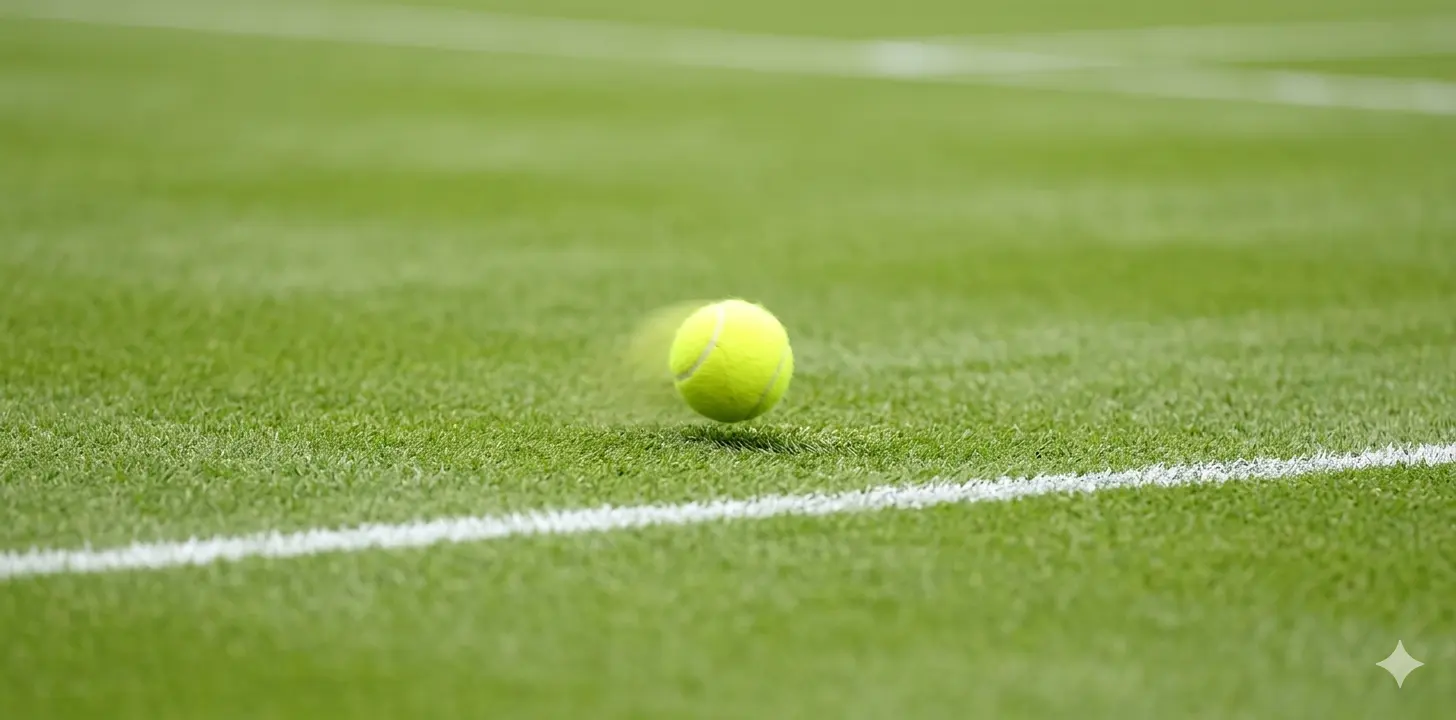
What It’s Actually Made Of (Wimbledon Specs)
Wimbledon uses 100% perennial ryegrass (Lolium perenne) in four cultivars: Authentic, Clementine, Cameron, and Melbourne. During the tournament, courts are cut to exactly 8 millimeters (0.3 inches) tall — mowed three times a week during preparation and every day during the tournament. The grounds crew has just 2 hours per day to mow, water, and repaint lines.
What few people know: since 2001, Wimbledon deliberately changed its grass blend. Before that, they used 70% ryegrass / 30% creeping red fescue. They eliminated the fescue and switched to 100% ryegrass. The result was a slower court with more bounce — intentionally designed to encourage longer rallies and make baseline play more competitive. The legend of Wimbledon as an ultra-fast surface is, partly, ancient history.
How the Ball Behaves
Grass is the lowest-friction surface of the three main types:
- The grass blades bend under the ball instead of resisting it, producing a very low, very flat bounce.
- The coefficient of restitution is approximately 0.75 — lower than clay (0.85), meaning the ball rebounds with less vertical energy.
- The 16° entry angle maintains an exit angle of ~16°, without the height amplification that occurs on clay.
The result is a ball that skids (slides along the ground), perfect for servers looking to keep the bounce low before the opponent’s return.
The Speed Myth
Here’s the counterintuitive fact we mentioned earlier: Wimbledon’s CPI historically ranges between 37 and 43 (Medium to Medium-Fast category). The Australian Open on hard court frequently sits above that range, in the Fast category. So why does everyone perceive grass as faster?
Because perceived speed isn’t actual speed. The low, skidding trajectory of the ball on grass — that low bounce forcing the opponent to bend down — creates an illusion of extreme speed even though the ball isn’t traveling faster than on hard court. It’s a biomechanical optical illusion.
Major Tournaments
- Wimbledon (Grand Slam, London) — CPI: ~37–43 — the only Grand Slam on grass
- Queen’s Club Championships (London, ATP 500)
- Halle Open (Germany, ATP 500)
- ‘s-Hertogenbosch (Netherlands, ATP 250)
- Eastbourne International (UK, ATP 250)
Only 10.6% of ATP tournaments are played on grass — it’s the least represented surface.
Playing Style
Grass favors:
- Big servers (the low bounce makes it hard to return with power)
- Serve-and-volley players
- Flat or heavy slice hitters (the low bounce suits these trajectories)
Grass hurts:
- Heavy topspin specialists (the low bounce neutralizes the effect)
- Baseliners who rely on consistency in long rallies
- Clay court specialists: the same player who dominates Roland Garros can crash out in the first round at Wimbledon
Injuries on Grass
Grass is generally softer on impact than hard courts, but it has its own risks:
- Higher incidence of ankle sprains (uneven surface, wet blades)
- Slips are more frequent, especially in the early days when the grass is freshest
- Courts change significantly throughout the tournament: second-week grass is noticeably more worn than first-round conditions
Hard Court: The Universal Surface
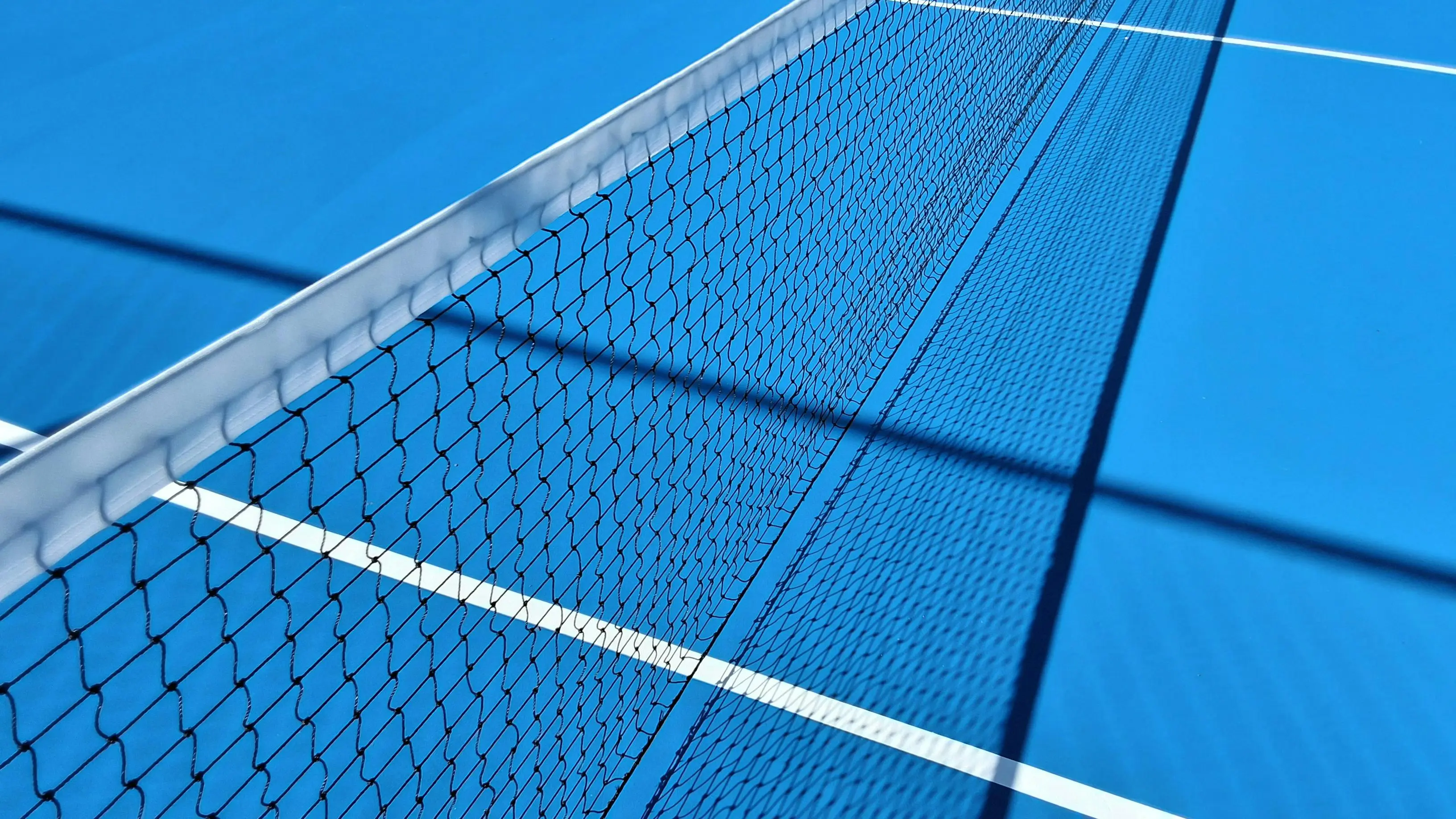
What It’s Actually Made Of
Hard court isn’t a single surface — it’s a family of products over an asphalt or concrete base. Speed is controlled by modifying the proportion of sand in the acrylic paint: more sand = more friction = slower.
There are two main types:
Standard (non-cushioned) hard court: Asphalt/concrete + layers of acrylic resin with silica. Faster and harder. Greater joint impact.
Cushioned hard court: An intermediate layer of rubber or foam is added between the base and acrylic surface. Reduces impact forces by 15–20% compared to non-cushioned hard courts.
The two main Grand Slam hard court surfaces:
Laykold (US Open, since 2020): Replaced the DecoTurf that was used for 42 consecutive years (1978–2019). Includes a rubber cushioning layer. CPI: ~40–42 (Medium-Fast).
GreenSet (Australian Open, since 2020): Replaced Plexicushion (2008–2019), which in turn replaced the infamous Rebound Ace (until 2007). Rebound Ace was notorious because at temperatures above 104°F (40°C), it would physically soften, changing the court speed mid-tournament. The modern GreenSet is designed to maintain consistent properties under extreme heat. CPI: ~40–45 (Medium-Fast to Fast) — consistently the fastest or one of the two fastest Grand Slams depending on the year.
How the Ball Behaves
Hard court offers the most consistent and predictable bounce of any surface:
- The bounce is moderate — neither as high as clay nor as low as grass
- The surface doesn’t deteriorate throughout the tournament (unlike grass which wears down)
- Conditions are virtually identical across all parts of the court
It’s the most “neutral” surface in tennis: it doesn’t drastically favor any playing style, which means the better player wins more often than on specialized surfaces.
Major Tournaments
Hard court accounts for 56% of the ATP tour — the dominant surface:
- US Open and Australian Open (Grand Slams)
- Indian Wells Masters, Miami Open (Masters 1000, outdoor)
- Canadian Open (Montreal/Toronto), Cincinnati Masters, Shanghai Masters (Masters 1000)
- Paris Bercy, ATP Finals (Masters 1000 / ATP Finals, indoor)
Injuries on Hard Court
Hard court doesn’t allow the sliding that clay does, meaning all braking force is absorbed by the joints. The medical research data is clear:
- Higher incidence of ankle and knee sprains
- Achilles and patellar tendinitis are more frequent
- Plantar fasciitis and metatarsalgia (from the hardness)
- Research by biomechanist Benno Nigg found that painful injuries are 5 to 8 times more frequent on high-friction surfaces that don’t allow sliding compared to surfaces that do
This doesn’t mean every hard court player gets injured — but at higher volumes of professional play, the cumulative risk is significantly greater. Top-level players who spend more time on hard courts report more chronic knee and ankle problems than peers who play more on clay.
Cushioned courts mitigate this, but don’t eliminate it.
Carpet: Tennis’s Forgotten Surface
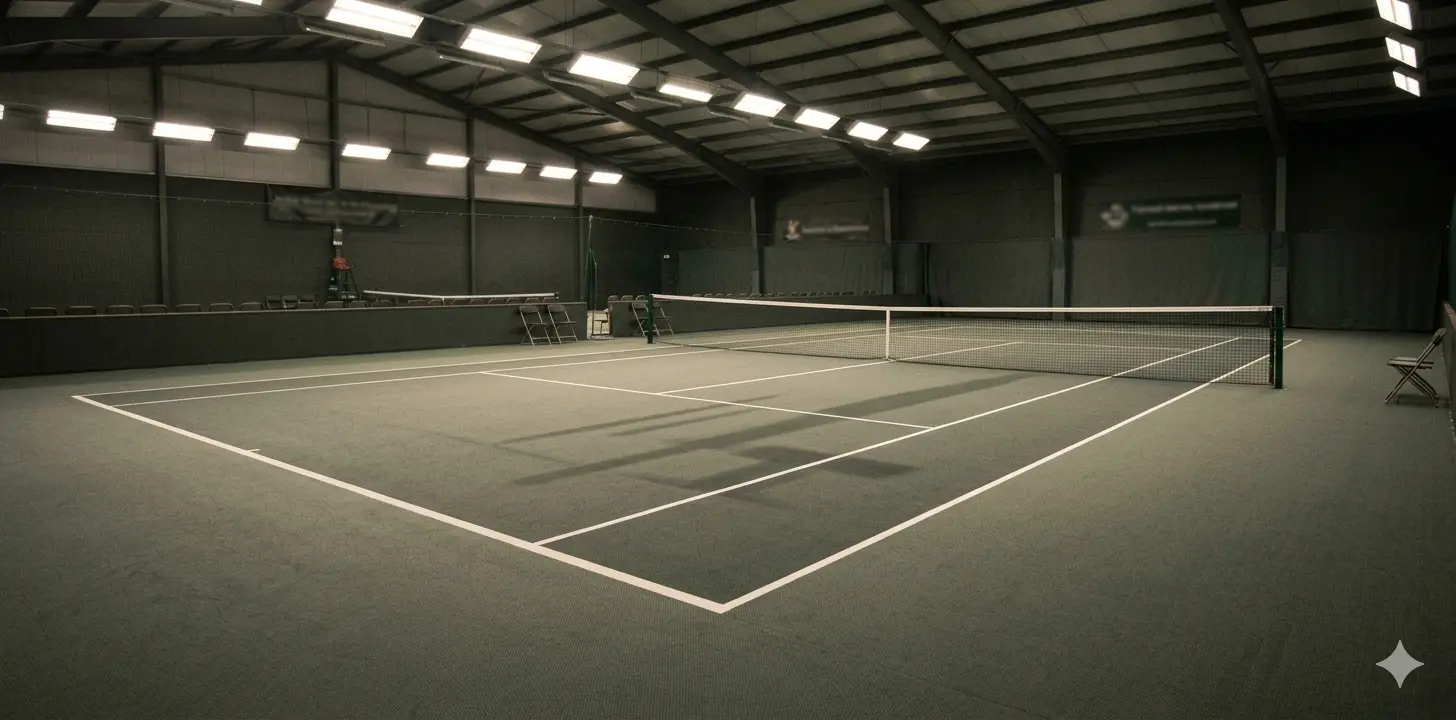
Carpet was for decades the surface of indoor tennis. Fast, leveling, and controversial. Today it has virtually disappeared from professional tennis — and the story of why is more interesting than it seems.
What Carpet Was
Technically, tennis carpet was a textile or polymer material supplied in rolls that was laid over any flat concrete base. There were two variants:
- Indoor: Nylon or rubber over concrete (the most common)
- Outdoor: Artificial turf with sand infill (slower than indoor)
Its playing characteristics:
- Second-fastest surface after grass in its era
- Low, flat bounce (similar to grass)
- Virtually no friction between ball and surface
- Extremely high ball speed — points were short
Carpet was first introduced in competitive tennis in 1968 — the exact same year the Open Era began. Modern tennis and carpet were born simultaneously.
Where It Was Played
| Tournament | Carpet Period |
|---|---|
| ATP Finals (Masters) | 1977–1989, intermittently in the 90s and 2005 |
| Paris Masters (Bercy) | Used carpet intermittently over ~25 years |
| US Pro Indoor (Philadelphia) | First carpet tournament, 1968 |
| Kremlin Cup (Moscow) | Historically used carpet |
| Zagreb Indoors | Carpet tournament |
| WCT Finals | Historical carpet era |
Why the ATP Banned It
In 2009, the ATP Tour banned carpet from all top-level tournaments. ATP spokesperson Kris Dent officially stated:
“The most important reason for the change was to standardize indoor competitions to hard court, which will reduce the risk of injuries.”
But the official reason didn’t tell the whole story. The real reasons were multiple:
1. Injury risk: Carpet was slippery. Falls were frequent, and knee injuries (including ACL problems) were higher than on other surfaces. The surface didn’t absorb impact and didn’t allow controlled sliding.
2. Matches too short: Big servers dominated on carpet. Points were extremely brief and matches ended in under an hour. Tournaments struggled to deliver a satisfying spectacle for fans — and to justify the broadcast time they’d contracted.
3. Surface degradation: Unlike asphalt or clay, carpet deteriorated rapidly under intensive use. The bounce in the first days of a tournament was different from the bounce in the semifinals — an inconsistency incompatible with modern professionalism.
4. Tour standardization: The ATP wanted indoor tournaments to be a coherent extension of the outdoor hard court season, not a surface anomaly requiring a completely different style of play.
Carpet Didn’t Disappear in 2009
Here’s a fact almost nobody knows: carpet didn’t disappear from professional tennis in 2009. It was only banned from the ATP Tour’s main events.
- The WTA continued using carpet after 2009. The last WTA carpet tournament was the Tournoi de Quebec in 2018. The last carpet champion in any professional circuit was Pauline Parmentier, who defeated Jessica Pegula in the Quebec City 2018 final.
- The ATP Challenger circuit also continued using carpet for years. The last Challenger carpet tournament was the Wolffkran Open in 2023 — 14 years after the ATP Tour “ban.”
In other words, carpet disappeared completely from professional tennis in 2023, not 2009.
The Nostalgic Carpet Era
Players like Mario Ančić and Jo-Wilfried Tsonga publicly argued that carpet was essential for developing fast-court skills. Roger Federer was one of the last elite players to compete on carpet at the professional level (Davis Cup matches in 2007).
Carpet had a unique atmosphere: indoor carpet tournaments, under artificial lights with no wind, produced tennis of a speed and explosiveness that doesn’t exist on any surface on today’s tour. For fans who lived through that era, there’s something modern tennis hasn’t managed to replicate.
Surface Comparison: Summary
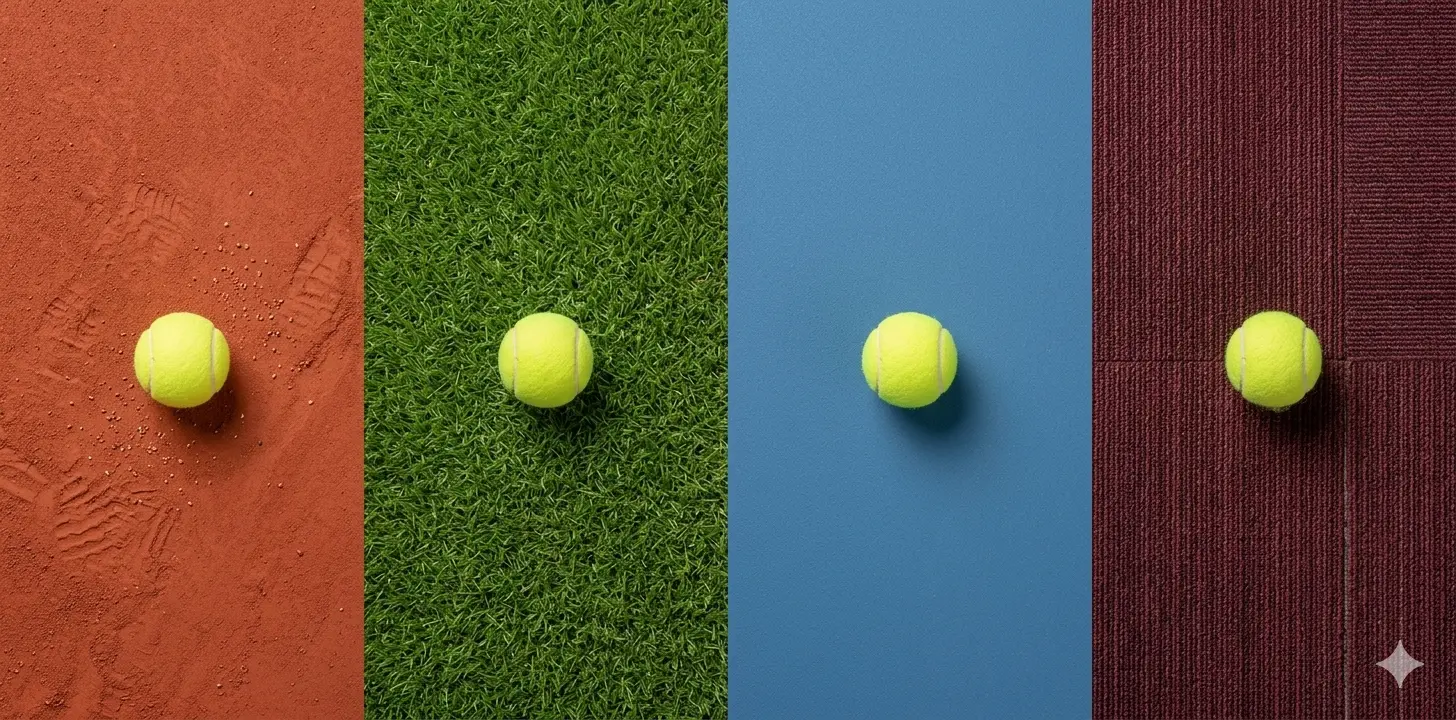
| Characteristic | Clay | Grass | Hard Court | Carpet |
|---|---|---|---|---|
| CPI (Grand Slam) | ~21 | ~37–43 | ~40–45 | N/A (historical) |
| Relative speed | Very slow | Medium* | Medium-Fast | Fast |
| Bounce height | High | Very low | Medium | Low |
| Predictability | High | Low | Very high | Medium |
| Durability | Daily (watered and swept) | Wears out in 2 weeks | High | Low |
| Injury risk | Lower (sliding) | Medium | Higher (impact) | High (slips) |
| ATP tournaments (%) | 33% | 11% | 56% | 0% |
*Grass is perceived as faster than it actually measures, due to the low, skidding ball trajectory.
How Surface Affects Your Equipment
The surface doesn’t just change your game — it should change your string setup and potentially your string pattern.
On clay: Rallies are longer and the ball arrives with more spin. A slightly lower tension (2–4 lbs less) helps maintain depth when the ball arrives heavy. A 16x19 pattern will generate more spin to take advantage of the high bounce.
On hard court: The factory-standard tension is usually adequate. The surface doesn’t especially favor or penalize anything. An 18x20 pattern can add more control for a flatter game.
On grass: Rallies are short and the bounce is low. A medium-high tension can give more control in quick exchanges. Polyester monofilament strings make more sense for those who play aggressively and flat.
Racket stiffness also comes into play: on hard courts where impacts are more abrupt, a more flexible racket can protect your arm better than on clay where the slide already absorbs some of the impact. Swing weight matters here too: on clay, where rallies are long, a lower swing weight reduces fatigue; on grass, where exchanges are short and explosive, a higher swing weight adds stability on impact.
What Most People Don’t Know
To wrap up, the most surprising facts from this guide:
- The Australian Open is consistently one of the fastest Grand Slams, often above Wimbledon. Grass is perceived as faster than it measures.
- Roland Garros has 2mm of clay. The red layer is decorative; performance comes from the five layers underneath.
- “Clay” isn’t actually clay — it’s crushed brick dust, classified by the ITF as an artificial surface.
- Wimbledon slowed down its grass in 2001 intentionally, changing its grass blend to lengthen rallies.
- Carpet survived until 2023 in professional tournaments, 14 years after its “ban.”
- Painful injuries are 5–8 times more frequent on hard surfaces without sliding than on surfaces like clay.
Sources and Further Reading
- Court Pace Classification Programme — ITF Official
- Court Pace Index: formula, data, and speed by tournament — TennisEdge.io
- CPR vs CPI: the difference between both metrics — Laykold
- Effects of playing surface on plantar pressures and injuries in tennis — British Journal of Sports Medicine / PMC
- The Science and Secrets of Red Clay Courts — ambelievable.com
- Grass Courts — Wimbledon Official
- The Lost Era of Carpet Courts — Tennis.com
- The Physics of Grass, Clay, and Cement — Grantland
- Slipping and sliding on tennis courts prevents injuries — The Conversation
Keep learning
Turn this information into a better decision for your game
Explore more guides on the same topic or visit the complete archive to compare your options with context.
Continue reading
Related articles
Extra Duty vs Regular Duty Tennis Balls: Which Court?
Learn when to use Extra Duty or Regular Duty tennis balls on hard courts, clay, indoor courts, and grass, plus when altitude matters more than felt.
Swing Weight in Tennis Rackets: What It Means
Learn what swing weight means, why equal-weight rackets can feel different, and how to choose or customize the right range.
Tennis Racket Types: Power, Control and Spin
What separates power, control and spin tennis rackets, which specs matter, and what to demo based on your swing and typical miss.