
Tennis Dampeners: What They Change and What They Don't
Few tennis accessories create as much debate as the tennis dampener. Some players never step on court without one, others remove it because the racket feels too “muted,” and plenty of players use one because they think it protects the elbow.
The short answer is this: a dampener does change something, but probably not what you think. It mainly changes the sound and feel of the string bed. What it has not consistently been shown to do is reduce the shock that reaches your arm or prevent tennis elbow.
Let’s separate myth, physics, and practical decision-making.
What is a tennis dampener?
A tennis dampener is a small piece of rubber, silicone, or another elastic material placed between the racket strings, usually near the bottom of the string bed. The two most common formats are:
- Button dampener: small, round or oval, placed between two main strings.
- Worm dampener: longer, woven across several strings.
Its real function is to dampen some of the vibration in the strings, not to turn the whole racket into a more arm-friendly machine. That is why many players immediately notice an acoustic change: the metallic “ping” turns into a lower, duller “pop” or “thud.”
That sensory difference can matter. If the high-pitched sound distracts you, or if you prefer a more muted response at impact, a dampener can make the racket feel better. But it is worth separating that sensation from a meaningful reduction in the mechanical load reaching your forearm.
The key: strings, frame, and arm do not vibrate the same way
When you hit the ball, there is not just one uniform vibration. Several mechanical responses happen at the same time.
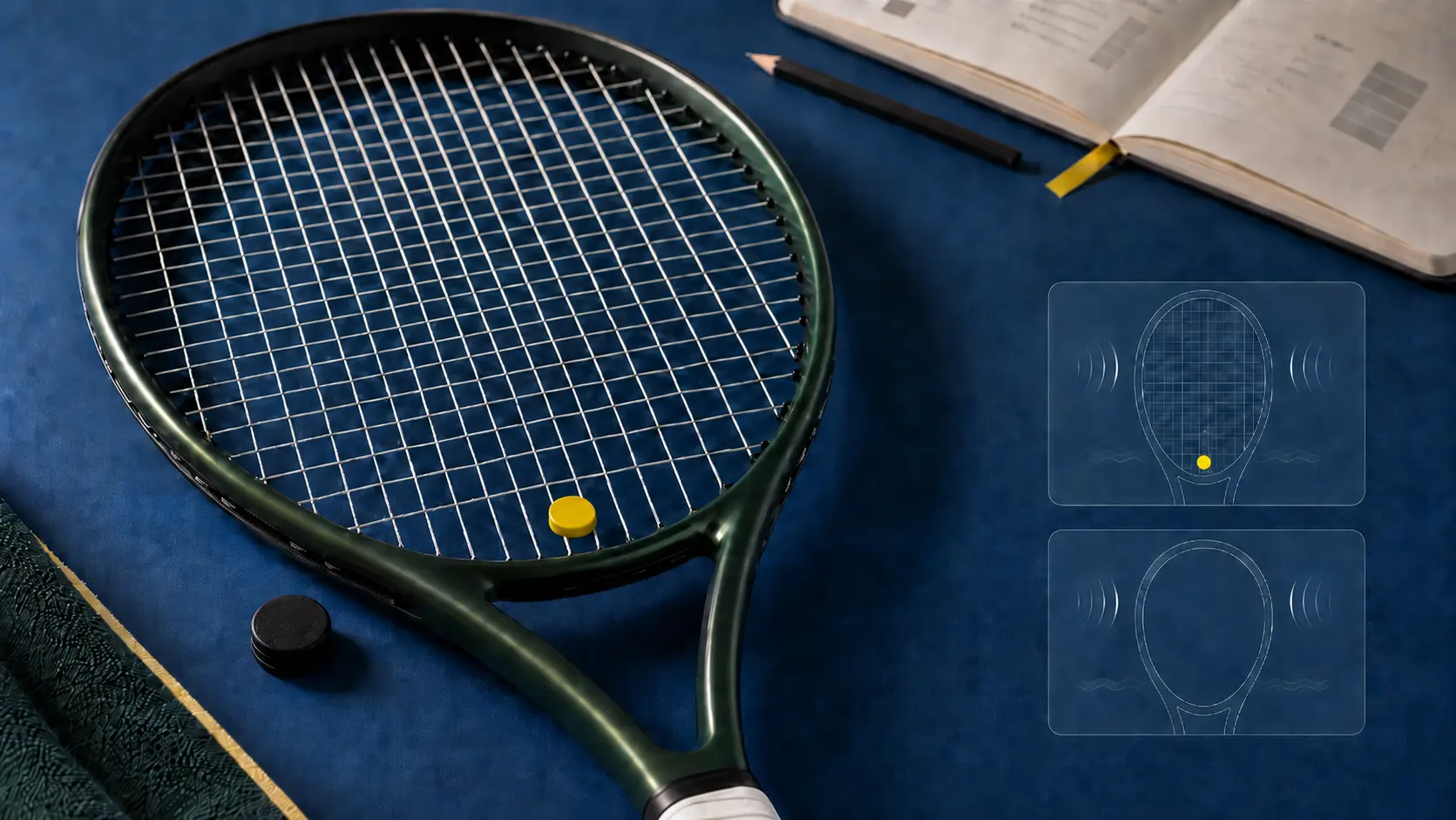
The one players notice most is string vibration. It is fast, high frequency, and responsible for much of the sound you hear after impact. This is where the dampener does work: it adds local mass and damping to the string bed, reducing that residual buzz.
The other important part is frame vibration and impact shock. That energy travels through the hoop, throat, handle, and finally into the hand and forearm. This is the part that matters more when we talk about arm comfort, soreness, or lateral epicondylitis.
The problem for dampener marketing is that a small piece placed between the strings has very little ability to change how the entire racket frame vibrates. It can quiet the string bed, but it does not meaningfully change frame stiffness, racket mass, impact location, string tension, or your technique.

What the studies say about tennis dampeners
The published evidence is fairly consistent.
In the study by Stroede, Noble, and Walker (1999), 20 players evaluated impacts with two racket models, with and without a dampener. The participants could not see or hear the impacts, and they rated hand and arm discomfort. The result was clear: dampeners quickly absorbed high-frequency string vibrations, but did not reduce low-frequency frame vibration or perceived discomfort.
The work by Li, Fewtrell, and Jenkins (2004) pointed in the same direction. They measured vibration transfer to the wrist and elbow during controlled impacts and found no significant difference in vibration amplitude with or without a dampener. They also observed that the accessory did not change grip force or forearm muscle activity after impact.
More recent research on damping technologies built into the frame did find relevant reductions in vibration transmitted to the arm. But that distinction matters: we are talking about the structural design of the racket, not an external accessory placed between two strings.
In other words: if your goal is to change the sound and feel of the string bed, the dampener works. If your goal is to seriously reduce the load that reaches your arm, the evidence points toward other factors.
The tennis elbow myth
The classic line is: “I use a dampener to prevent tennis elbow.” It sounds logical, but the logic breaks down when we look at what usually causes the problem.
Tennis elbow, or lateral epicondylitis, is usually related to overuse and repeated loading of the forearm extensor tendons. In tennis, the risk rises when poor mechanics, off-center contact, high playing volume, and unfriendly equipment combine.
A dampener does not fix any of those main factors. If you are worried about your arm, it usually has much more impact to review:
- Technique, especially on a one-handed backhand and on late or off-center contact.
- Racket stiffness, because a very stiff frame can transmit a harsher response.
- String type, especially if you use polyester without the swing speed to take advantage of it.
- String tension, since higher tensions can increase the force transmitted to the arm.
- Weight and swing weight, because a racket that is too light or unstable can punish you more on off-center hits.
This does not mean you should throw away your dampener. It means you should not treat it as a medical solution or as a substitute for a real review of your setup.
Does it affect power, control, or spin?
In practice, very little.
A typical dampener weighs only a few grams and sits low in the string bed. That weight exists, but it is nowhere near the effect of adding lead tape to more influential positions on the frame. The difference in power, maneuverability, or spin is usually too small for a recreational player to detect reliably.
What can change is your perception of the shot. With a dampener, some players feel the racket is more stable or solid because the sound is lower and there is less string buzz. Without a dampener, others feel they get more information from the string bed and prefer that livelier response.
Both preferences are valid. They just belong to the world of feel, not objective performance improvement.
Where to place it so it is legal
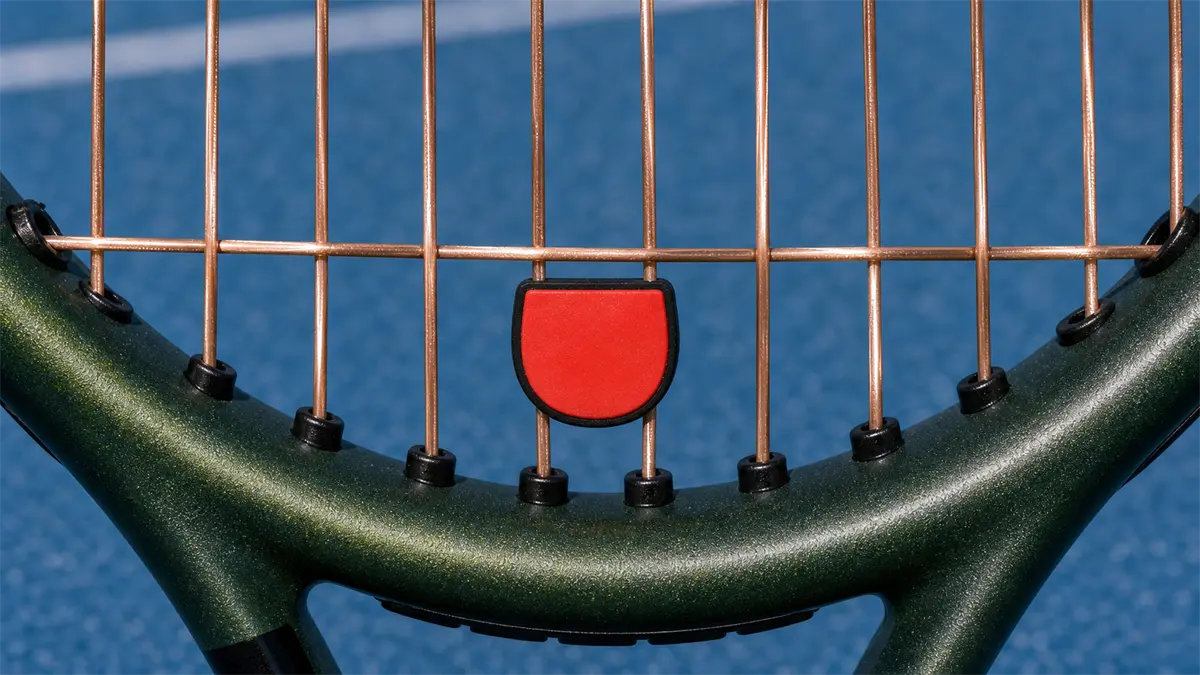
According to the ITF Rules of Tennis, vibration dampening devices may be placed on the strings, but only outside the pattern of crossed strings.
In simple terms: place it below the bottom cross string, above the top cross string, or outside the main hitting area. The most common and practical location is below the bottom cross string, centered between the two middle main strings.
Avoid placing it in the main impact zone. Besides being illegal, it can interfere with normal ball contact.
So, should you use a tennis dampener?
The honest answer: yes, if you like how it feels. No, if you expect it to solve an arm problem.
It makes sense to use one if:
- You cannot stand the string bed “ping.”
- You prefer a more muted impact sensation.
- It gives you confidence or psychological comfort.
- It helps you focus better on the shot.
You should not expect it to:
- Prevent tennis elbow.
- Meaningfully reduce frame vibration.
- Improve power or spin in any noticeable way.
- Compensate for a racket that is too stiff, strings that are too harsh, or poor technique.
The good news is that it is a cheap and reversible experiment. Play one session with a dampener and one without it, ideally with the same racket, same strings, and same tension. If you like it better with the dampener, use it without guilt. If you prefer a livelier string bed, take it off.
The scientific and practical conclusion is simple: a tennis dampener is a sensory comfort accessory, not a physical protection tool or a real performance upgrade. Used well, it does its job. The mistake is asking it to do the work that belongs to the racket, strings, technique, and load management.
Keep learning
Turn this information into a better decision for your game
Explore more guides on the same topic or visit the complete archive to compare your options with context.
Continue reading
Related articles
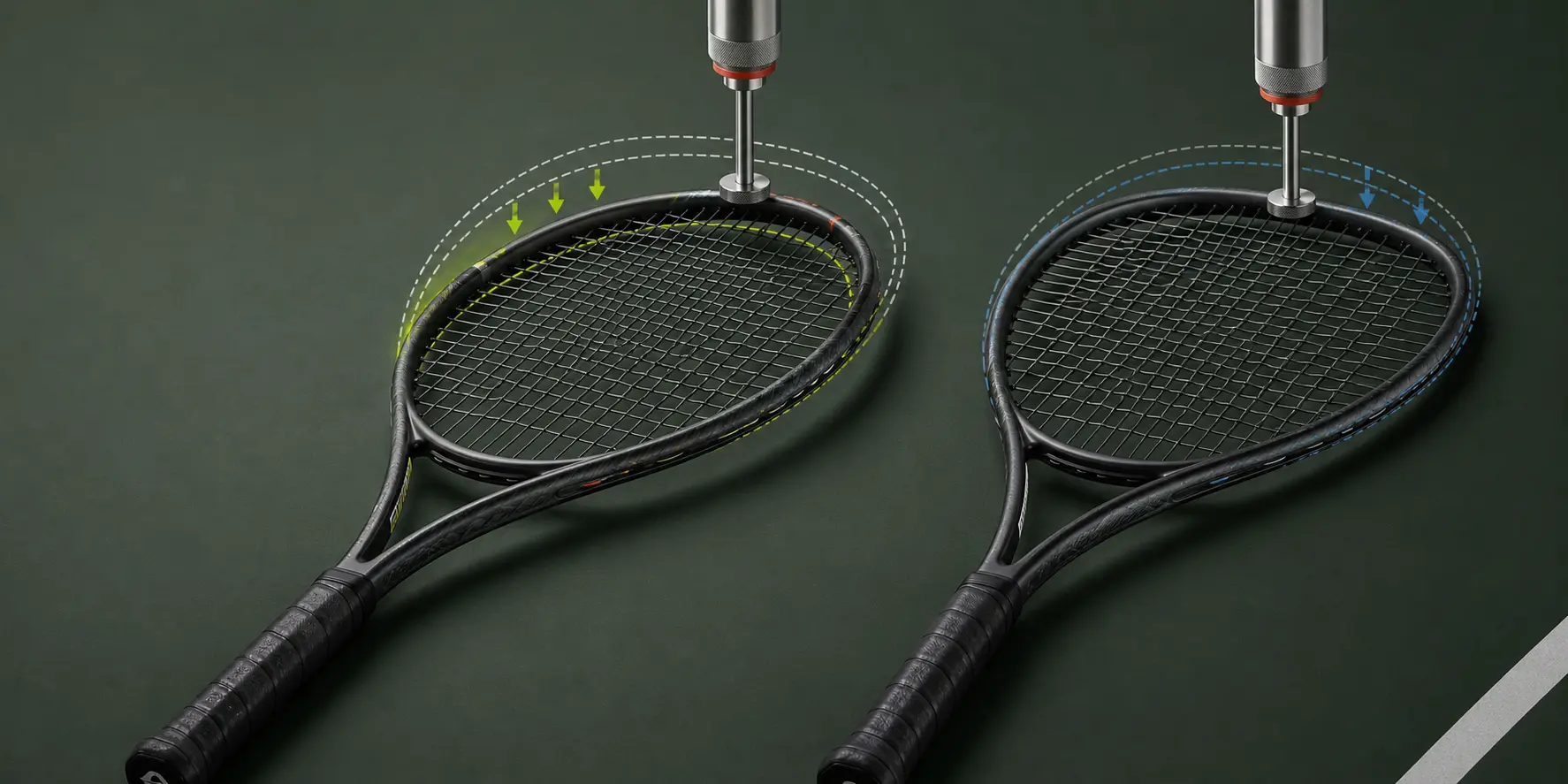
Racket Stiffness (RA): Power, Control and Your Arm
Learn what racket RA stiffness means, how it affects power, control and comfort, and which stiffness rating suits your level and playing style.

Extra Duty vs Regular Duty Tennis Balls: Which Court?
Learn when to use Extra Duty or Regular Duty tennis balls on hard courts, clay, indoor courts, and grass, plus when altitude matters more than felt.

Tennis Racket Types: Power, Control and Spin
What separates power, control and spin tennis rackets, which specs matter, and what to demo based on your swing and typical miss.