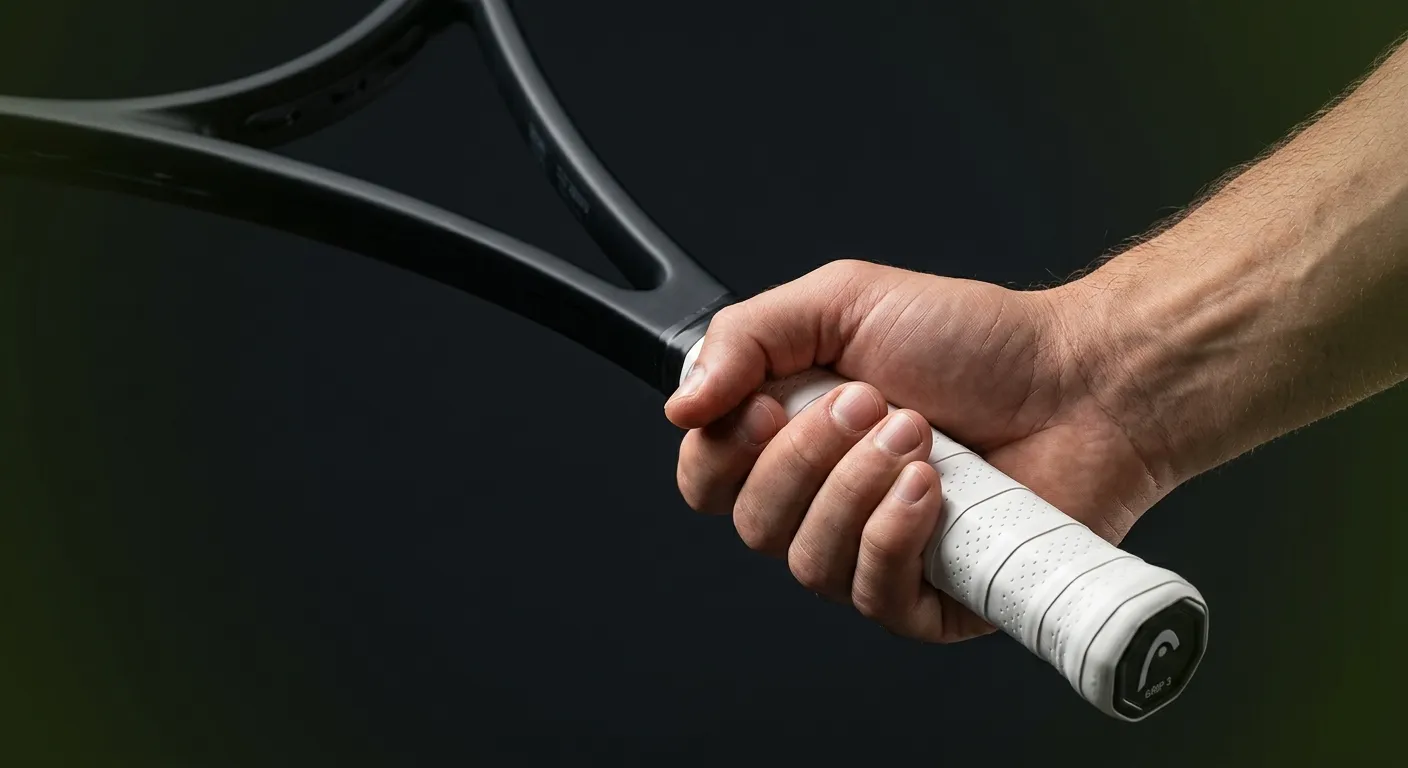
Tennis Grip Size: How to Measure It and Why It Matters
Most players pick up the racket they bought and never think about tennis grip size again. That is surprisingly common, and surprisingly important. Grip size affects wrist mobility on the serve, how much topspin you can generate, your risk of overuse injuries, and even the swing weight of your racket.
The worst part: many players spend years competing with a grip size that does not actually fit their hand.
This guide covers how to measure your correct grip size, what happens when you play with the wrong size, and the debate that splits tennis players and racket shops alike: is it better to go slightly too small or slightly too big?
The Size Chart: From L0 to L5
The tennis grip size system uses two parallel naming conventions: the European system (L0 to L5) and the American system (in inches). Both measure the circumference of the handle, meaning the distance around the grip.
| European size | US size | Circumference (mm) | Most common use |
|---|---|---|---|
| L0 | 4” | 101.6 | Juniors |
| L1 | 4 1/8” | 104.8 | Women (smaller hands) |
| L2 | 4 1/4” | 108.0 | Women (most common) |
| L3 | 4 3/8” | 111.1 | Men (most common) |
| L4 | 4 1/2” | 114.3 | Men (larger hands) |
| L5 | 4 5/8” | 117.5 | Uncommon |
Each jump in size represents 3.2 mm of extra circumference, less than the thickness of two coins. It sounds tiny, but your hand notices it.
The vast majority of adult players fall between L2 and L3. L2 is the most common size sold for women and L3 for men, according to data from major racket manufacturers.
How to Measure Your Tennis Grip Size
There are two reliable methods. Ideally, use both so one confirms the other.
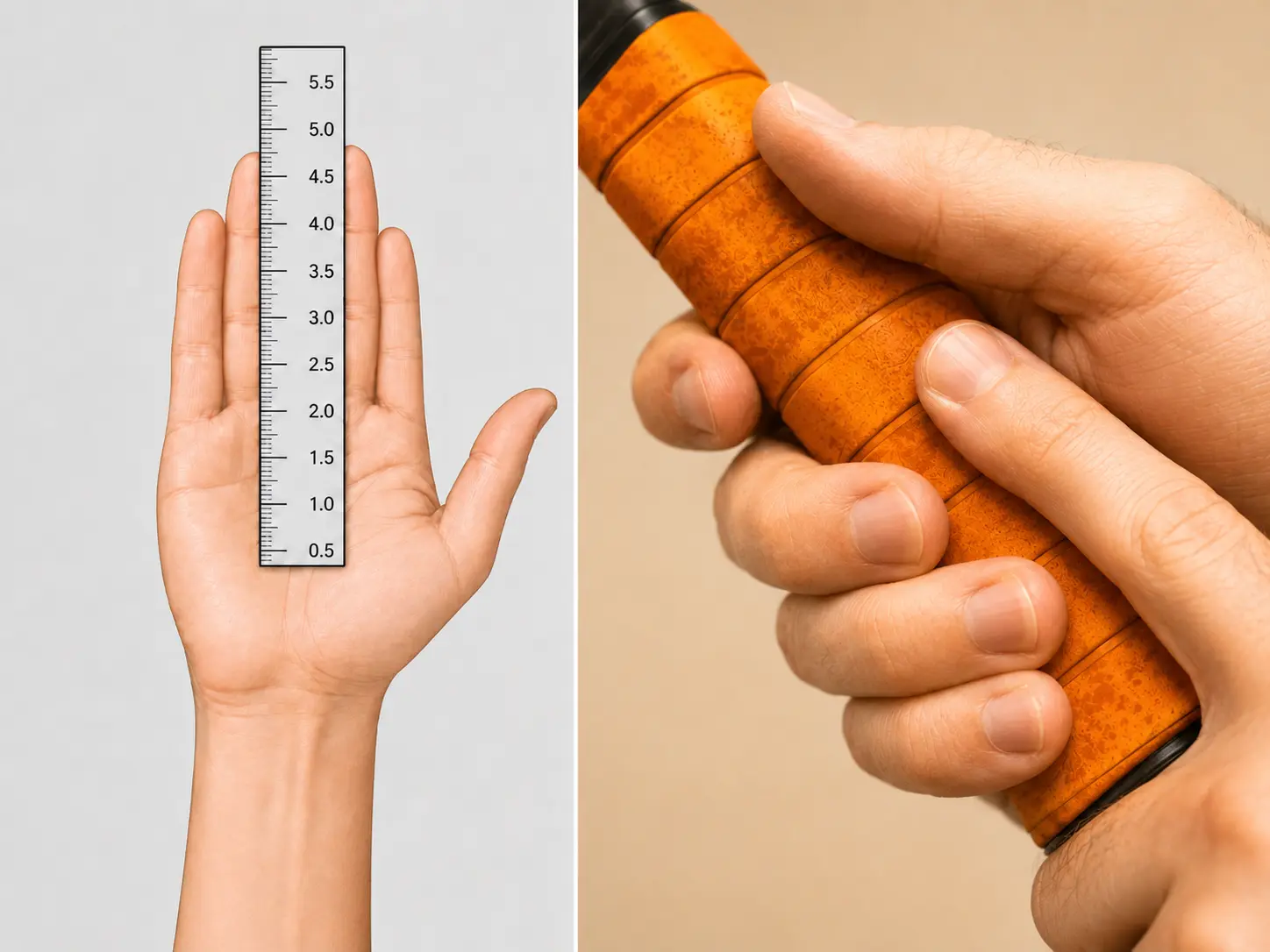
Method 1: The Ruler (the most accurate)
- Open your dominant hand with your fingers extended and together.
- Place a ruler on the lower lateral crease of your palm (the crease that crosses the base of the hand, parallel to the fingers).
- Measure from that crease to the tip of your ring finger.
- The result, in inches, maps directly to your grip size in the chart.
For most adults, this measurement falls between 4 1/8” and 4 1/2” (L1-L4).
Method 2: The Index-Finger Test (on-racket check)
- Hold the racket with an Eastern forehand grip (your palm on the main side bevel).
- With your free hand, try to slide your index finger into the space between your fingertips and the base of your palm.
How to read it:
- Your finger fits snugly, with no extra space: correct size.
- Your finger does not fit: grip is too small.
- There is extra space: grip is too large.
This method is less precise than the ruler, but it works well as a quick confirmation, especially when you are in a shop testing rackets.
What Happens When the Grip Is Too Big or Too Small
Grip size is not just about comfort. It directly changes how you strike the ball.
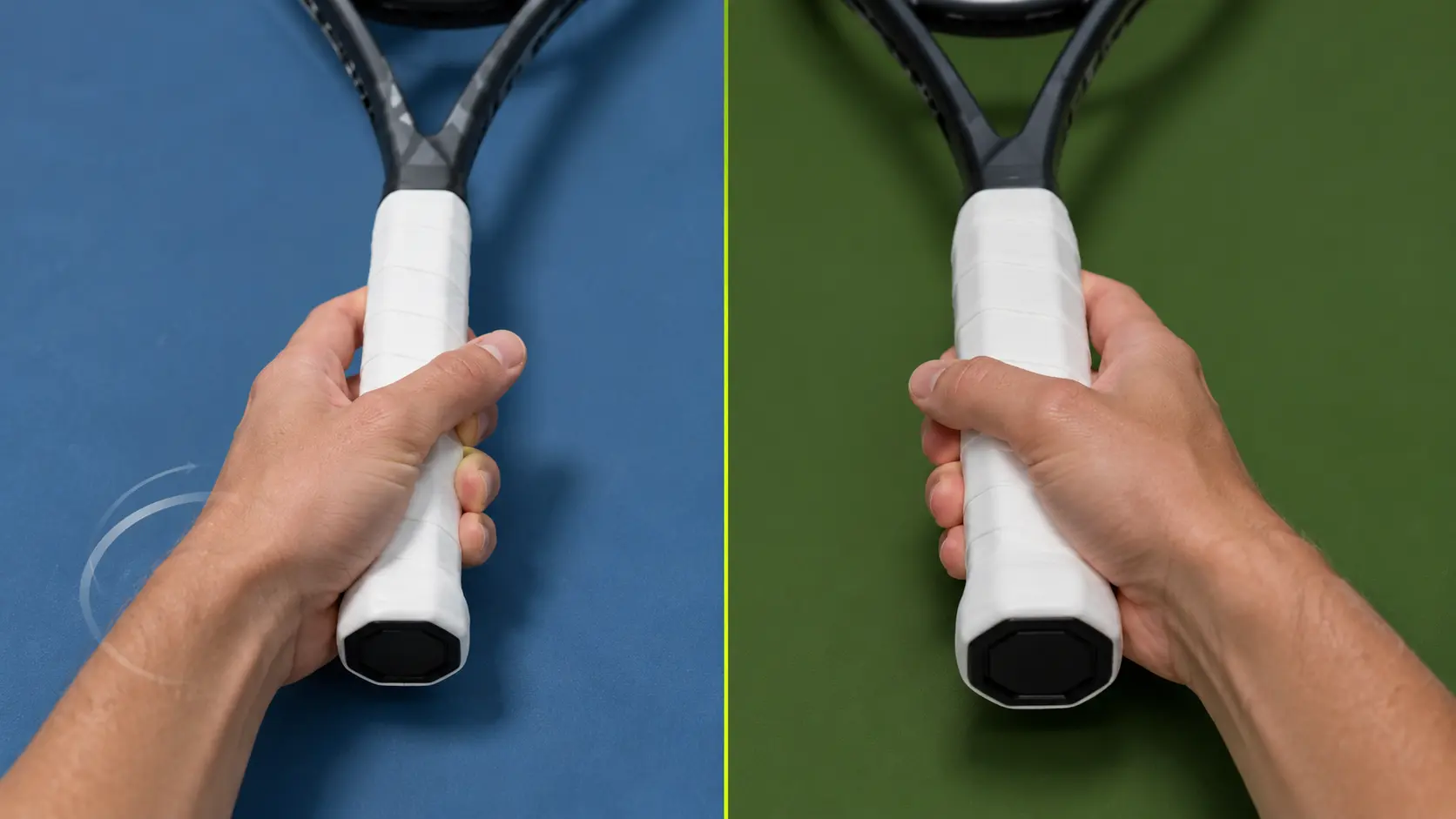
Grip too large
- It restricts wrist mobility. On the serve, you need a quick wrist snap to generate speed and spin. A thick grip limits that motion.
- It makes grip changes harder between shots. Moving from an Eastern grip to a Semi-Western grip between forehand and backhand requires releasing and readjusting, which is harder with a thick handle.
- It requires more force to hold. Your forearm works harder than necessary to keep the racket under control.
Grip too small
- It allows more wrist mobility, which sounds useful for topspin, but comes with a cost.
- It gives less stability at impact. The racket tends to twist more on off-center hits, forcing you to squeeze harder to compensate.
- It increases muscle fatigue over time. Constantly squeezing a narrow grip overloads the forearm extensors.
The key point: a slightly smaller grip helps topspin generation and spin serves, but sacrifices stability. A slightly larger grip adds control and stability, but limits the wrist. There is no universal answer. It depends on your playing style.
Grip Size and Injuries: What the Science Says (and Does Not Say)
This is where things get interesting. The common belief is that the wrong grip size causes tennis elbow (lateral epicondylitis). But the science is not that simple.
A 2006 study from the Kerlan-Jobe Orthopaedic Clinic analyzed NCAA Division I and II players using fine-wire electromyography. Its conclusion: changing grip size by +/- 1/4 inch did not produce significant changes in forearm muscle activation patterns during the backhand. In other words, the classic advice to “change your grip to prevent tennis elbow” did not have strong empirical support.
However, a later 2014 study found that there is an optimal grip diameter that reduces the grip force needed during the stroke, which in turn reduces load on the extensor tendons, one risk factor for epicondylitis.
The honest takeaway? Grip size is probably not the main cause of tennis elbow. Factors like racket stiffness, backhand technique, and string type matter more. But a correctly sized grip reduces the grip force you need, which lowers accumulated load on the forearm. It is not the magic fix some people sell, but it is not irrelevant either.
How Grip Size Affects Your Racket Specs
One detail many players miss: changing your grip size changes your racket specifications.
An overgrip adds roughly 1/16 inch of circumference, essentially half a grip size. In weight, it adds about 5 to 7 grams. Small, but not zero.
A shrink sleeve (a heat-shrink tube used to build up one full size) adds around 17 grams to the handle. That translates into:
- About 3 extra points of more head-light balance
- A couple of additional swing weight points
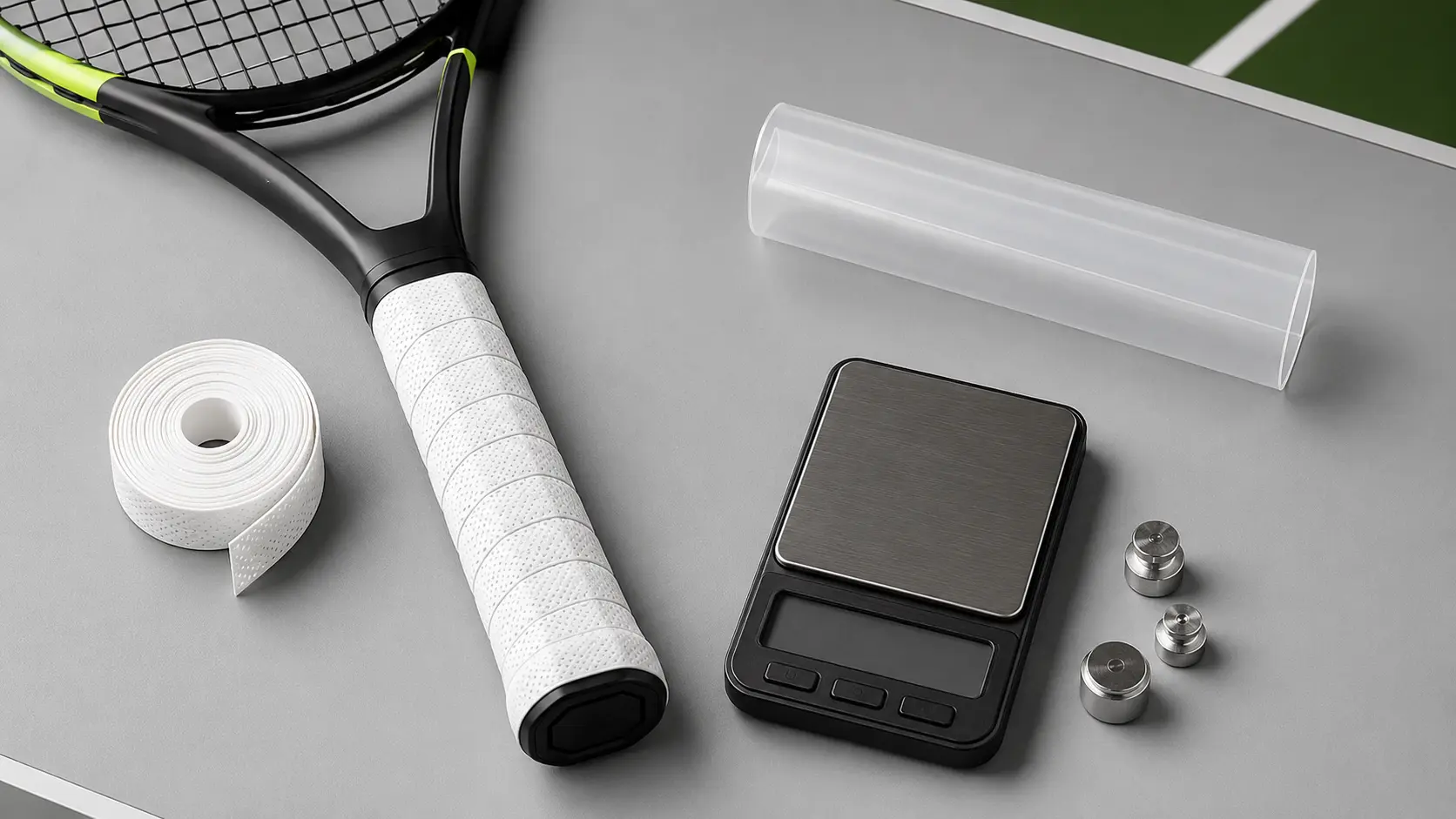
For a player who has carefully tuned racket balance with lead tape, changing grip size can undo part of that work. It is a chain reaction worth understanding.
The practical rule: if you are between two sizes, choose the smaller one and adjust with an overgrip. An overgrip adds minimal weight (5-7g) and gives you the flexibility to go back. A shrink sleeve adds meaningful weight (17g) and is not reversible without replacing the whole handle.
The Debate: “When in Doubt, Choose the Smaller Size”
This is the most repeated advice in tennis shops and forums: if you are between two sizes, go smaller and add an overgrip. It is practical advice. Building up half a size with an overgrip is easy and cheap, while reducing a grip size requires sanding the handle or buying a new racket.
But there is a nuance the standard advice often misses. In modern tennis, where heavy topspin dominates, many players have deliberately moved toward smaller grips to maximize wrist mobility. Roger Federer historically played with an L3 grip, smaller than you might expect for his hand size, for exactly this reason.
When does it make sense to go smaller?
- You play with heavy topspin and need wrist freedom
- Your serve relies on wrist snap to generate spin
- You change grips frequently between shots
When does it make sense to go larger?
- You play a flatter style and want more stability at impact
- You have a history of forearm or elbow discomfort
- You prefer a more controlled stroke with less variation
The truth is that the “correct” size is not one fixed measurement. It is a range where your game feels better. And you only find that range by testing.
Conclusion
Grip size is one of those specs that seems minor until you get it right. Here is the practical summary:
- Measure with a ruler (palm crease to ring fingertip) and confirm with the index-finger test.
- If you are between two sizes, choose the smaller one. You can easily build up half a size with an overgrip.
- A smaller grip helps topspin and wrist action; a larger grip helps stability and control.
- Do not assume grip size cures tennis elbow. The science says it can help, but it is not the main cause.
- Remember that changing grip size changes racket weight and balance, especially if you use a shrink sleeve.
Most important: test it on court. No rule or formula replaces the feeling of hitting 50 balls with one size and then another.
Keep learning
Turn this information into a better decision for your game
Explore more guides on the same topic or visit the complete archive to compare your options with context.
Continue reading
Related articles

US Open History: Records, Surfaces and Facts
Explore US Open history: when it began, its three court surfaces, who won the most singles titles, the latest American champions and New York traditions.

Tennis Rating Systems: UTR, NTRP and WTN
Tennis rating systems explained: what UTR, NTRP and World Tennis Number measure, why exact conversions fail and how to read your rating for fairer matches.
Racket Head Size: 98 vs 100 sq in — Which One Is Right for You?
Technical guide to tennis racket head sizes. Discover the real differences between 97, 98, and 100 sq in in control, power, spin, and sweet spot.