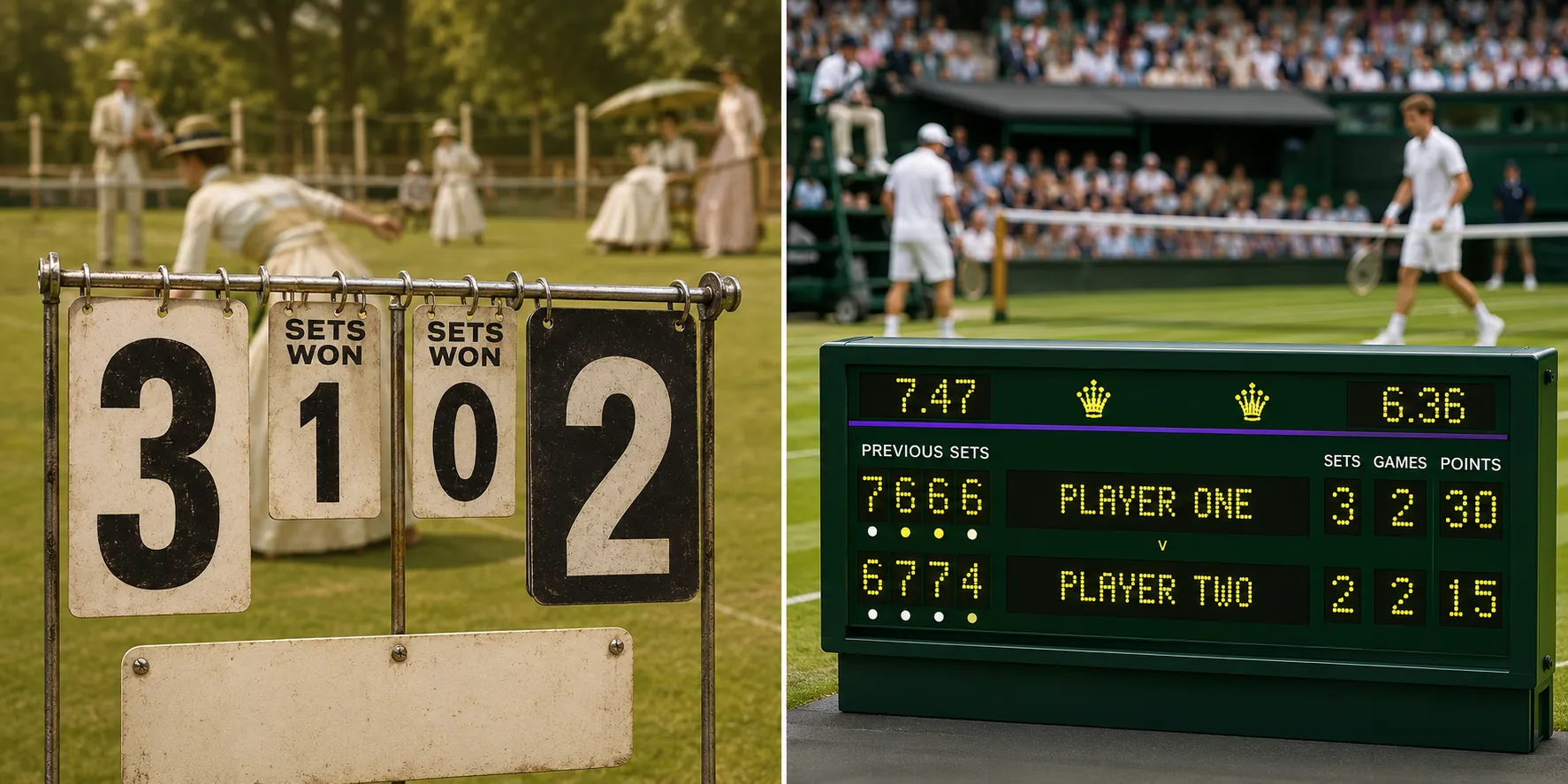
Tennis Scoring: Why Is It 15, 30 and 40?
If you have ever explained tennis to someone new, you probably reached this sentence: “the first point is 15, the second is 30, the third is 40.” And then comes the obvious question: why does tennis scoring work like that when it would be much easier to say 1, 2, 3 and game?
The short answer is this: nobody can prove one single definitive explanation. What we do know is more interesting. The 15, 30 and 40 scoring system comes from a very old tradition, probably inherited from medieval French tennis, and the tie-break arrived centuries later as a practical solution to matches that could last far too long.
Quick answer: why tennis scores 15, 30 and 40
In tennis, a normal game is scored like this:
| Points won | Traditional score |
|---|---|
| 0 | Love or zero |
| 1 | 15 |
| 2 | 30 |
| 3 | 40 |
| 4 | Game, if there is a two-point lead |
The modern system requires a player to win at least four points and hold a two-point advantage. That is why 40-40 does not end the game: it is called deuce, and from there a player needs to win two points in a row, advantage and game.
The history is less tidy. According to TIME’s historical overview of tennis scoring, old records include scores of 15, 30 and 45. Over time, 45 was simplified to 40, but the exact reason is still debated.
The most famous theory: the 60-minute clock
The explanation you hear most often is the clock theory:
- First point: the hand moves to 15.
- Second point: it moves to 30.
- Third point: it moves to 45.
- Fourth point: it reaches 60 and wins the game.
It sounds perfect. It also fits a four-point structure for closing out a game. The problem is that it has not been proven.
The story has cracks. Some historians point out that minute hands were not common during the earliest period linked to these references. And while the theory explains 15, 30 and 45 neatly, it does not prove why 45 eventually became 40.
The honest version is this: the clock theory is possible and easy to remember, but it is not settled historical proof.
The most likely story: an inheritance from medieval tennis
Before modern tennis, there was jeu de paume, a medieval French game first played with the hand and later with rackets. Today’s tennis inherited a lot from that world: vocabulary, rituals and part of its scoring language.
TIME cites references from the 15th and 16th centuries where scores similar to 15, 30 and 45 already appear. In other words, this oddity did not begin with televised tennis or Wimbledon. It came from much earlier.
Modern tennis, or lawn tennis, developed in the 19th century. Early on, there were attempts to simplify rules and formats, but when Wimbledon held its first championship in 1877, the game adopted much of the traditional system. Since then, the score has become part of the sport’s identity.
There is an important lesson here: some rules survive not because they are the simplest, but because they become shared language. A player who says “40-30” is not doing math. They are reading a pressure situation.
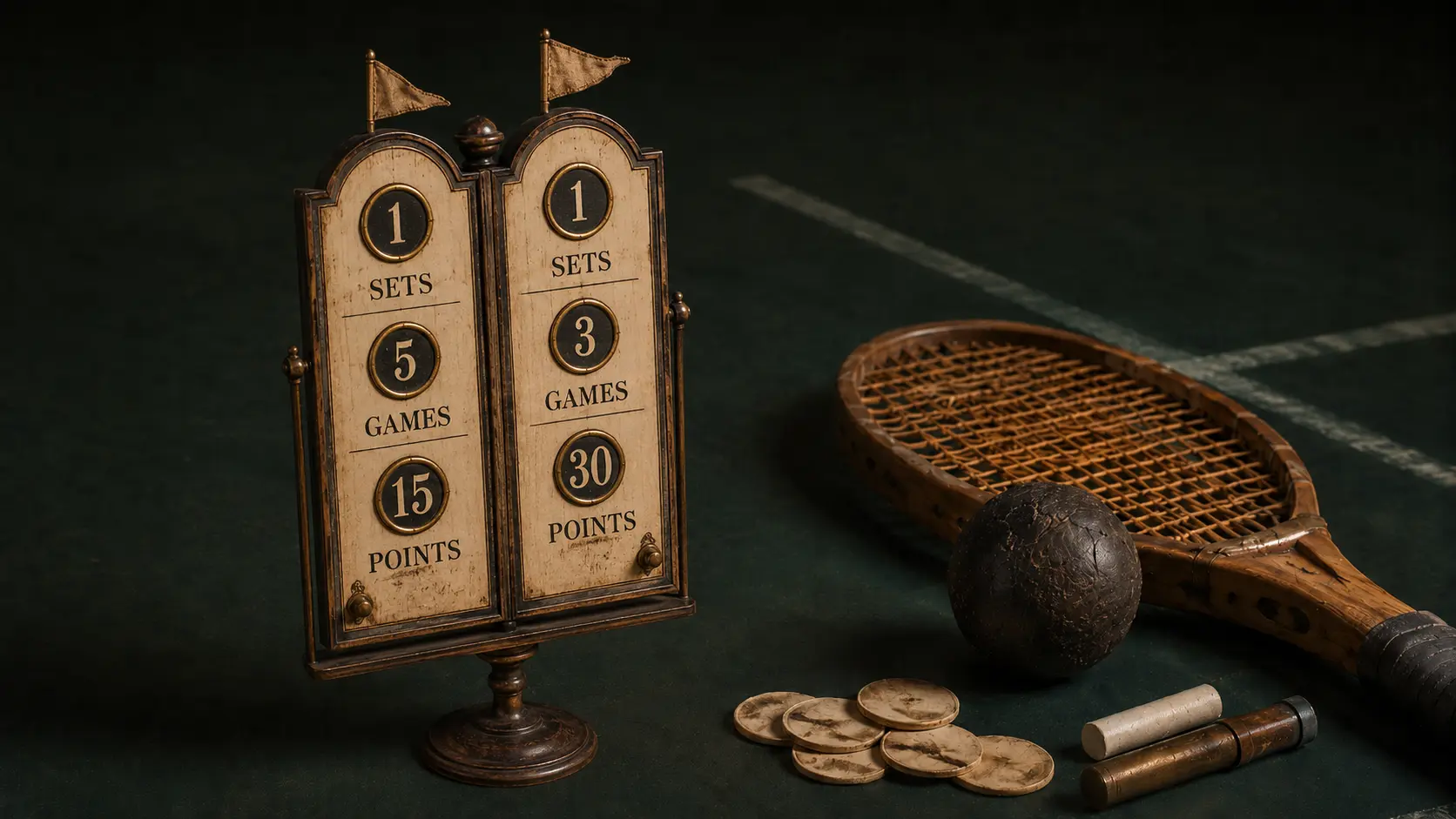
Why don’t we say 45?
This is the question that breaks the clock theory: if the system was 15, 30, 45, why do we say 40 today?
There are several possible explanations:
- Spoken simplification: “forty” may have been easier or faster to say than “forty-five” in some languages and contexts.
- Room for advantage: if the score was imagined as a scale up to 60, dropping from 45 to 40 left space to mark advantage before game.
- Evolution through use: many sports rules do not change by decree, but through repetition and habit.
None of these options has universal proof. What we can verify is that old references to 45 existed and that modern tennis eventually settled on 40.
For the club player, the practical point is to understand the current logic: 40 does not mean three exact points on a mathematical scale. It means you are one point from winning the game if your opponent has 30 or less.
What love, deuce and advantage mean
Tennis scoring has three words that confuse many beginners.
Love: zero points
Love means zero. The popular theory says it comes from the French l’oeuf, “the egg,” because of the shape of a zero. It is a nice explanation, but also disputed. TIME summarizes other possibilities, including links to Dutch terms or the English idea of playing “for love,” meaning for honor or without money.
The cautious conclusion: love means zero in tennis, but its exact origin is not settled.
Deuce: tied from 40-40 onward
Deuce appears when both players reach 40. From there, the game requires a two-point advantage. The word is usually linked to the French deux, two, because two consecutive points are needed to close the game.
In Spanish, players often say iguales. In competitive practice, the language does not matter: the concept is the same. Nobody wins a game from 40-40 with a single point.
Advantage: one point ahead after deuce
If you win the point at deuce, you have advantage. If you win the next point, you win the game. If you lose it, the score returns to deuce.
This system creates one of the toughest parts of tennis: you can play ten points in a game and still not have won it. That is why the serve, mental tolerance and risk management matter so much on important points.
How this scoring affects the way players compete
Tennis scoring is not just a historical curiosity. It changes the psychology of the match.
In other sports, each point usually adds the same amount to the scoreboard. In tennis, every point is worth one in real terms, but not every point carries the same weight. A 15-0 point and a 30-40 point are both one point, but they do not create the same pressure.
Examples:
- At 40-0, you can miss a ball and still have margin.
- At 30-40, the returner has break point.
- At deuce, every point can open or close the game.
- At advantage against, one poor return or one double fault ends the game.
That structure explains why tennis rewards consistency under pressure so heavily. It also connects with technical topics: a demanding racket can feel good in a rally but become difficult when your arm tightens on break point. If that side interests you, our guides on swing weight, racket stiffness and string types help explain why equipment matters more when the point has weight.
Why the tie-break was invented
For a long time, sets were played until someone won by two games. If the set reached 6-6, play continued: 7-7, 8-8, 9-9 and so on.
That sounds romantic, but it had a clear problem: a match could become endless. For players, organizers, television and spectators, not having a predictable finish became harder and harder to manage.
This is where Jimmy Van Alen enters the story, an American official and advocate for shorter scoring systems. His idea was simple: keep the tension of tennis, but give the set a clearer finish line.
According to Tennis.com’s history of the introduction of the tiebreaker, the 1970 US Open was the first Grand Slam to use a tie-break. The initial format was not exactly today’s version: it was a nine-point tie-break, with sudden death at 4-4.
The story that pushed the change
The tie-break did not appear because someone was annoyed by counting 15, 30 and 40. It appeared because tennis needed to control the length of sets.
One often-cited example is the 1969 Wimbledon match between Pancho Gonzales and Charlie Pasarell. It was a very long duel, played over two days, which Gonzales won 22-24, 1-6, 16-14, 6-3 and 11-9. That kind of scoreline was dramatic, but it also showed the problem: without a tie-break, a set could continue as long as the players, daylight and schedule could tolerate.
And if you want the modern version of the same story, there is the most famous match of all: John Isner vs Nicolas Mahut at Wimbledon 2010. It was a first-round match played from June 22 to June 24, lasted 11 hours and 5 minutes and ended 6-4, 3-6, 6-7, 7-6, 70-68 to Isner in the fifth set. The Guardian’s live report captures the absurd and fascinating nature of the moment: the match was no longer only a sporting contest, it was a logistical problem.
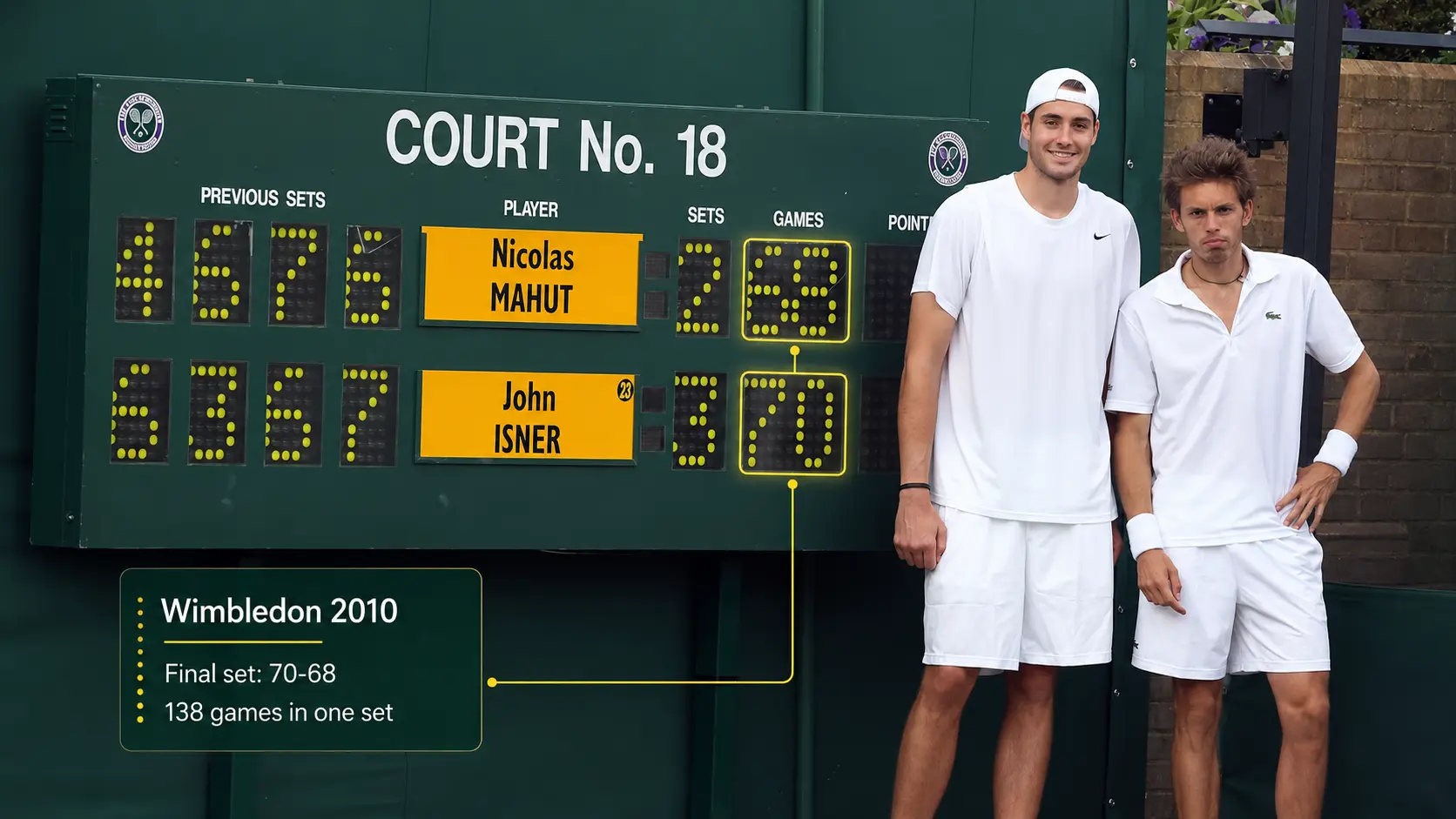
That match did not invent the tie-break, which had existed since 1970, but it made one question impossible to ignore: does it make sense for a Grand Slam to get trapped in an almost endless final set? Wimbledon kept its long advantage-set tradition for years, but Isner-Mahut became the perfect example of why tournaments eventually moved toward more controlled rules.
Van Alen wanted to avoid exactly that. His tie-break was a piece of competitive design: preserve the need to win under pressure, while reducing the risk of matches with no visible ending.
How the tie-break works today
In most sets that use a tie-break, it is played when the set reaches 6-6. The breaker is scored with normal numbers: 1, 2, 3, 4.
The usual rule:
- The first player to 7 points wins.
- They must win by two points.
- If it reaches 6-6, play continues to 8-6, 9-7, 10-8 or whatever is needed.
- The set ends 7-6 to the player who wins the tie-break.
In Grand Slams, since 2022, the deciding set uses a 10-point tie-break when it reaches 6-6, also with a two-point margin. The official Grand Slam announcement explained that the goal was to create more consistency across tournaments and improve the experience for players and fans, as the US Open reported in its 2022 announcement.
Why the tie-break changed tennis
The tie-break did not only shorten matches. It changed how players compete at the end of sets.
Before, if nobody broke serve, the set could continue indefinitely. Now, reaching 6-6 creates a mini-match inside the match. Every point weighs more because there are no games to hide inside.
For the recreational player, this has practical consequences:
- You need a reliable serve or return pattern to start the point.
- Hitting hard is not enough, because two quick errors can leave you down 0-2 or 1-4.
- Changing ends every six points breaks rhythm and forces a mental reset.
- Shot selection has to be clearer: safe pattern first, attack when the ball allows it.
That is why many players train tie-breaks as a separate situation. It is not just “play to seven.” It is learning to make decisions when the emotional margin is minimal.
Frequently asked questions about tennis scoring
Why does tennis say 15, 30 and 40?
Because modern tennis inherited an old scoring system, probably linked to medieval French tennis. There are historical records of 15, 30 and 45; 45 eventually became 40, although there is no definitive explanation accepted by all historians.
Why doesn’t tennis count 1, 2, 3 and 4?
It could, and some recreational formats do. But competitive tennis kept the traditional language because it is part of the sport’s identity and because the deuce and advantage system expresses the need to win by two points very clearly.
What does deuce mean in tennis?
Deuce is the tie from 40-40 onward. From deuce, a player needs to win two points in a row to take the game: first advantage, then game.
What does love mean in tennis?
Love means zero. Its exact origin is debated. The French egg theory (l’oeuf) is popular, but not proven; there are also explanations linked to playing for honor or without a wager.
Why does the tie-break exist?
The tie-break exists to prevent sets from stretching indefinitely when nobody can win by two games. It was promoted by Jimmy Van Alen and entered the Grand Slams at the 1970 US Open.
How many points are in a tie-break?
A standard tie-break is played to 7 points, with a requirement to win by two. In deciding sets at Grand Slams, a 10-point tie-break has been used since 2022, also with a two-point margin.
Conclusion: a strange rule, but not an accidental one
Tennis scoring feels strange because it blends layers from different eras. The 15, 30 and 40 sequence comes from an old tradition. Love and deuce carry historical vocabulary. The tie-break, by contrast, is a modern invention designed to solve a practical problem: matches needed a more predictable way to end.
That mix is part of what makes tennis unique. It is not the most intuitive system for a beginner, but once you understand it, it has one virtue: it turns every game into a small story of pressure, advantage, recovery and closure.
And that is the competitive key. In tennis, it is not enough to collect points. You have to win them at the right time.
Keep learning
Turn this information into a better decision for your game
Explore more guides on the same topic or visit the complete archive to compare your options with context.
Continue reading
Related articles
Extra Duty vs Regular Duty Tennis Balls: Which Court?
Learn when to use Extra Duty or Regular Duty tennis balls on hard courts, clay, indoor courts, and grass, plus when altitude matters more than felt.

Tennis Racket Types: Power, Control and Spin
What separates power, control and spin tennis rackets, which specs matter, and what to demo based on your swing and typical miss.
Tennis Racket Beam Width: Power, Control and Feel
What tennis racket beam width measures, how thin and thick frames affect power, control and feel, and why beam width is not the same as RA stiffness.