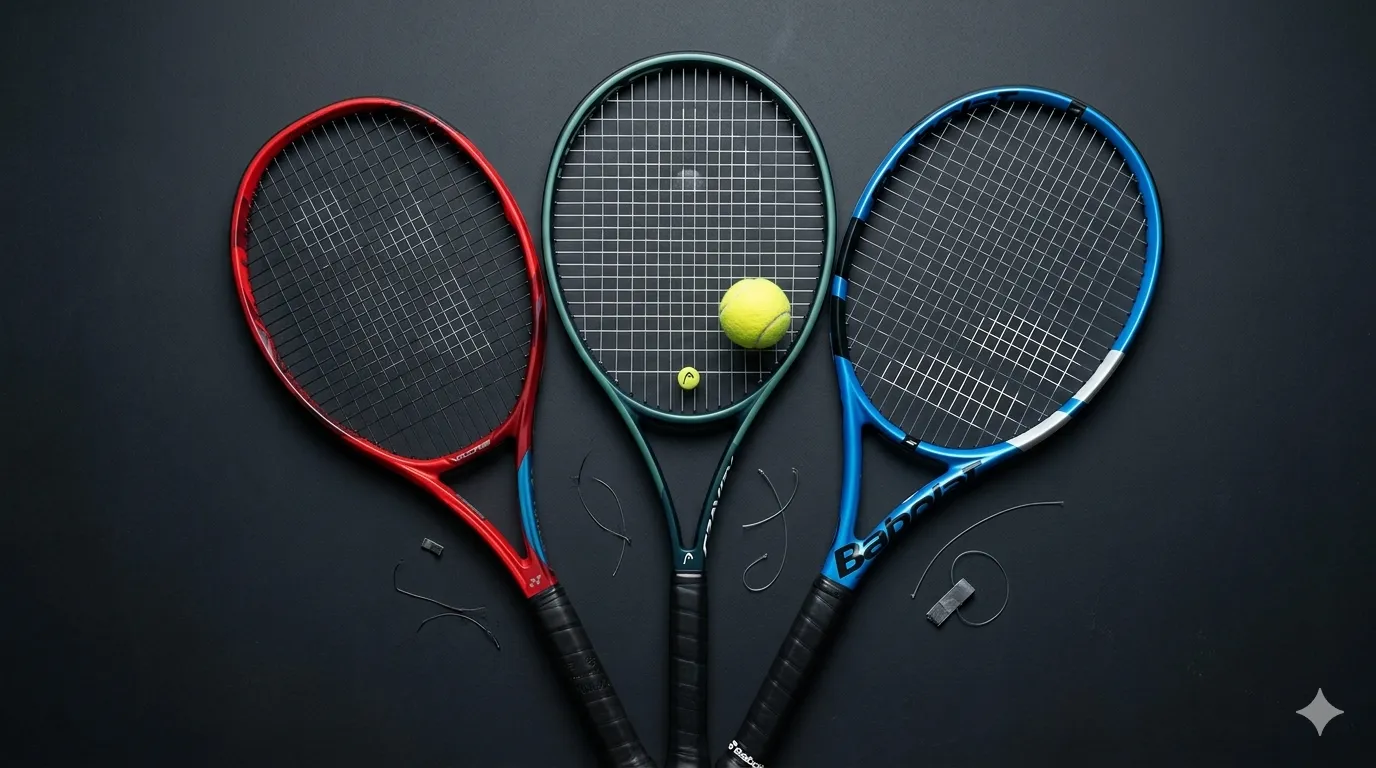
Racket Head Size: 98 vs 100 sq in — Which One Is Right for You?
When a player buys a new racket, the first question is usually “how much does it weigh?” But there’s another spec that influences how the racket feels just as much — if not more: head size. Those 2 square inches of difference between a 98 and a 100 may seem trivial on paper, but they change the string dynamics, the sweet spot, and the overall behavior of the racket more than you’d expect.
In this guide, we’ll break down the real differences between the most common head sizes, backed by data, so you can decide which one fits your game.
A brief history: from wood to graphite
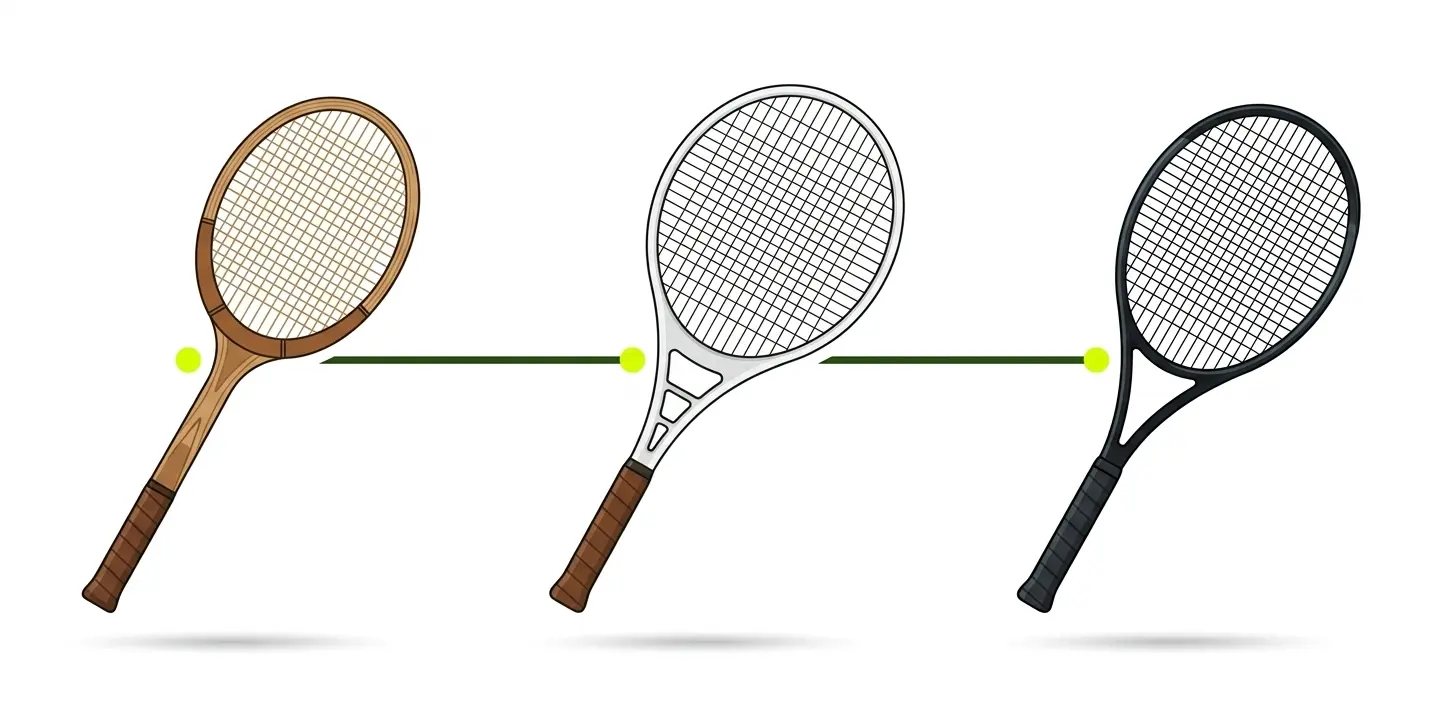
Racket head size wasn’t always a topic of debate. For nearly 80 years, wooden rackets maintained heads of around 65 sq in, and there wasn’t much variation.
Everything changed in 1976, when Prince released the Prince Classic with a 110 sq in head. It was a revolution. Suddenly, recreational players had access to a massive sweet spot and power that previously required flawless technique.
With the arrival of graphite and composite materials in the 1980s, manufacturers could experiment across the entire spectrum: from 85 sq in heads all the way to 130 sq in. After decades of evolution, the market settled into the ranges we know today, and sizes between 97 and 100 sq in became the competitive standard.
The most common sizes today
You can currently find rackets from roughly 95 to 115 sq in, but not all sizes are equally popular. Here’s how the market breaks down:
-
95 sq in: Virtually extinct. Even on the professional tour, almost nobody uses it anymore. Daniil Medvedev (with his Tecnifibre at 95 sq in) is one of the few who sticks with this size, and he’s considered an outlier.
-
97 sq in: Federer’s legacy. The Wilson Pro Staff RF97 defined this category. It’s an option for advanced players seeking maximum precision who are willing to sacrifice some forgiveness on off-center hits.
-
98 sq in: The current competitive standard. Carlos Alcaraz (Babolat Pure Aero 98), Stefanos Tsitsipas (Wilson Blade 98), and Andy Murray (HEAD Radical Pro) all use it. It offers an excellent balance between control and power.
-
100 sq in: The most popular size on the market, both on the professional tour and in stores. Novak Djokovic (HEAD Speed Pro), Jannik Sinner (HEAD Speed MP), and Alexander Zverev (HEAD Gravity Pro) are endorsers of 100 sq in rackets. It’s the “sweet spot” that works for most players. (Note: many professionals use custom “pro stock” versions that may differ from retail models, but the head sizes of the retail rackets they represent are indeed 100 sq in.)
-
102-110 sq in: Rackets designed to maximize power and forgiveness. Ideal for senior players, people returning to tennis after a break, or those with arm injuries who need the racket to do more of the work.
The trend is clear: even professionals have migrated from 90-95 to 97-100 heads over the past two decades. If the best players in the world want more forgiveness, you can afford it too.
The real differences: control, power, spin, and sweet spot
This is where “just 2 square inches” gets interesting. That small difference in area changes the string length, the stringbed stiffness, and the aerodynamics of the frame, and all of that affects how the racket plays.
Sweet spot
A larger head has longer strings, which creates a wider effective response zone. In practical terms, a 100 sq in racket “forgives” off-center hits more than a 98.
But there’s an important nuance: the sweet spot is not a single point, but rather three overlapping zones (the center of percussion, the vibration node, and the point of maximum coefficient of restitution). A larger head expands all three zones, but the longer strings also deform more on off-center hits, which can reduce directional precision. In other words: hitting off-center with a 100 generates more power, but the ball may leave with less directional control than with a 98.
Power
Longer strings = greater trampoline effect = more power. A 100 sq in head returns more energy to the ball than a 98, especially on shots where you don’t connect perfectly in the center. If you rely on the racket to help generate ball speed, the larger head is your ally.
Control
This is where the smaller head wins. A 97-98 sq in racket concentrates the effective zone, providing more feedback at contact and greater directional precision, as long as you hit cleanly in the center. The trade-off is obvious: when you miss the center, you feel it much more.
It’s worth remembering that control doesn’t depend solely on head size. The string pattern (16x19 vs 18x20) and string tension have an equal or even greater impact on precision.
Spin
Generally, a larger head with an open pattern (16x19) produces more spin. The longer strings have more room to move laterally and generate the “snap-back” effect that creates ball rotation. It’s no coincidence that Alcaraz uses a Pure Aero 98 with a 16x20 pattern, a balance between spin and control.
| Characteristic | 97 sq in | 98 sq in | 100 sq in | 102+ sq in |
|---|---|---|---|---|
| Sweet spot | Small | Moderate | Large | Very large |
| Power | Low (you generate it) | Medium | Medium-high | High |
| Control | Maximum | High | Moderate | Low |
| Spin | Moderate | High | High | Very high |
| Forgiveness | Low | Moderate | High | Very high |
| Best for | Advanced (5.0+) | Competitive (4.0-5.0) | Versatile (3.5-5.0) | Comfort / Senior |
Who should use each size?
97-98 sq in: the player who generates their own power
If you have a full swing, solid technique, and prefer to feel the ball on every shot, a 97-98 head is your territory. These sizes reward consistency: when you hit cleanly, the precision and feedback are superior. But when you miss the center, you pay for it more.
Typical profile: Aggressive baseliner, 4.0-5.0 level, long swing, generates their own ball speed.
100 sq in: the all-rounder
The 100 sq in size exists for a reason: it works for almost everyone. It offers enough power so you don’t have to force every shot, a large sweet spot that forgives errors, and enough control for players with good technique. If Djokovic and Sinner choose 100, it’s not a “beginner size”, it’s simply versatile.
Typical profile: All-court player, 3.5-5.0 level, looking for a balance between power and control.
102-110 sq in: keeping the game going
Rackets with a 102 sq in head or larger aren’t “for bad players”, they’re tools designed for a real need. Senior players who have lost swing speed, people recovering from elbow or wrist injuries, and players with compact swings benefit enormously from the extra power and expanded sweet spot.
These rackets allow players who have been on the court for decades to keep enjoying tennis without destroying their arm. And that’s worth a lot.
Typical profile: Senior player (55+), player with injuries, player returning to tennis after a long break, compact swing.
Conclusion
The difference between 98 and 100 sq in is real, but it’s not dramatic. What is dramatic is choosing a size that doesn’t fit your game and fighting against your own racket for months.
My practical advice: try both sizes before buying. Many specialty shops offer demo programs. Pay attention to how it feels on off-center hits (that’s where you’ll notice the biggest difference) and at the net (smaller heads are more maneuverable for volleys).
And remember: head size doesn’t work in isolation. It interacts with swing weight (which determines how “heavy” it feels when swinging), string type (which affects power and comfort), and string pattern (which modifies control and spin). The best racket is the one that combines all these factors for your playing style, not the one with the “right” number on a single spec.