Tecnifibre Rackets: T-Fight, TF-40, Fire or Tempo?
The T-Fight 300, Fire 300 and TF-40 290 sit fairly close together on weight, yet they do not solve the same problem. If your forehand flies long when you accelerate, adding more easy depth is unlikely to help. If your defensive return dies before the baseline, moving to a more demanding control racket will not rescue it either.
If you have no strong preference, use the T-Fight 300 as your reference: a 100 sq in head, 300 g (10.6 oz) unstrung weight and a balanced brief. Move toward the Fire 300 when you need depth, the TF-40 290 16M when you already create pace but need a lower launch, or the Tempo 285 when getting the racket into position matters more than keeping the reach and mass of a standard frame. The Tecnifibre racket range is not a ladder from “less serious” to “more professional.”
This is a desk-based buying guide built from the current catalogue, official specifications and independent technical analysis—not our own court test. Professional endorsements help explain how Tecnifibre positions each family, but they do not prove that a retail racket shares a tour player’s competition specifications.
Which Tecnifibre racket should you choose? Quick comparison
Tecnifibre’s current racket collection is organised around four main families: T-Fight, TF-40, Fire and Tempo. Fire now fills the leading power position. You may still find TF-X1 in shops and older guides, but Tecnifibre had moved it to its outlet racket section when this guide was reviewed; adult Tempo V2 models also appeared there. Check local stock before planning a demo around either range.
Fire inherits the power focus and keeps X-Damp in the handle, but it is not simply a TF-X1 with a new paint job. Tecnifibre describes changes to the frame sections and mass distribution intended to lower swingweight. A discounted TF-X1 may occupy similar territory, but compare the exact model rather than treating the two lines as one-for-one equivalents.
| Family | What it prioritises | First model to demo | Match-day risk |
|---|---|---|---|
| T-Fight | Balance of power, control and speed | T-Fight 300 | Does not maximise any one quality |
| TF-40 | Lower launch and precision | TF-40 290 16M V3 | Leaving the ball short in defence |
| Fire | Accessible depth from power-oriented geometry | Fire 300 | Hitting long when you accelerate |
| Tempo | Faster preparation with less weight and length | Tempo 285 V2 | Losing reach or stability against pace |
How to read Tecnifibre racket names
With Tecnifibre, the number usually states the unstrung weight. A 300 weighs 300 g (10.6 oz) before strings, overgrip and dampener are added. Those additions alter total weight, balance and swing weight, which is why two 300 g rackets can arrive very differently on a fast return.
Five labels explain most of the range:
- S identifies the competitive 98 sq in variants in the current T-Fight and Fire families. It does not mean lighter: the Fire 305S is heavier than the Fire 300.
- 16M and 18M on a TF-40 refer to the number of main strings. A 16M has a 16x19 pattern; an 18M has an 18x20.
- V2 or V3 marks the generation of a family, not the player’s level.
- 255, 270 or 285 means less static weight and easier acceleration, but also less mass against a heavy incoming ball.
- OS means oversize: a larger head intended to increase the hitting area and assistance.
Before treating 98 or 100 sq in as a level badge, read our guide to tennis racket head size. A 98 does not automatically improve control if it makes you contact late or outside the centre.
Tecnifibre T-Fight: the balanced power-and-control option
T-Fight occupies the middle of the range. If you can demo only one Tecnifibre family at first, start here, then decide whether you need Fire’s power or TF-40’s more restrained response. The official T-Fight overview combines RS Section—a shape between a round and square beam—with Isoflex, which varies stiffness around the hoop. Those are useful design clues, but weight, head size and string pattern should drive the buying decision.
The family splits into two groups. T-Fight 255, 270, 285 and 300 use 100 sq in heads. T-Fight 300S, 305S and 315S move down to 98 sq in for a more concentrated response. Every model uses a 16x19 pattern except the 305S, whose 18x19 pattern restrains launch without going as dense as the TF-40’s 18x20 option.
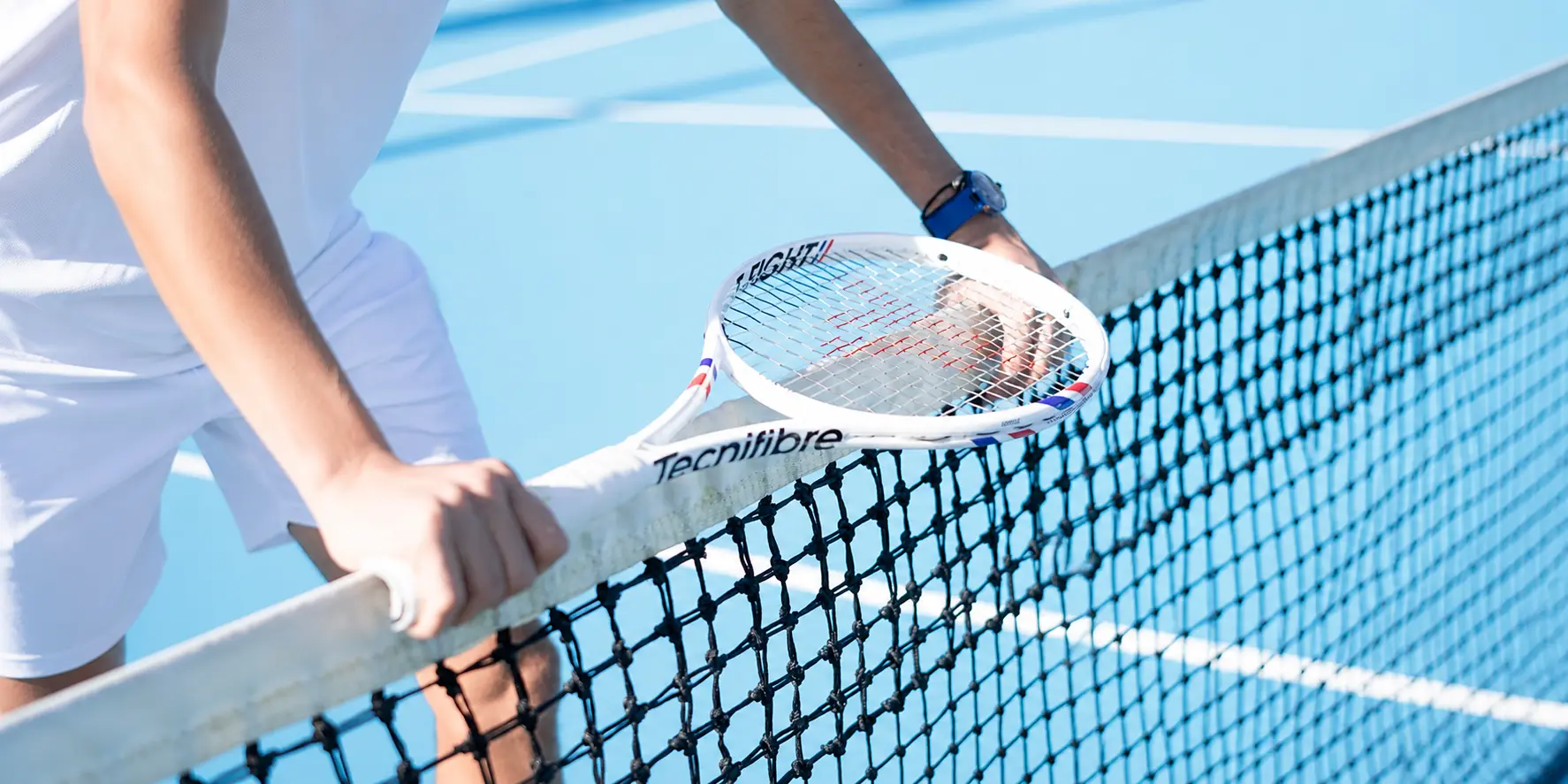
T-Fight 300 vs 300S vs 305S
For an intermediate trying to make sense of the line, the T-Fight 300 is the cleanest reference: 100 sq in, 300 g (10.6 oz) and a 16x19 pattern. It provides more margin away from the centre than the S versions without dropping into lightweight-racket territory. It also appears in Tennis Warehouse’s 2026 selection for intermediate players, though that external recommendation cannot replace a demo with your usual string setup.
The T-Fight 300S keeps the 300 g weight and 16x19 pattern but reduces the head to 98 sq in. It is the next comparison if the 300 gives you depth to spare and you want a more concentrated response when attacking a short ball. It is not an automatic upgrade: the margin narrows on returns, defensive shots and late backhands.
The T-Fight 305S adds 5 g (0.2 oz) and changes to an 18x19 pattern. It is the most control-oriented T-Fight, better suited to a fast swing, repeatable contact and little need for free power. Do not choose it because Daniil Medvedev is associated with the line. His match racket does not establish whether the retail 305S is right for a club player.
| Model | Head | Unstrung weight | Pattern | Who it makes most sense for |
|---|---|---|---|---|
| T-Fight 285 | 100 sq in | 285 g / 10.1 oz | 16x19 | Intermediate prioritising acceleration and a lower physical load |
| T-Fight 300 | 100 sq in | 300 g / 10.6 oz | 16x19 | Strong intermediate or advanced player seeking balance and margin |
| T-Fight 300S | 98 sq in | 300 g / 10.6 oz | 16x19 | Full swing that needs more precision without extra weight |
| T-Fight 305S | 98 sq in | 305 g / 10.8 oz | 18x19 | Competitor who supplies pace and controls the centre |
| T-Fight 315S | 98 sq in | 315 g / 11.1 oz | 16x19 | Advanced player already effective with high mass for a full match |
The useful distinction is not “300 for intermediates, 305S for advanced players.” It is this: the 300 protects your normal ball; the 305S rewards your clean ball. If the latter starts leaving your defensive shots short late in a set, its supposed control is not helping.
Tecnifibre TF-40: more control and a lower launch
TF-40 is built around a more restrained response. Every current model has a 98 sq in head and a thin 21.7 mm (0.85 in) beam. Tecnifibre fills the frame with foam and uses a squarer geometry called RS Sharp Section. The official TF-40 V3 page lists five versions across 290, 305 and 315 g, with either 16x19 or 18x20 patterns depending on the model.
Foam by itself cannot tell you exactly how the racket will feel. The specification sheet does establish a clear contrast with the Fire 300: a thinner beam, smaller head and denser-pattern options. With a complete swing, that package can rein in a ball that already carries speed. When contact quality varies from shot to shot, the likelier cost is lost depth after a point breaks down.
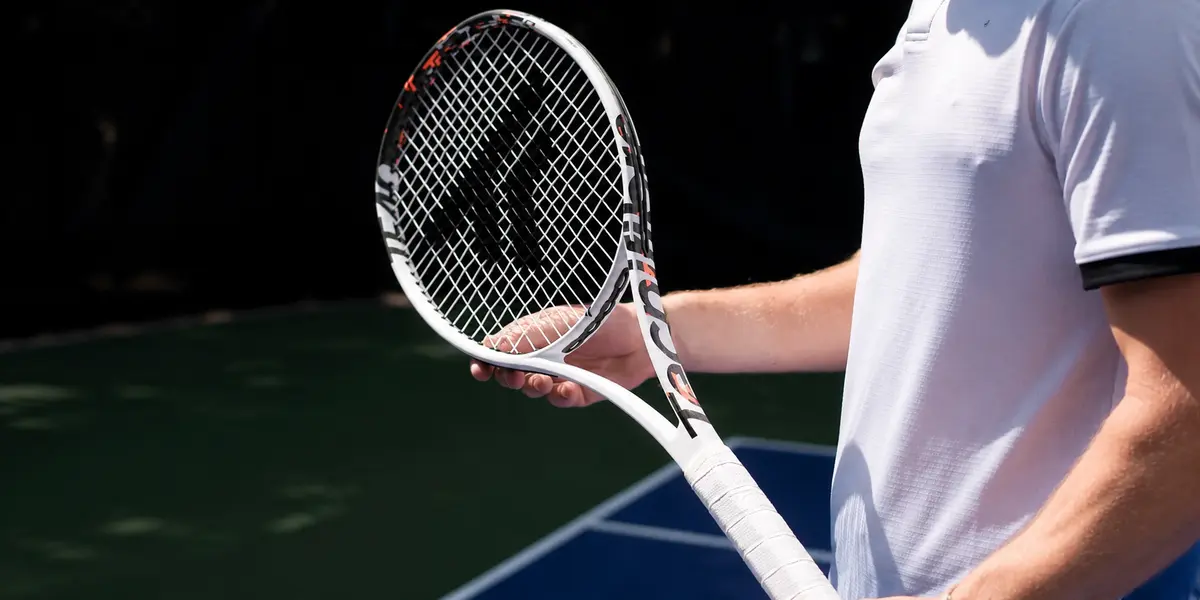
TF-40 16x19 vs 18x20: what changes?
Within the TF-40 family, 16x19 gives you a more open launch; 18x20 keeps the trajectory lower. That comparison is only clean when strings and tensions are similar.
The TF-40 290 16M V3 lowers the physical load compared with the 305 and 315 g frames. It is still a thin-beamed 98, however, so it is not an automatic substitute for a powerful 100 sq in racket.
The TF-40 305 16M V3 adds stability while retaining the 16x19 pattern. Among the 305 g TF-40s, it gives you more room to lift and shape the ball. The TF-40 305 18M V3 keeps the same weight and moves to 18x20; its lower launch is more relevant to a player who strikes relatively flat, redirects pace and does not need the stringbed to add height.
| Model | Unstrung weight | Pattern | The decision it helps resolve |
|---|---|---|---|
| TF-40 290 16M V3 | 290 g / 10.2 oz | 16x19 | Entering a control line with a lower physical load |
| TF-40 305 16M V3 | 305 g / 10.8 oz | 16x19 | Control with easier access to height and spin |
| TF-40 305 18M V3 | 305 g / 10.8 oz | 18x20 | Lower launch and stronger directional control |
| TF-40 315 16M/18M V3 | 315 g / 11.1 oz | 16x19 or 18x20 | Maximum stability, if you arrive on time with the mass |
String pattern never works alone. Our guide to 16x19 vs 18x20 string patterns explains the broad trade-off, but string material and tension can pull two TF-40s closer together or push them further apart. Demo them with comparable stringbeds before attributing every difference to the frame.
Tecnifibre Fire: accessible power and depth
In the 2026 catalogue, Fire is the power family. The official range introduction describes three meaningful changes: thinner, somewhat squarer frame sections; mass redistributed toward the centre to lower swingweight; and X-Damp in the handle. That system places a steel piece inside an elastomer pocket so it moves against the vibration produced at impact.
Tecnifibre credits X-Damp with a 36% reduction in certain vibrations. That is a brand measurement, not evidence that Fire prevents injury or will feel comfortable with every string setup. A firm frame paired with old polyester at high tension can still be a poor choice for a sensitive arm; our guide to racket stiffness and RA explains why comfort never comes from one technology alone.
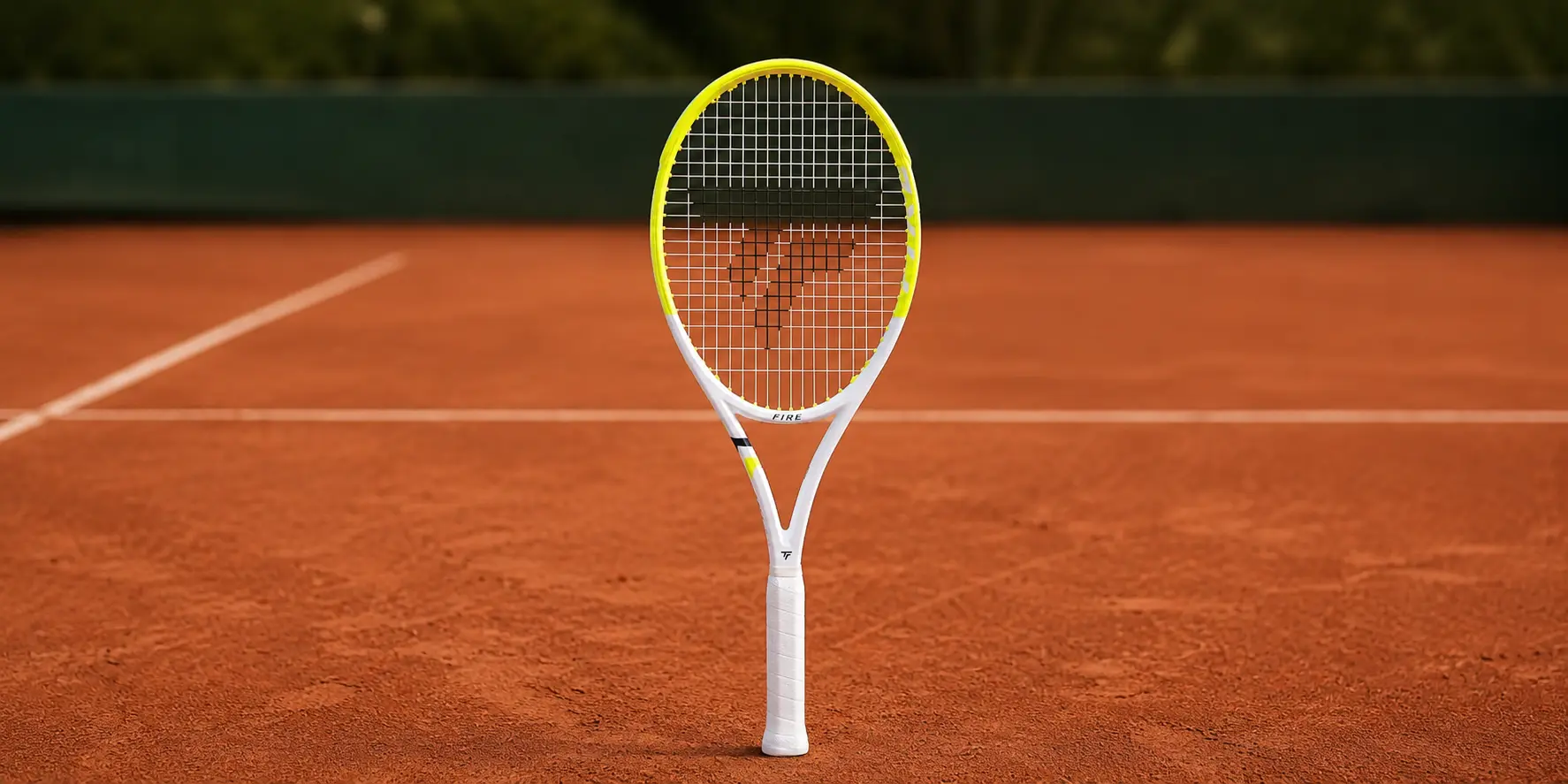
Fire 300 vs Fire 305S: margin or a concentrated response
The Fire 300 is the reference model: a 100 sq in head, 300 g (10.6 oz), 320 mm (12.6 in) balance, 16x19 pattern and a 24.5-25-24.5 mm beam. Compared with the T-Fight 300, the wider beam and power positioning make it the first Fire to put in your demo bag when the ball lands short, especially while defending or blocking a return.
The Fire 305S is not merely a heavier Fire 300. It moves down to 98 sq in, narrows the beam to 23-23-22.5 mm and retains the 16x19 pattern. It is the option for players who want Fire’s power orientation with a more concentrated response. The Fire 285 retains the 100 sq in head and 16x19 pattern with less mass. It should be quicker to prepare, but you need to test whether it remains stable enough when returning heavy pace.
| Model | Head | Unstrung weight | Pattern | Who it makes most sense for |
|---|---|---|---|---|
| Fire 285 | 100 sq in | 285 g / 10.1 oz | 16x19 | Intermediate needing power and faster preparation |
| Fire 300 | 100 sq in | 300 g / 10.6 oz | 16x19 | Player leaving the ball short who wants accessible depth |
| Fire 305S | 98 sq in | 305 g / 10.8 oz | 16x19 | Fast-swinging attacker who wants more contained power |
If your usual miss is long when you accelerate, do not start with Fire simply because it promises comfort. Compare the T-Fight 300S or TF-40 290/305 first. Filtering vibration at the handle and controlling depth are different jobs.
Tecnifibre Tempo: manoeuvrability from less length
Tecnifibre markets Tempo as a range engineered specifically for women. That describes the campaign audience; it does not decide who is allowed to play the frame. The design is more useful: weights from 255 to 285 g, heads of 100 sq in or larger across part of the range, and a length of 67.5 cm (26.6 in)—roughly one centimetre shorter than the 68.5-68.6 cm, or about 27 in, of the adult T-Fight, TF-40 and Fire lines.
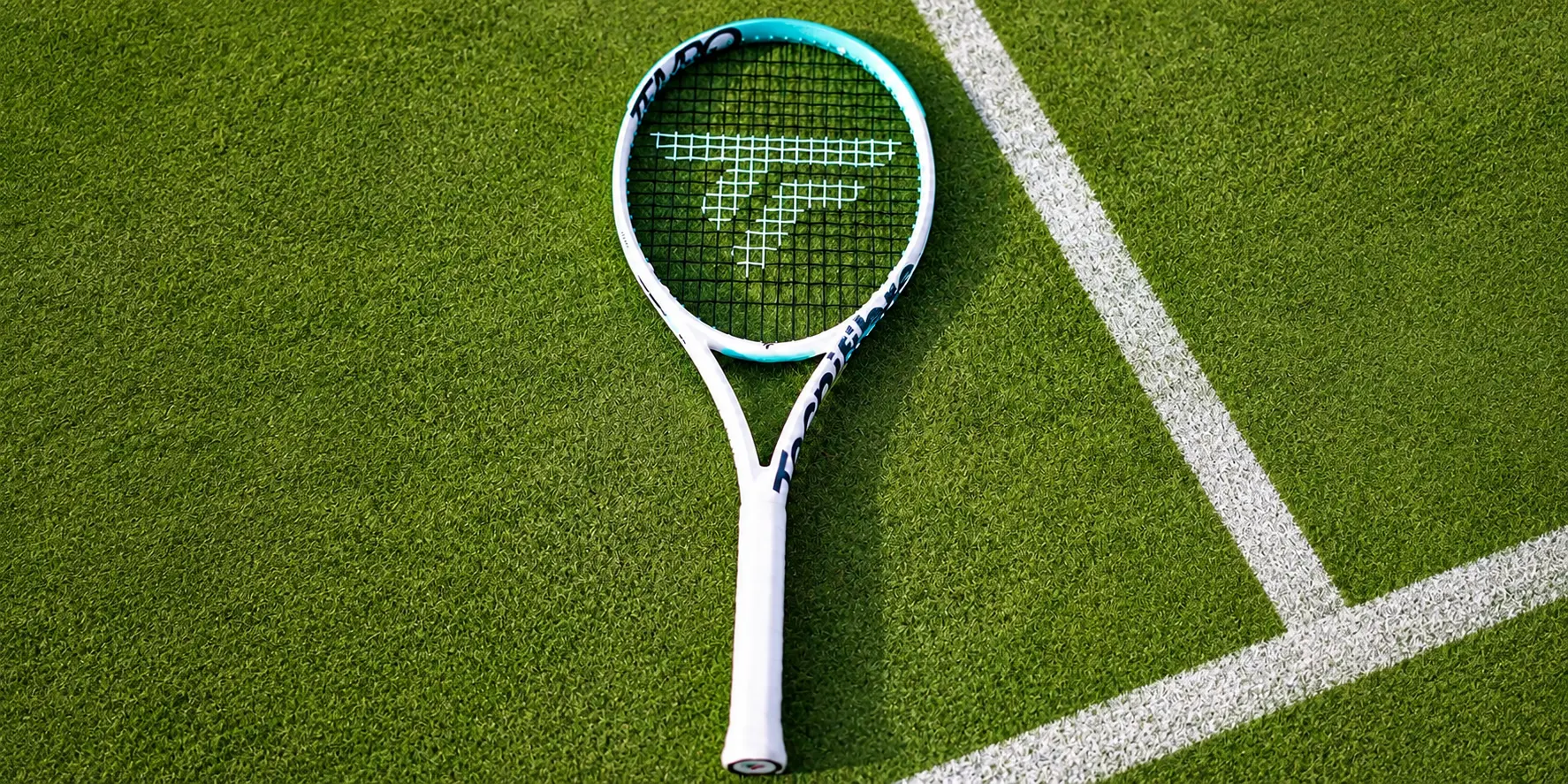
The Tempo 285 V2 combines a 100 sq in head, 285 g (10.1 oz) and a 16x19 pattern. Its official product page emphasises racket-head speed and manoeuvrability. Shortening a racket brings its mass closer to the body and reduces the turning radius; the trade-off is less reach and leverage on serves and stretched shots. Our guide to 27 vs 27.5 inch racket length explains the effect in more detail.
Tempo deserves a demo if standard frames make you late, you play plenty of doubles, use a compact swing or simply perform better with a shorter, lighter racket. Sex and playing level do not answer the important question: whether the extra speed is worth the loss of reach and mass in your game. Check grip availability as well, because some Tempo models come in fewer sizes than the main lines.
How to choose between T-Fight, TF-40, Fire and Tempo
You do not need to test all four families. Let the ball you miss in a match set the order.
- The ball lands short under pressure. Start with the Fire 300. Then compare the T-Fight 300 if Fire launches too high or makes it difficult to close the racket face.
- The ball goes long when you accelerate. Try the T-Fight 300S and TF-40 290 16M. Move up to the TF-40 305 18M only if you preserve depth with the denser pattern.
- You are late on returns or defensive shots. Compare the T-Fight 285, Fire 285 and Tempo 285. Do not confuse speed with stability: face heavy pace as part of the test.
- The frame twists on off-centre contact. Do not assume a few extra grams solve everything. Compare 300-305 g frames and judge the return and volley, not only a comfortable baseline rally.
- You want a 98 for competition. The T-Fight 300S is the middle ground, the TF-40 305 prioritises control, and the Fire 305S retains more of a power orientation.
Keep the string and tension as similar as possible. After each demo, write down three things: depth on a defensive return, your normal error when attacking, and serve timing once you are tired. Those answers matter more than the best shot you struck in the warm-up.
Frequently asked questions about Tecnifibre rackets
What is the easiest Tecnifibre racket for an intermediate player?
The T-Fight 300 is the most neutral starting point for an intermediate who already accelerates fairly consistently. The Fire 300 gives more help if depth is missing. If 300 g makes you late, comparing the T-Fight 285 and Fire 285 is more honest than forcing yourself into a “competitive” version.
What is the difference between Tecnifibre T-Fight and TF-40?
T-Fight sits between power, control and preparation speed. TF-40 concentrates the response with a 98 sq in head, thin beam and 16x19 or 18x20 options. Start with T-Fight while you are still looking for balance. Demo TF-40 if you already generate depth and need to contain launch or direct a fast ball.
T-Fight or Fire: which has more power?
Fire is the family Tecnifibre positions for power and depth. T-Fight keeps a more even balance between assistance and control. If your ball lands short when blocking or defending, try Fire first. If you already accelerate and your frequent miss is long, T-Fight is the more logical comparison.
Is an S version better than the T-Fight 300 or Fire 300?
No. In the current lines, S marks a competition-oriented 98 sq in variant, not a superior tier. It is worth testing if you make clean contact and need a more concentrated response. If it costs you depth in defence or makes you late at the end of a set, the 100 sq in version is the more useful competitive racket.
Which Tecnifibre rackets do Daniil Medvedev and Iga Swiatek use?
Both are commercially associated with T-Fight. That endorsement explains the family’s positioning better than it establishes their real match specifications. Do not assume a retail T-Fight 305S reproduces a professional player’s frame, weight, balance or string setup.
Change one variable at a time
If you still do not know which variable to prioritise, take a step back and identify whether weight, head size, power or control is causing the problem. Once the problem is clear, begin with the T-Fight 300 and change one thing: move to Fire 300 if depth is missing, a 98 sq in head if launch is excessive, TF-40 if you already create pace, or 285 g if preparation is late.
Changing family, weight, head size and string setup at once will only tell you which racket you liked that day. A useful comparison identifies what corrected your ball, then checks whether the improvement survives the return, the serve and the end of a set.
Keep learning
Turn this information into a better decision for your game
Explore more guides on the same topic or visit the complete archive to compare your options with context.
Continue reading
Related articles

Prince Rackets Guide: Tour, Phantom, Ripstick and More
Compare Prince Tour, Phantom, Ripstick, Ripcord and Beast rackets, understand O3, and choose the right family to demo for your game.
Dunlop Rackets Guide: CX, SX, FX or LX?
Compare Dunlop CX, SX, FX and LX rackets, understand Tour and LS versions, and decide which models to demo for your swing and game.

Wilson Rackets Guide: Blade, Clash, Ultra and More
A practical guide to Wilson tennis rackets: compare Blade, Clash, Ultra, Defyer, Pro Staff and RF 01, then choose by swing, level and match-day needs.