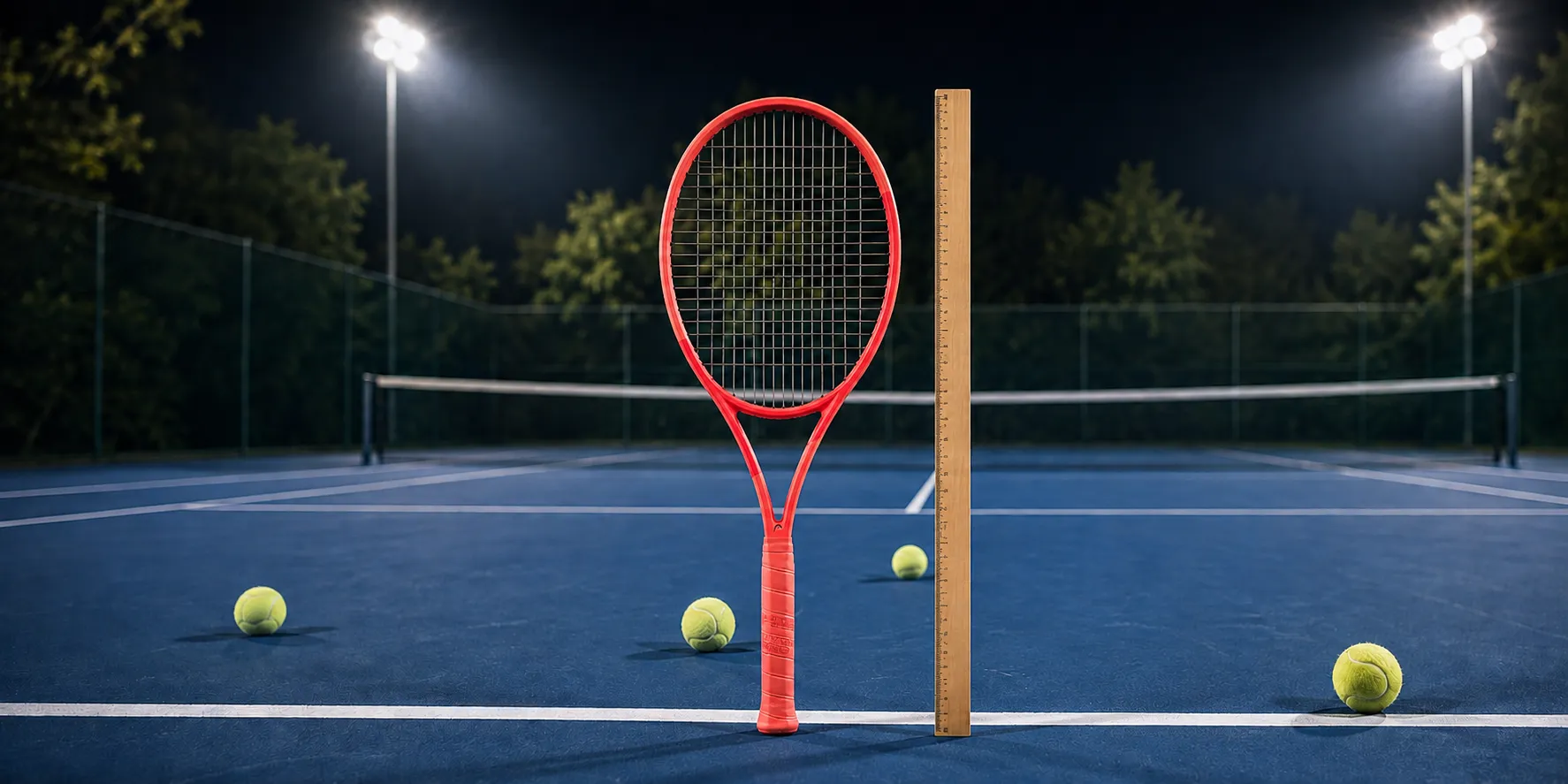
Tennis Racket Length: 27 vs 27.5 Inches
An extra half inch sounds like an easy advantage when you think about serving. On a return jammed into your body, it can be exactly what makes the racket head arrive late.
The standard adult tennis racket is 27 inches (68.58 cm) long. A 27.5-inch (69.85 cm) frame—often described as extended, XL or Plus—adds 0.5 inch (1.27 cm). For most players, 27 inches remains the more manageable choice. An extended racket is worth testing when you want more reach or serve leverage and can preserve racket-head speed.
If you cannot compare both rackets strung and play with them, choose 27 inches. Weight, balance and mass distribution can make two 27.5-inch frames move very differently. Length opens the comparison; it does not settle it.
Tennis racket length: 27 vs 27.5 inches
The difference is 0.5 inch (1.27 cm), roughly 1.9% of the standard length. It looks trivial until you consider where it sits: at the end of the lever. With a comparable mass distribution, that extra distance increases the racket’s resistance to rotation. You notice the half inch less while holding the frame than when trying to accelerate it late.
| Measurement | 27 inches (adult standard) | 27.5 inches (extended, XL or Plus) |
|---|---|---|
| Overall length | 68.58 cm | 69.85 cm |
| Maximum reach | Reference | +0.5 in (1.27 cm) |
| Tendency with comparable mass | Easier to reposition | More leverage, but asks for more time |
| Most likely fit | Returns, volleys and quick defense | Serves and strokes with full preparation |
| Main trade-off | Less maximum reach and leverage | Less margin when preparation is late |
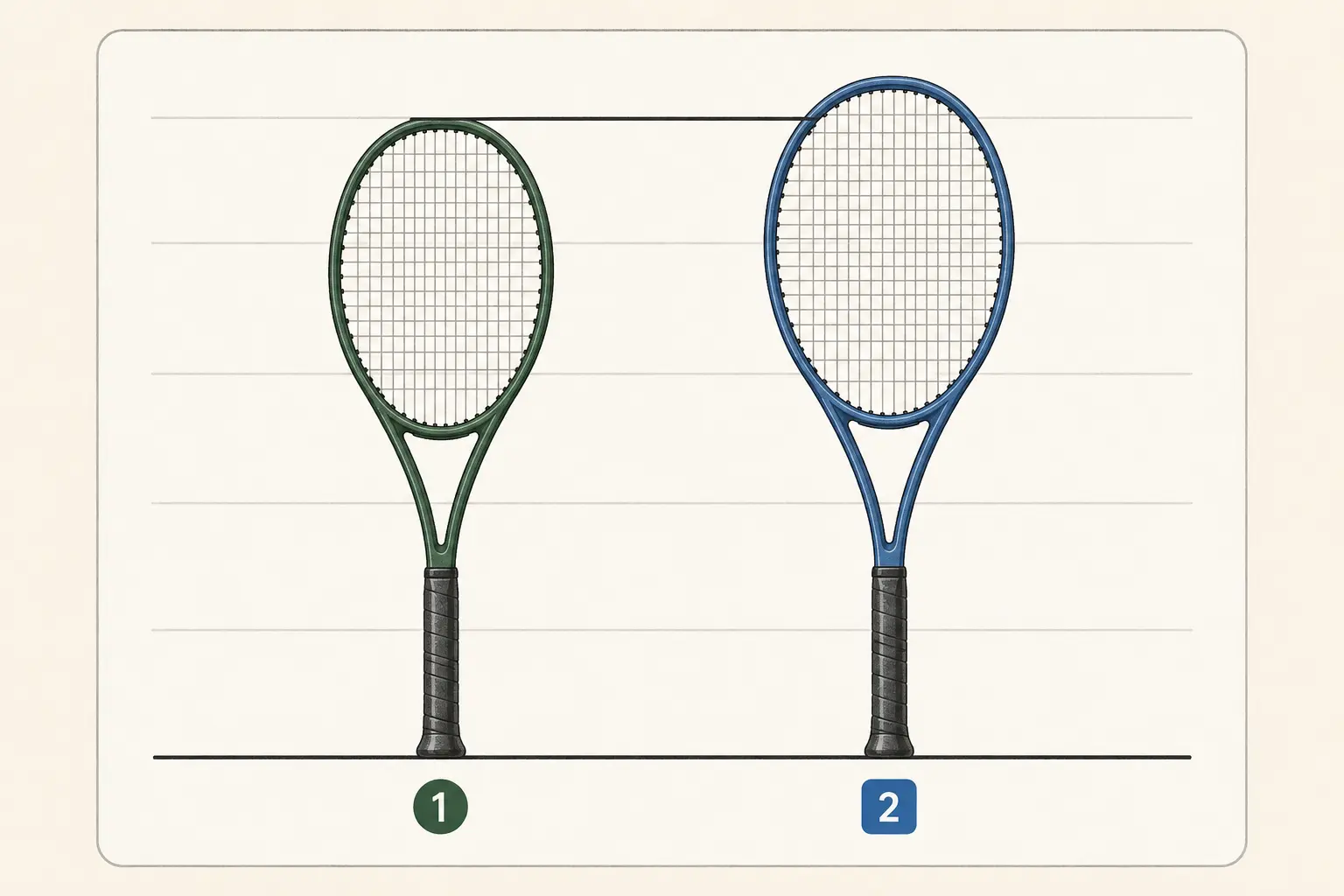
Appendix II of the 2026 ITF Rules of Tennis allows an overall racket length of up to 29 inches (73.7 cm). Both 27- and 27.5-inch rackets are therefore legal for competition. The first is the adult retail standard, not the legal limit.
Pros and cons of a 27.5-inch tennis racket
An extended racket is not more powerful by definition. The change is the swing radius: it may add serve leverage and bring the hoop slightly closer to a stretched ball, but it also leaves less time to accelerate or redirect the head when preparation gets shortened.
Slightly more reach, not an extra stride
With your arm fully extended, the hoop reaches 0.5 inch (1.27 cm) farther. That can matter on a stretched volley, a defensive ball outside your normal reach or a return caught near the tip. It does not rescue a lost ball; your movement and reading still cover far more ground than the frame.
The adjustment shows up mostly at contact. During the first few sessions, you may crowd the ball or meet it nearer the tip than usual. That adaptation period is part of the cost too.
More serve potential, not guaranteed miles per hour
If two swings maintain the same angular velocity, the point farther from the axis moves faster. A longer racket can also place contact slightly higher. In theory, both effects favor the serve.

The catch is keeping that racket-head speed and reaching contact on time. If the extra inertia slows you down or disrupts the serving chain, the geometric advantage disappears. Tennis Warehouse’s racket-selection guide associates extra length with more reach, leverage and power with other variables held equal. Two retail models rarely hold them all equal.
Direct evidence comparing exactly 27 and 27.5 inches in adult players is limited. The 1998 paper published by the International Society of Biomechanics in Sports used a computer simulation, not an on-court test. It still offers a useful design warning: extending the handle without redesigning the mass distribution did not guarantee an improvement, while frames designed from the outset as longer rackets produced a more favorable relationship between ball velocity and load. That is a design clue, not a promise for your serve.
Swingweight usually decides the adjustment
Tennis racket swingweight measures resistance to rotation around an axis near your hand. Because distance from that axis matters so much, extending a frame can raise the demand even when static weight stays unchanged.
This is where a spec sheet can mislead you. A 300 g (10.6 oz), 27.5-inch racket is not simply a 300 g racket with free reach. If it places more mass farther from your hand, it will take more effort to start moving. A manufacturer can compensate through racket balance or a different mass distribution, so compare strung measurements before drawing a conclusion.
The suffix Plus, +, XL or XTD often identifies an extended version. Babolat, for example, lists the Pure Drive + at 27.5 inches. The name helps you find the model; it does not replace a comparison of weight, balance, swingweight and stiffness.
Power and spin depend on arriving on time
If you preserve racket-head speed, the additional leverage and inertia may translate into greater depth or a heavier ball. If you already make contact late, the face will be even more compromised when you are pulled out of position. Extra length suits a complete preparation and stable contact better; static weight, string pattern and strings finish shaping the result.
27 vs 27.5 inches: which length fits your game?
Leave length until late in the selection process. If you are still comparing head size, string pattern, weight or stiffness, settle those broader requirements before isolating length. The 27-versus-27.5 comparison is cleanest when the two frames are otherwise similar.
Choose 27 inches if…
- You play plenty of doubles and prioritize quick reactions at net.
- You block returns with compact preparation.
- You often arrive late when defending or changing direction.
- You want a wider choice of models and demos, or you have not identified a problem that extra length would solve.
It is the simpler starting point for assessing the rest of the specifications without adding another adjustment.
Test 27.5 inches if…
- The serve is central to your playing pattern.
- You use a full swing and can still accelerate a medium- or high-swingweight setup.
- You want more room for a two-handed backhand and the frame you are testing actually extends the usable handle.
- You want a little more reach and depth, accept an adjustment period and know what you want to change from a standard frame.
Height does not settle the choice. A shorter player may benefit from serve leverage, while a tall player can still arrive late with too much inertia. Swing speed, preparation and contact point matter more.
How to compare both lengths without fooling yourself
A light 27-inch racket with multifilament and a heavy 27.5-inch racket with polyester do not isolate length; they compare two complete setups. Look for two frames from the same family or, at minimum, similar head size, weight and stiffness, then use the same string and tension.
Take them into the situations where the difference costs points:
- Serve to three targets. Compare pace, percentage and how easily you repeat the motion; do not judge by the fastest serve of the session.
- Return serves into the body. Compact preparation quickly reveals whether the racket head arrives late.
- Play stretched defensive balls. Track reach, height and depth when you cannot prepare comfortably.
- Volley through quick exchanges. Check whether you can reset the racket face in time after the first contact.
- Repeat the test while tired. An advantage that disappears at the end of a set is not an advantage in competition.
Record contact timing, depth, second-serve control and any load in your arm or shoulder. If 27.5 inches improves your serve but hurts two strokes you use more often, the half inch is charging too much.
Should you extend a racket you already own?
Lengthening the handle changes the relationship between your hand, the rotation axis and the frame’s mass. It may also alter balance, swingweight, grip shape and the warranty. This is not the same type of customization as adding an overgrip.
If you want to try it, use a technician who can measure the racket before and after and match your frames. A factory Plus model is more predictable than a homemade extension. You will still need to test it: keeping the same number of grams does not preserve the same response.
Frequently asked questions
Is a 27.5-inch tennis racket legal?
Yes. The ITF maximum is 29 inches (73.7 cm), so a 27.5-inch racket is legal.
Is a 27.5-inch racket worse for your arm?
Length alone cannot answer that. Arm load depends on the complete setup: mass, swingweight, balance, stiffness, strings, tension, technique and playing volume. If pain persists, do not try to diagnose it by changing half an inch.
Should a shorter player use an extended racket?
It is worth a test when the player wants serve leverage or a little extra reach, but height does not prescribe 27.5 inches. The racket must still arrive on time for returns, volleys and defensive shots.
A simple decision rule
If you cannot name the problem you want to solve, stay with 27 inches. Test 27.5 when you want more serve leverage or slightly more reach and can compare the swingweight of both frames.
Do not judge it by your first five serves. Play a set, return into the body and serve again while tired. The half inch earns its place only if it still helps when the ball is uncomfortable.
Keep learning
Turn this information into a better decision for your game
Explore more guides on the same topic or visit the complete archive to compare your options with context.
Continue reading
Related articles

Tennis Racket Types: Power, Control and Spin
What separates power, control and spin tennis rackets, which specs matter, and what to demo based on your swing and typical miss.
Lead Tape on a Tennis Racket: Where to Put It and How Much to Use
Learn how lead or tungsten tape changes racket weight, balance, swingweight and the sweet spot, where to place it and how to test without overdoing it.
Tennis Racket Weight: 260g, 285g, 300g or 315g
Tennis racket weight explained: compare 260g, 285g, 300g and 315g frames, choose the right weight, and separate static weight from swingweight.