Tennis Racket Balance: Head Light, Even or Head Heavy
Two rackets can both weigh 300 g (10.6 oz) yet arrive at the ball at very different times. Often, the difference starts with tennis racket balance: not how much the frame weighs, but where that mass is concentrated.
Quick answer: a head-light racket balances closer to the handle and is generally easier to redirect. An even-balance racket balances near its midpoint. A head-heavy racket carries relatively more mass toward the hoop and can put more inertia behind contact. None is automatically better; balance only makes sense alongside static weight and swingweight.
What is tennis racket balance?
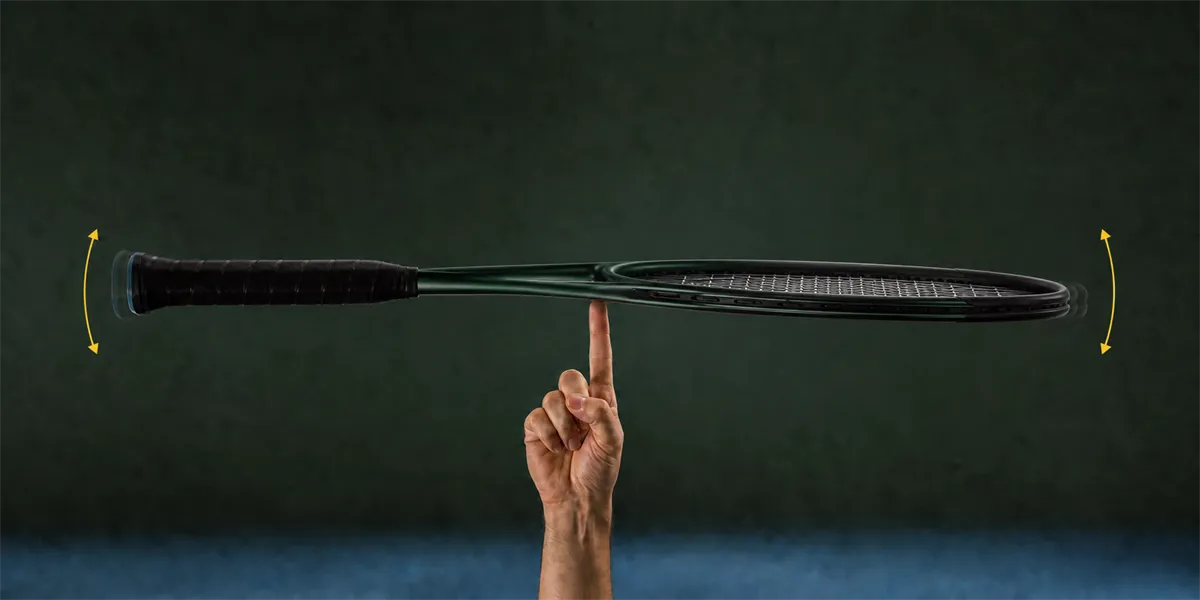
Balance is the position of a racket’s center of mass along its length. Rest the frame horizontally on a narrow edge and move it until neither the handle nor the head drops. That support point is the balance point. Tennis Warehouse University uses the same definition.
Manufacturers and retailers usually express it in one of two ways:
- Centimeters or millimeters from the butt cap: for example, 32 cm or 320 mm.
- Points head light (HL) or head heavy (HH): each point equals 1/8 inch, or 3.175 mm, relative to the geometric midpoint.
A standard 27-inch (68.6 cm) racket has its midpoint at 13.5 inches (34.3 cm). A 33.0 cm (13.0 in) balance is roughly four points toward the handle: 4 pts HL, following the system explained by Tennis Warehouse.
Do not memorize 34.3 cm as a universal dividing line. An extended-length racket has a different midpoint. Also check whether a published balance is for the frame strung or unstrung.
Head light vs even balance vs head heavy
| Balance type | Balance-point location | Typical feel | Often useful for | Watch out for |
|---|---|---|---|---|
| Head light (HL) | Toward the handle | Quicker to prepare and redirect | Returns, volleys, serves and long swings | Does not guarantee low swingweight or stability |
| Even balance | Near the midpoint | More neutral weight distribution in the hand | All-court play and players without an extreme preference | “Neutral” does not necessarily mean easy to swing |
| Head heavy (HH) | Toward the head | More hoop presence through the swing | Depth with compact strokes and blocked returns | Can delay contact and become tiring if inertia is excessive |
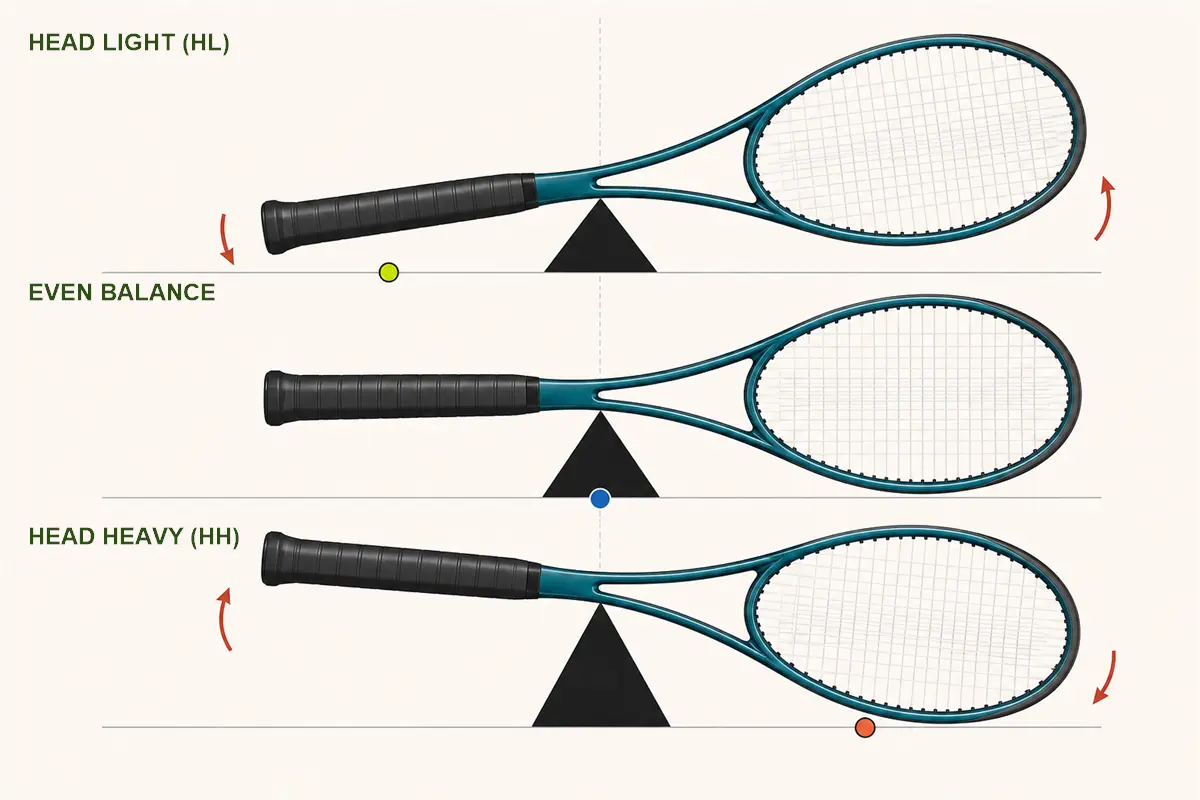
These are tendencies, not guaranteed outcomes. A heavy HL racket can have a higher swingweight than a light HH racket. Two frames with the same weight and balance can also distribute mass differently.
What changes with a head-light racket?
A head-light racket keeps more of its mass close to your hand. That usually makes it easier to start the swing and change direction quickly: blocking a body serve, fixing a late preparation or handling two volleys in quick succession.
Many heavier rackets are balanced toward the handle. But HL does not mean “low power” or “more control.” The frame may still have a substantial swingweight, while direction and depth continue to depend on your stroke, string pattern, stiffness and string setup.
When does even balance make sense?
An even-balance racket balances near its midpoint. In the hand, it may feel less polarized: the hoop does not pull forward clearly, but the mass is not concentrated near the butt cap either.
It can be a sensible starting point in light and midweight frames, particularly for an all-court player. Still, the “even” label says less than many spec sheets imply. If total weight or swingweight is too high for you, the racket will still arrive late. Compare all three numbers in the same strung condition.
What does a head-heavy racket add?
A head-heavy racket moves the center of mass toward the hoop. At the same static weight, this usually increases resistance to rotation and can provide easier depth with a compact stroke or a firm blocked return.
That is why HH balance often appears in lighter rackets aimed at players with shorter swings. Extra mass in the head partly compensates for the low total weight. HEAD describes the general relationship between balance, power and maneuverability in its selection guide.
The cost appears when you need to accelerate late. On a fast return, a stretched defensive ball or a body volley, too much mass far from your hand can delay the racket head. Head-heavy balance does not guarantee off-center stability either. Resistance to twisting depends on how mass is distributed across the hoop, not only on the center of mass along the racket.
Balance vs weight and swingweight
This distinction prevents a lot of poor racket choices:
- Static weight tells you how much mass the racket has.
- Balance tells you where its center of mass sits.
- Swingweight tells you how strongly it resists rotation around an axis near your hand.
Swingweight is highly sensitive to how far each portion of mass sits from the axis of rotation. A few grams at 12 o’clock therefore change the moving feel much more than the same mass near the butt cap. Rod Cross demonstrates that relationship in his work on racket weight customization. Adding weight to the handle can make the balance more head light, but it does not reduce swingweight; the racket is now heavier.
How to measure racket balance at home
- Prepare the racket as you play it. Include strings, overgrip and dampener if you want to measure your actual setup.
- Rest it horizontally on the edge of a rigid ruler or a narrow cylinder.
- Slide it slowly until it stays level without dropping toward either end.
- Measure from the butt cap to the support and note the condition, such as “32.4 cm (12.76 in), strung with overgrip.”
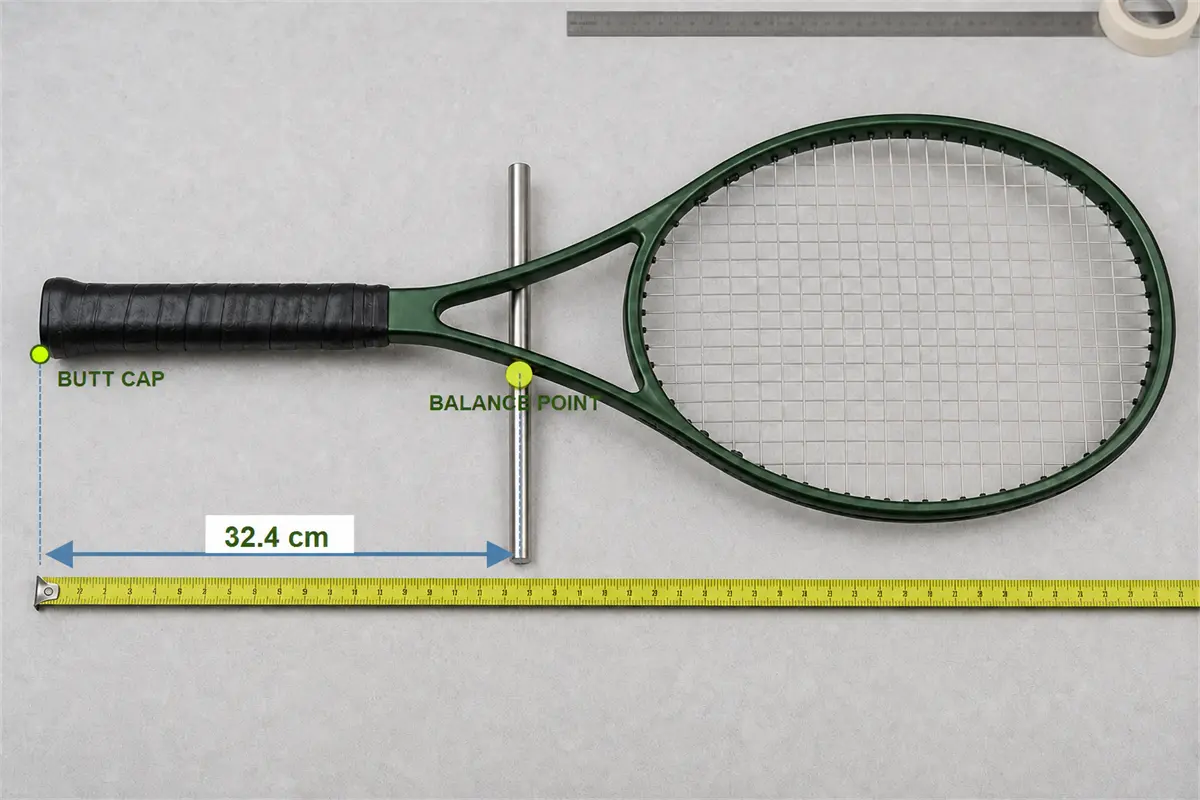
To convert that measurement into points on a 27-inch racket, subtract the measured balance from the 13.5-inch (34.3 cm) midpoint, then divide the difference by 1/8 inch (0.3175 cm). A point toward the handle is HL; a point toward the head is HH.
The goal of a home measurement is consistent comparison between your own rackets, not laboratory certification.
Interactive calculator
Calculate your racket’s HL or HH balance
Enter the distance from the butt cap to the balance point. Change the total length too if your racket is not 27 inches long.
Why strings, overgrips and lead change balance
- Strings add mass mainly to the hoop, so they usually move the balance toward the head and increase swingweight.
- An overgrip adds mass near your hand. It usually shifts balance toward the handle with only a small swingweight effect.
- Lead or tungsten at 12 o’clock moves balance toward the head and raises swingweight noticeably.
- Weight inside the handle shifts balance toward the butt cap, but total weight also increases.
This is why you should not compare a manufacturer’s 320 mm unstrung figure directly with a retailer’s 4 pts HL strung specification. Put both measurements in the same condition first. If you also change handle size or grip materials, remember that grip setup can alter weight and balance.
Which racket balance should you choose?
- You are late on returns or defensive balls: try a more maneuverable package. That may mean lower swingweight, a more HL balance, less static weight or some combination.
- Your racket feels empty against a heavy ball: look for useful mass and stability, not merely an HH label.
- You have a compact swing and struggle for depth: a light frame with slightly more mass toward the head may help, provided it does not slow your acceleration.
- You use a long service motion and play frequently at net: an HL balance often makes head speed and quick repositioning easier.
- You do not know your preference yet: start in a moderate range and demo two rackets with similar static weight but different balance points.
Do not decide after five minutes of cooperative hitting. Test returns, stretched balls, volleys and at least one set. If the racket starts arriving late as you tire, the number does not fit your game.
Frequently asked questions
Does head light mean the racket is lightweight?
No. Head light describes where the mass is distributed, not how many grams or ounces the frame weighs. A 330 g (11.6 oz) racket can be very head light, while a 270 g (9.5 oz) racket can be head heavy.
What does 4 pts HL mean?
It means the balance point is four eighths of an inch toward the handle from the geometric midpoint. On a 27-inch racket, that is approximately 33.0 cm (13.0 in) measured from the butt cap.
Does head-heavy balance give more power?
It can put more inertia in the head, especially when comparing rackets of similar static weight, but it does not guarantee more ball speed. If the frame slows your swing or makes you contact late, the advantage disappears. Swingweight is a better indicator of that dynamic demand.
What is the best balance for an intermediate player?
There is no universal number. A long, fast swing will often tolerate a more HL setup; a compact stroke may benefit from a lighter frame that is less head light. Choose the package that preserves timing, depth and stability through a full match.
The on-court decision that matters
Use balance to form a hypothesis, not to deliver the verdict. Head-light frames tend to redirect more easily; head-heavy frames can leave more mass behind the ball; even balance occupies the middle ground. Then check static weight and swingweight.
If you can demo two rackets, choose models with similar static weight and different balance points. Play under pressure and watch one thing: which racket lets you arrive on time without the incoming ball pushing the frame around? That answer matters more than the label on a spec sheet.
Keep learning
Turn this information into a better decision for your game
Explore more guides on the same topic or visit the complete archive to compare your options with context.
Continue reading
Related articles
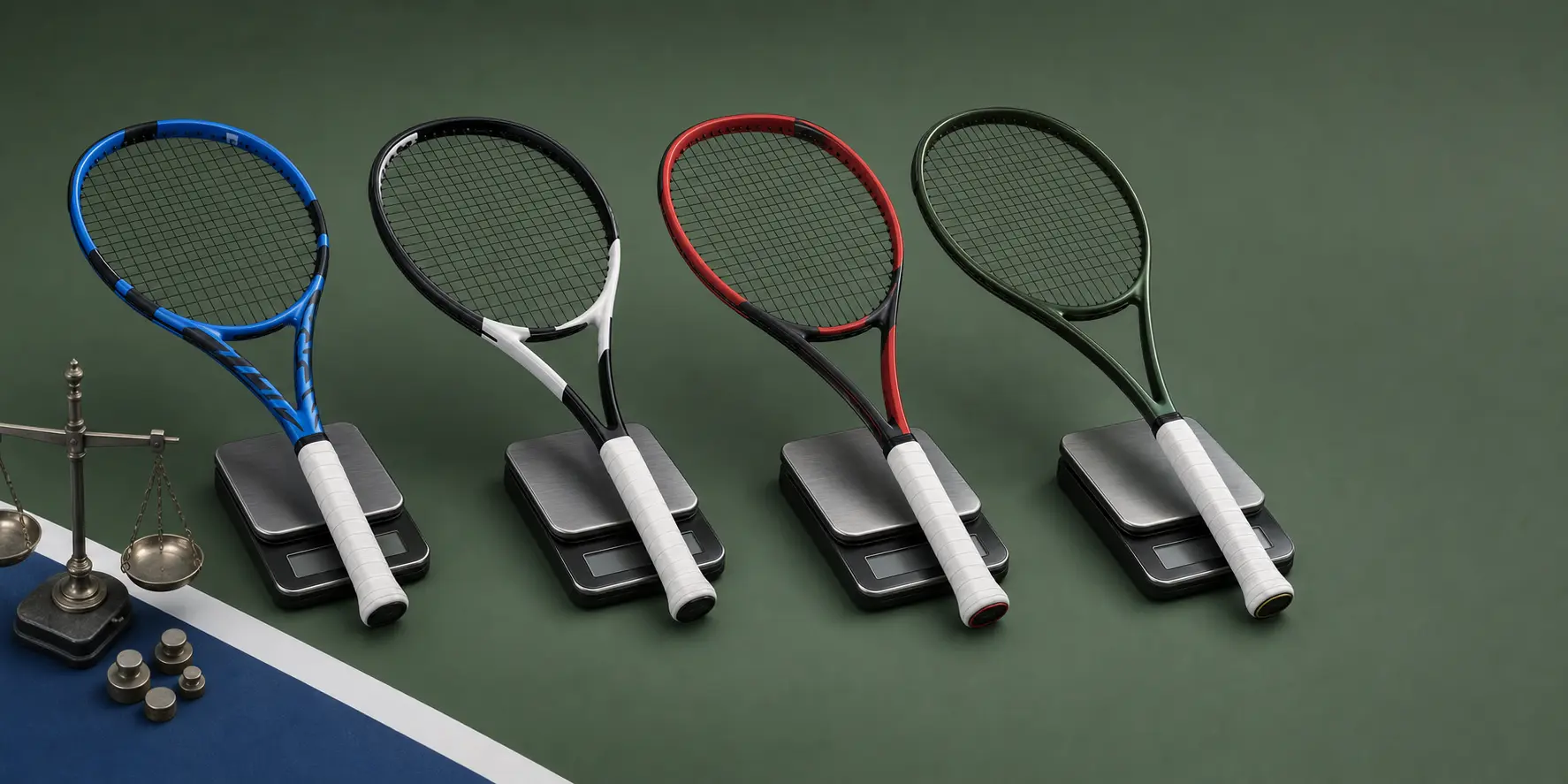
Tennis Racket Weight: 260g, 285g, 300g or 315g
Tennis racket weight explained: compare 260g, 285g, 300g and 315g frames, choose the right weight, and separate static weight from swingweight.
Extra Duty vs Regular Duty Tennis Balls: Which Court?
Learn when to use Extra Duty or Regular Duty tennis balls on hard courts, clay, indoor courts, and grass, plus when altitude matters more than felt.
Tennis Racket Types: Power, Control and Spin
What separates power, control and spin tennis rackets, which specs matter, and what to demo based on your swing and typical miss.