Lead Tape on a Tennis Racket: Where to Put It and How Much to Use
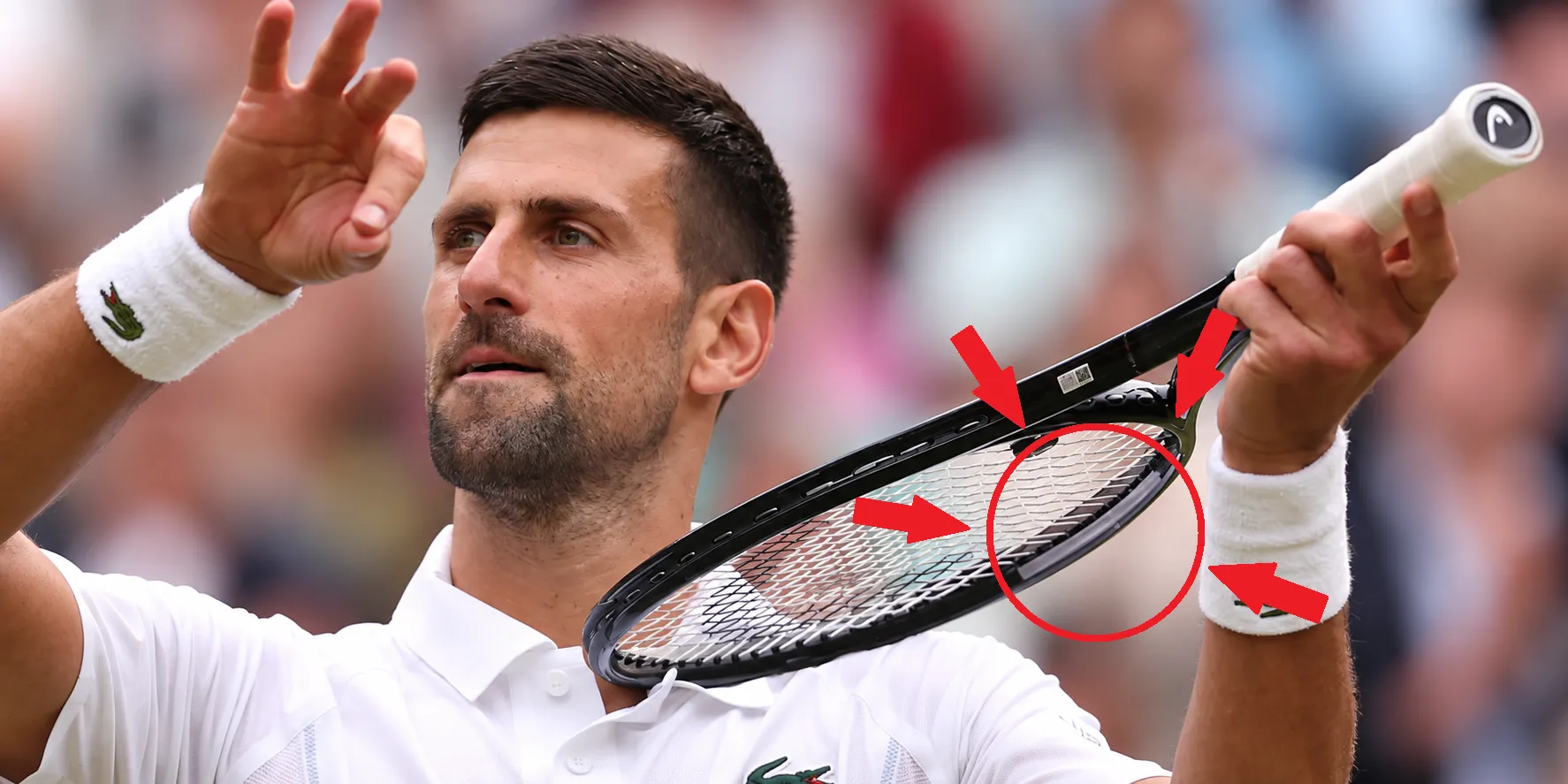
A hard return catches the string bed a couple of inches off center and the racket face turns in your hand. That is a reasonable case for testing weight at 3 and 9 o’clock. If you meet the ball cleanly, the racket arrives on time and the shot still lands short, 12 o’clock suggests a different experiment. But if you already make contact late, more mass in the head will probably make matters worse.
That distinction matters more than memorizing a clock face. The farther added weight sits from your hand, the more it raises swingweight. At 12, a few grams have a large effect on acceleration and the mass arriving at impact. At 3 and 9, the specific gain is resistance to twisting. Weight in the handle can shift balance toward your hand, but it cannot turn a heavy racket into a light one.
Our deliberately cautious starting point is 1 g (0.04 oz) total at 12, or 1 g per side at 3 and 9. This is not a final recipe. It is a reversible test of whether added mass solves the miss you actually see on court.
What lead tape actually changes
Lead tape does not add “power” or “control” as separate settings. Every strip changes at least three specifications:
- Static weight: always goes up, wherever you place the mass.
- Balance: shifts toward the added weight.
- Swingweight: rises sharply near the tip, less around the throat and only slightly near the butt cap.
Mass on the sides of the hoop also raises twistweight, the racket’s resistance to turning when the ball strikes away from the centerline. That may improve directional consistency on a lateral mishit. It will not correct a swing that arrives late or presents the face at the wrong angle.
Distance explains the difference. For a point mass, the change in moment of inertia is approximated by ΔI = m × d², where m is the added mass and d is its distance from the measurement axis. Rod Cross’s work on customizing rackets with added weight shows why mass near the tip has a much larger effect than the same mass near the handle.
On a standard 27-inch (68.6 cm) racket, 1 g at 12 typically adds about 3.4 kg·cm² of swingweight. Treat that as an estimate, not a factory specification: racket length and the true midpoint of the strip alter the result. The Tennis Warehouse University customization tool can model the change from your racket’s starting weight, balance and swingweight.
Does lead tape make the sweet spot bigger?
On court, it can make the useful hitting area feel larger. Strictly speaking, it does not enlarge the string bed, and “sweet spot” is not one circle with a fixed edge. The term may refer to the frame’s minimum-vibration node, the center of percussion that minimizes the initial shock transmitted to the arm, or the area of highest rebound. Those locations need not coincide; a study of racket vibration and wrist shock, for example, distinguishes the vibration node from the center of percussion.
For customization, power zone or effective hitting area is more useful. Tennis Warehouse University defines its sweet zone as the string-bed area above a chosen rebound-potential threshold. In that model, higher swingweight extends the zone toward the tip, while higher twistweight extends it outward.
That is where placement matters. Mass at 3 and 9 raises twistweight, reduces face rotation on a lateral mishit and helps the ball retain more speed and direction. In that functional sense, the forgiving area can become wider. Mass at 12 raises swingweight and effective mass near the tip more efficiently, so it can extend the higher-response area upward. Weight in the handle primarily changes balance and contributes little to either effect.
Do not turn this into a promise of a specific number of square inches. Cross’s experiment used 30 g (1.06 oz)—far more than our 1 or 2 g starting test—to make the changes easy to measure. Tip weight shifted the point of maximum power upward; mass divided between 3 and 9 improved rotational stability but produced no observable shift of the vibration node or center of percussion along the racket’s length. Normal customization amounts should produce a much smaller change, and the result also depends on the frame, string bed and actual impact location.
Where to put lead tape for each problem
| Position | What it changes most efficiently | When to test it | The cost to watch |
|---|---|---|---|
| 12 o’clock | Swingweight and effective mass near the tip | You center the ball, arrive on time and still lack depth | Slower preparation, late contact and a more head-heavy balance |
| 3 and 9 | Twistweight and lateral stability | The face turns on returns, volleys or off-center groundstrokes | More weight, more swingweight and a face that is harder to redirect |
| 10 and 2 | A blend of swingweight and lateral stability | You need a compromise between 12 and 3/9 | It becomes harder to tell which change solved the problem |
| 6 o’clock | Static weight with a moderate swingweight increase | You want more overall mass without loading the tip as heavily | Adds weight without doing much for lateral twisting |
| Butt cap | More handle-biased balance and total weight | You want to counterbalance a loaded hoop or match static weight | Does not remove swingweight already added to the hoop |
Interactive calculator
Add grams at one or more locations and see how the racket’s inertia changes. At paired positions, the amount is divided equally between both sides.
Select a zone to focus its control.
Quick estimate for a standard 27-inch adult racket.
The largest swingweight increase per gram.
A blend of swingweight and lateral stability.
The most efficient twistweight increase.
More mass with a moderate swingweight change.
Counterweight with little effect on either inertia.
Adjust measurements and starting values
The tape’s real distance determines the result. Enter your measurements to refine the estimate.
x is measured from the butt cap to the tape’s center; y is measured from the centerline toward one side.
Point-mass estimate: ΔI = m × d². Swingweight uses the standard axis 10 cm from the butt cap.
At 12: the largest swingweight change per gram
The tip is the most efficient place to raise swingweight. It suits a player who accelerates the frame comfortably, finds the center often and wants to retain more momentum through impact. Cross found that mass at the tip moves the area of maximum response upward and increases the frame’s potential power.
The limit appears quickly. If the head begins to lag on returns, stretched defensive shots or a one-handed backhand, extra inertia is no longer worth the loss of racket-head speed. Start with 1 g because it produces a measurable change without turning the first test into a major commitment.
At 3 and 9: stability on lateral mishits
Place equal amounts on both sides of the hoop. This distribution increases twistweight and limits how far the face turns when contact misses the center laterally. In practice, it creates a wider effective hitting area: slightly off-center shots lose less direction and depth. That does not mean every physical sweet spot has moved.
The USTA guide to lead tape identifies 3 and 9 as a common starting point for stability. The price is specific: those grams also raise total weight, swingweight and balance. If the return twists less but now arrives late, you added too much.
At 10 and 2: a hybrid adjustment
These positions sit closer to the tip than 3 and 9 while retaining some lateral separation. They increase both swingweight and twistweight. That makes sense once you have established that you need both. As a first experiment, however, they mix two effects and make the result harder to interpret. Save 10 and 2 for fine-tuning.
In the handle: counterbalancing is not undoing
Mass under the replacement grip or inside the butt cap moves the center of mass toward your hand. The head may feel less prominent during preparation even though total racket weight has increased.
It does not reduce swingweight. If you add 2 g at 12 and then put 4 g in the butt cap, you keep almost all the extra inertia created at the tip. You have changed balance and total mass. To lower swingweight, remove weight from the hoop or start with a different frame.
Why 2 grams can be a substantial change
Consider a standard-length racket weighing 320 g (11.3 oz) with a 32.0 cm (12.60 in) balance. Add 2 g (0.07 oz) at 12, and a physics-based estimate gives:
| Measurement | Before | Approximate result |
|---|---|---|
| Static weight | 320 g / 11.3 oz | 322 g / 11.36 oz |
| Balance | 32.0 cm / 12.60 in | 32.23 cm / 12.69 in |
| Swingweight change | — | +6.9 kg·cm² |
The calculation treats the added mass as if it were concentrated near the tip and uses the standard swingweight axis 10 cm (3.94 in) from the butt. A real strip covers several centimeters, so a machine may return a slightly different number.
You do not need to chase the decimal to understand the consequence: 2 grams can move a racket outside your comfortable range. A bumper protector, a different overgrip or a heavier string job will move the specifications again. Measure the setup you actually take onto court.
How to customize without losing your baseline
-
Name an observable miss. “I want more control” does not tell you where to add mass. “The face turns when I block a first serve off center” points toward 3 and 9. “I center the ball but it lands short against pace” gives you a reason to test 12. If the complaint is fatigue or late contact, stop: more weight is not the next move.
-
Measure the racket as you use it. Leave the strings, overgrip, dampener and head guard in place. Record total weight on a scale reading to at least 0.1 g (0.004 oz), balance from the butt cap and, if possible, swingweight. A machine is easiest, but TWU also publishes a DIY pendulum method. Note the tape brand, width and stated mass as well. Length alone does not tell you the weight because products differ in width and density.
-
Use little weight and keep it symmetrical. At 12, begin with 1 g total centered at the tip. At 3 and 9, place 1 g on each side at the same height. Clean and dry the inside of the frame, keep the tape clear of the grommet holes and press the adhesive firmly. You do not need to remove the bumper guard for a temporary test.
-
Compare situations that expose the adjustment. Use the same balls and do not change strings, tension or overgrip at the same time. Alternate the original and modified setups on blocked returns, off-center volleys, stretched defensive shots, an extended serving sequence and a rally or set long enough for fatigue to appear. Ten comfortable forehands during the warm-up will not show whether the head becomes late in the third set.
-
Write down what improved and what got worse. “Feels better” is not enough. Record “less twisting on the backhand volley” or “more depth, but late on the wide return.” If the benefit survives the cost, add no more than another gram total and repeat. Otherwise, remove the tape.
Once you find a useful setup, record the date, mass, position, final weight and balance. Measure a second racket before copying the strip lengths. Manufacturing tolerances can leave two frames of the same model with different starting mass and inertia.
Lead tape vs tungsten tape
Both materials add mass. Lead is dense, inexpensive and easy to cut. Tungsten tape avoids handling lead, although some products are thicker or need more length to reach the same weight.
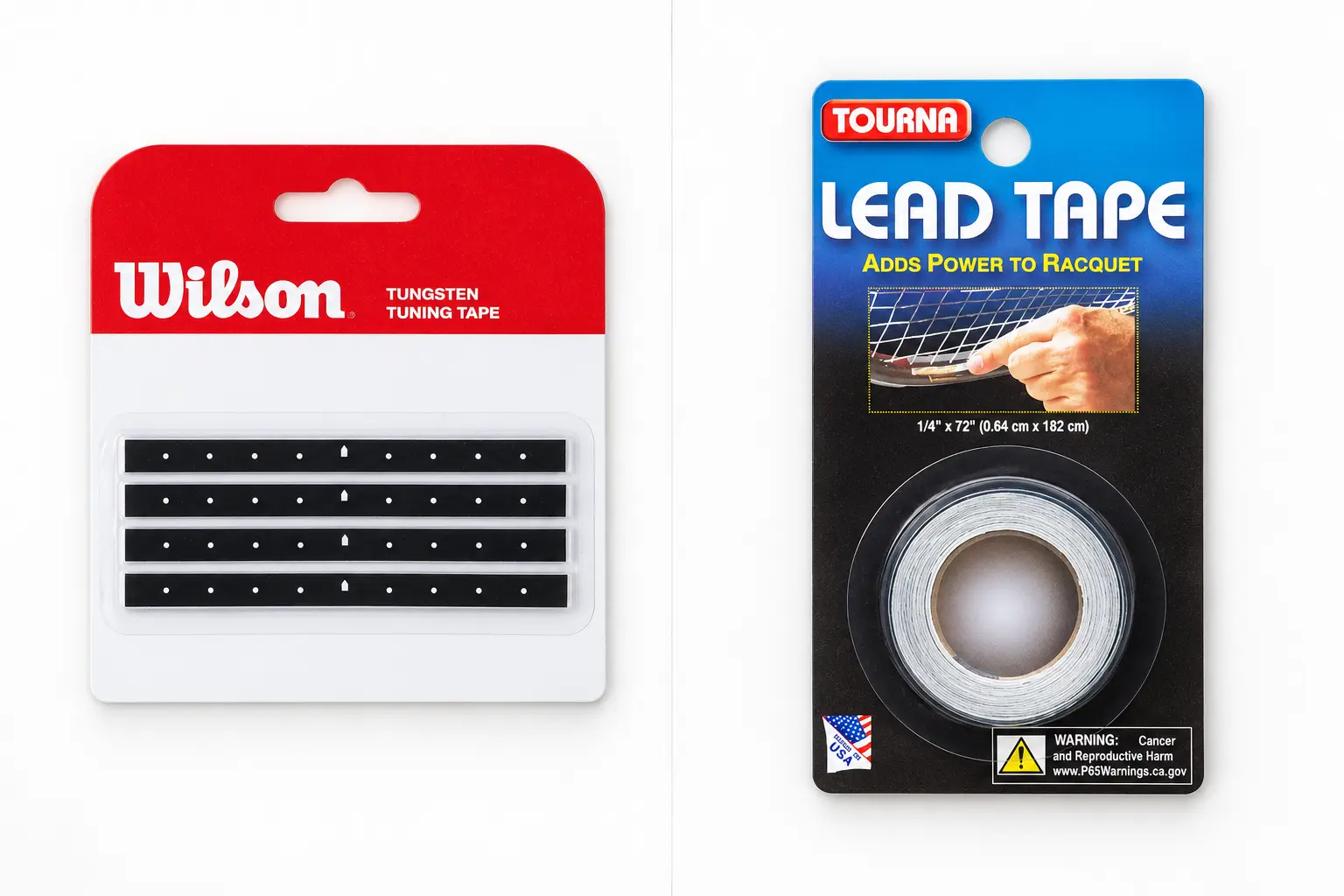
If you use lead, avoid touching your mouth while working, wash your hands with soap and water afterward, cover the strips and keep the tape and offcuts away from children. The EPA recommends hand washing after activities that may involve contact with lead. In a home with young children or during pregnancy, choosing tungsten or using a racket technician is the cautious option.
Do not leave loose pieces inside the handle. If you want permanent counterweighting under the grip or in the butt cap, a technician can secure the mass and verify that it will not move.
When adding weight is the wrong fix
- The racket already arrives late. Handle counterweighting may alter the sensation, but it does not erase inertia in the head.
- You are trying to fix pain. Tape is not a treatment. Review technique, workload, string type and tension, and consult a health professional if pain persists.
- You have not isolated the problem. A stiff, dead or unsuitable string job can create a response you mistakenly attribute to the frame.
- You need less weight or swingweight. Added mass only moves those numbers upward; lowering them means removing accessories or changing rackets.
- You are planning a large modification. Silicone, pallet changes, weight under the bumper or more than a few grams justify professional measurement.
Is lead tape legal in tennis?
Yes, provided the modification is reasonable in size and placement. The 2026 ITF Rules of Tennis allow objects attached to the frame for the purpose of distributing weight. The rules prohibit devices that can change the racket’s playing characteristics during a point.
Check the adhesive before playing and replace any strip that is lifting or damaged.
Let the first failing stroke decide
Do not copy a professional’s setup or cover half the hoop on your first attempt. If the face turns on lateral mishits, test 1 g at 3 and 1 g at 9. If contact is centered, you arrive on time and the ball still lacks weight, test 1 g total at 12. To match two rackets, measure both and add weight only to the lighter frame, in the position that also brings balance and swingweight closer.
Then play a full session. Your best forehand does not deliver the verdict; the first stroke to deteriorate does. It may be the wide return, the running defensive shot, the late-match serve or a quick volley. Keep the tape only if it solves the original problem without narrowing your timing window. If it does not, take it off. That result is useful information too.
Keep learning
Turn this information into a better decision for your game
Explore more guides on the same topic or visit the complete archive to compare your options with context.
Continue reading
Related articles

Tennis Racket Length: 27 vs 27.5 Inches
How long is an adult tennis racket? Compare 27 and 27.5 inches for reach, serve leverage, swingweight and maneuverability, then choose for your game.
Tennis Racket Twistweight: What It Means
Learn what tennis racket twistweight measures, why it matters on off-center hits, how to measure it, and how high or low values change stability on court.
Tennis Racket Weight: 260g, 285g, 300g or 315g
Tennis racket weight explained: compare 260g, 285g, 300g and 315g frames, choose the right weight, and separate static weight from swingweight.