Tennis Racket Beam Width: Power, Control and Feel
Try two rackets that both weigh 300 g (10.6 oz) and have a 100 sq in head. One sends a blocked return deep with little effort. The other asks for more racket-head speed, yet lets you swing freely without the ball jumping off the strings. Beam width may explain part of that difference.
As a first read, a wider beam tends to add structural stiffness and easier depth; a thinner beam usually gives a less explosive response and more room to accelerate. Millimetres alone do not decide power, control or feel, though. The layup, RA stiffness, swingweight, cross-sectional shape and string setup can all overturn that first impression. Treat beam width as a hypothesis to test on court, not a verdict.
What tennis racket beam width actually measures
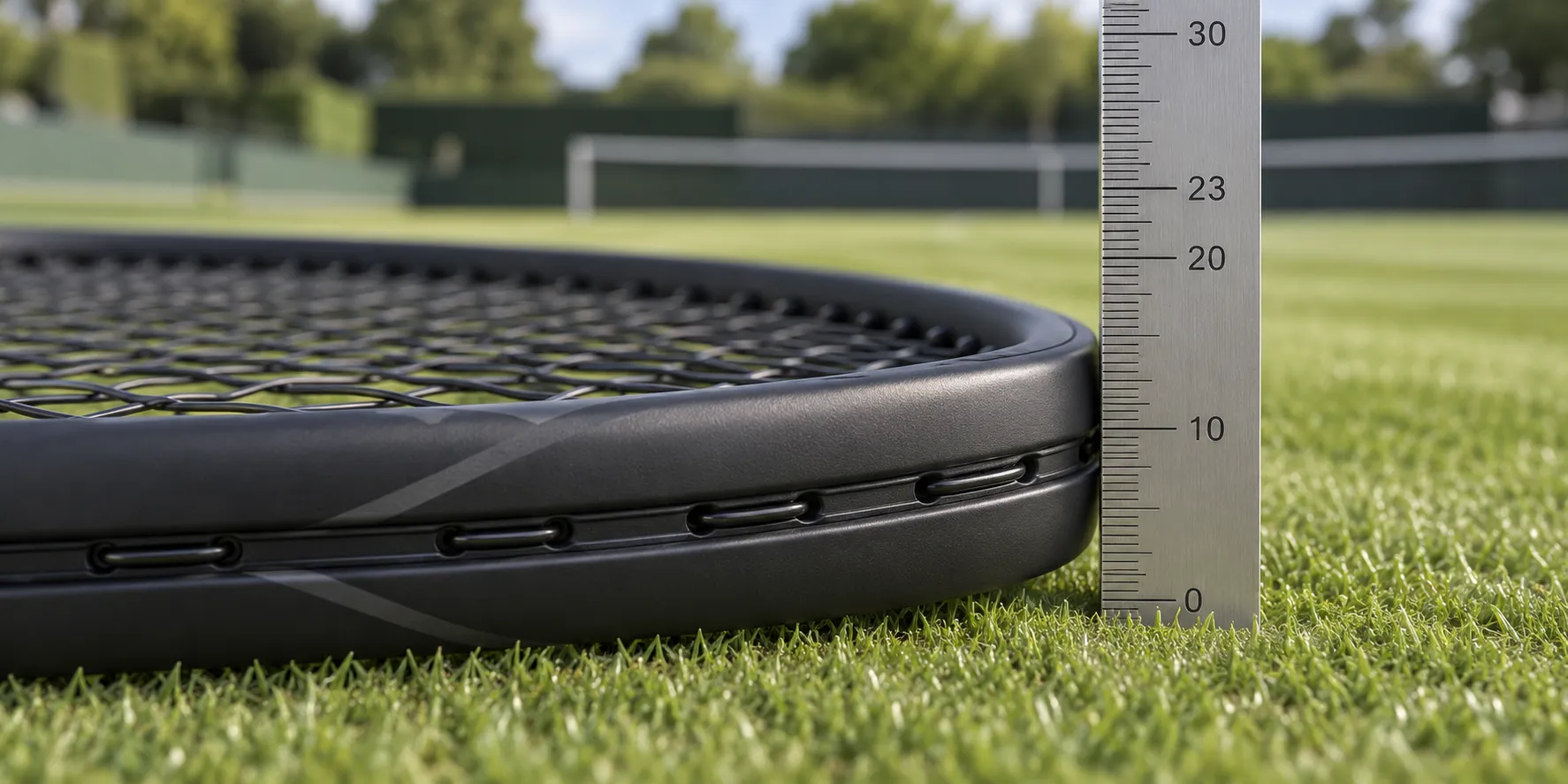
The beam width is the depth of the frame when you look at it from the side, measured in millimetres. It is not the overall width of the racket head or the thickness of the carbon wall.
If a spec sheet lists only 22 mm, it normally describes a constant or nearly constant beam. A sequence such as 23-26-23 mm means the beam changes through different parts of the hoop and throat; the manufacturer’s diagram should show where each measurement was taken.
There is no official line that turns a measurement into a “power” or “control” racket. These ranges are useful for deciding what to demo first—nothing more:
| Indicative beam | What often comes with it | What to check on court |
|---|---|---|
| Thin: 18-21 mm | More flex, less explosive response and direct feedback | Whether you retain depth and stability against a heavy ball |
| Medium: 22-24 mm | A balance of assistance, swing speed and response | Whether you can accelerate without sending the ball long |
| Wide: 25-28+ mm | More structural stiffness and easier power | Whether depth remains manageable and impact feels acceptable |
The final row does not invalidate the first, but neither does it guarantee it: a 24 mm frame can be flexible, while a 21 mm frame can feel firm.
Why a wider beam tends to be stiffer
With material and construction held constant, a deeper cross-section resists bending more. That is the basis of the link between a wide beam and stiffness, but it is not the whole explanation: the fibres, resins and arrangement of the layers matter too. A study modelling the bending stiffness of 525 rackets examined that combination of material and geometry.
A modern racket frame is a hollow composite tube. Two 23 mm rackets can hide different layups and internal shapes, then flex by different amounts. That is why beam width and RA stiffness are not synonyms: one is an external dimension; the other is the result of a test on the complete racket.
How beam width affects power
A stiff frame deforms less and loses less energy to bending. That helps explain why wide beams often appear on rackets designed to produce depth with short or moderate strokes: a blocked return or volley still needs a useful response when there is no full swing behind it.
The important qualification is that beam width is not a direct ball-speed dial. Measurements from Tennis Warehouse University show that the effect of stiffness changes across the stringbed. It matters less near the vibration node and more toward the tip, where the frame is more likely to bend.
An impact model published in the Journal of Sports Sciences also found greater rebound speed as structural racket stiffness increased. Its scope matters: this was a simulation with the frame initially stationary. On court, your swing speed, contact location, strings and effective mass all enter the equation.
Before calling a 26 mm racket “powerful,” check its swingweight. If it arrives late or makes you decelerate, the frame’s assistance cannot recover the speed you lost during the stroke.
Does a thin beam give you more control?
That depends on what you mean by control. Controlling depth and directing the ball are different problems. A thin beam often provides less free power, leaving a player with a long swing more room to accelerate without every clean contact flying past the baseline. Much of the “control racket” reputation starts there.
Directional accuracy has other drivers: racket-face angle, lateral stability and the response of the stringbed. If a thin frame twists on off-centre contact, fewer millimetres will not make it precise. Racket twistweight is the more relevant specification for that behaviour.
With a compact stroke, the answer can even reverse. A predictable amount of easy depth may give you better control than a thin beam that forces you to work hard on every ball.
What changes in impact feel
“Feeling the ball” is not one property. It combines the initial impact, the vibrations that follow, sound, frame flex and string response. Beam width contributes to that mix, but it cannot reconstruct the experience by itself.

A thin beam is often associated with a flexible, connected response; another player may call that same response soft or vague. A wide beam tends to feel firmer and crisper, although strong damping can mute that crispness.
A 2025 study of parameters associated with racket feel helps set limits on those associations. Across ten frames, high stiffness combined with low damping showed a weak relationship with persistent vibrations. Those measurements still need to be compared with player evaluations. The practical conclusion is narrow but useful: neither beam width nor RA predicts feel on its own.
When comparing two beams, use the same string type and an equivalent tension. Change both at once and you may end up judging the string job rather than the frame.
Constant, variable and aerodynamic beam shapes
A single measurement also misses the shape of the section:
- Constant beam: keeps a similar depth around the frame, though that does not guarantee uniform flex.
- Variable beam: widens or narrows selected areas to tune stiffness, flex or aerodynamics.
- Box beam: a squarer cross-section commonly associated with thin, traditional frame designs.
- Elliptical or aerodynamic section: rounds edges and transitions to reduce air resistance.
A computational fluid-dynamics study of tennis-racket frame aerodynamics found that cross-sectional shape and ports could reduce drag at certain orientations. A thin beam is not automatically the more aerodynamic one: the shape of those millimetres matters as much as the number.
Which beam width suits your game?
| If this happens in your game | Start by testing | Do not ignore |
|---|---|---|
| A compact stroke leaves the ball short | 24-26 mm | Swingweight that delays contact and an uncomfortable stringbed |
| You want a versatile racket for club competition | 22-24 mm | RA, string pattern and launch angle—not just average beam width |
| You create pace and want room to accelerate | 20-22 mm | Enough stability when the incoming ball is heavy |
| You swing steeply and produce heavy topspin | Thin or aerodynamic beam | Actual racket-head speed rather than the label |
| You have arm pain | Do not filter by beam alone | Stiffness, mass, strings, tension, technique and medical advice |
Use the table to choose what to test first, not what to buy without a demo. A complete racket-selection process should put beam width alongside head size, static weight, swingweight, balance and strings.
How to compare two beam widths on court
- Match what you can. Look for similar head sizes, static weights, swingweights and string setups. If you cannot isolate the variables, you may learn which racket suits you better—but not necessarily why.
- Start with a blocked return. Note which frame holds depth and stability without requiring a large stroke.
- Accelerate on the forehand and second serve. Check whether the wide beam supplies useful pace or makes you hold back, and whether the thin beam lets the head move more freely.
- Move to difficult contacts. Defend late, play a low volley and test near the end of a set. The racket still needs to arrive on time when your contact is no longer clean.
Change one variable at a time. Record depth, long misses, frame contacts and stability on return. “It felt better” is a valid observation; identifying which shot and what kind of pressure produced that difference is far more useful.
Two spec-sheet questions worth clearing up
What does 23-26-23 mm mean?
It describes a variable beam measured at three locations. The frame reaches 26 mm at its widest point and returns to 23 mm in the other two. Check the manufacturer’s diagram for the exact order of those locations.
Which beam width is more arm-friendly?
There is no universal winner. Damping, mass, contact location, string type and tension also matter. If pain persists, reduce the load and consult a healthcare professional; one figure on a spec sheet is not a diagnosis.
The practical decision
Use beam width as a hypothesis, not a verdict: start wider if a compact stroke needs help reaching depth; try thinner if you already accelerate and want to contain the response.
Then demand an answer on court. A blocked return shows how much help the frame provides; a full swing reveals whether you can accelerate without holding back; late contacts tell you whether the racket remains manageable. If two models share the same beam width, move on to RA, swingweight, cross-sectional shape and strings. That is where a promising number either becomes an advantage for your game—or does not.
Keep learning
Turn this information into a better decision for your game
Explore more guides on the same topic or visit the complete archive to compare your options with context.
Continue reading
Related articles

Tennis Racket Types: Power, Control and Spin
What separates power, control and spin tennis rackets, which specs matter, and what to demo based on your swing and typical miss.
Racket Stiffness (RA): Power, Control and Your Arm
Learn what racket RA stiffness means, how it affects power, control and comfort, and which stiffness rating suits your level and playing style.

Extra Duty vs Regular Duty Tennis Balls: Which Court?
Learn when to use Extra Duty or Regular Duty tennis balls on hard courts, clay, indoor courts, and grass, plus when altitude matters more than felt.