Tennis Racket Twistweight: What It Means
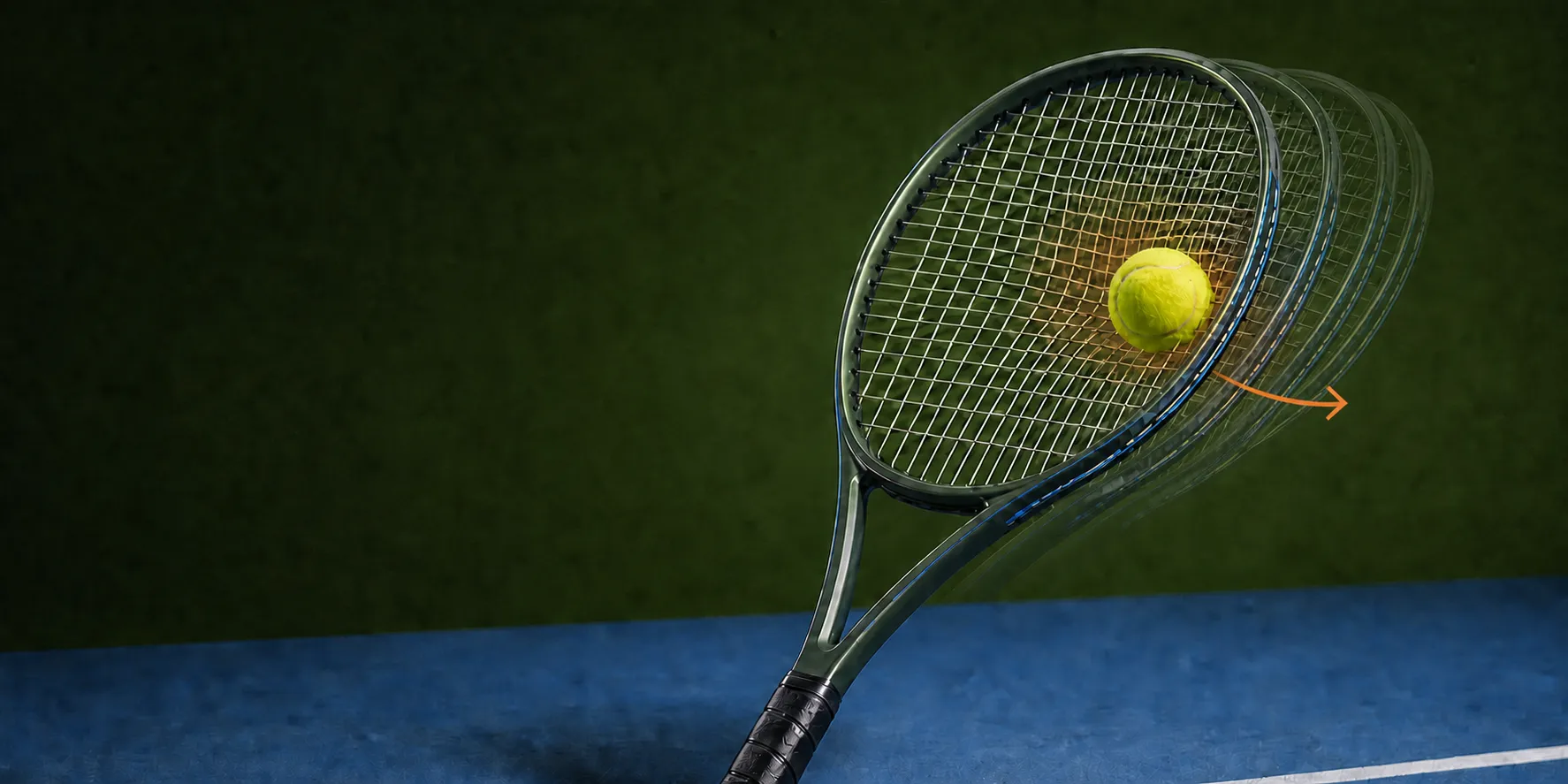
You block a heavy return, catch the ball slightly off-center, and feel the racket head turn in your hand. The frame might weigh 320g (11.3oz) and still feel unstable. The specification that helps explain that reaction is not static weight or swing weight. It is tennis racket twistweight.
Twistweight measures how strongly a racket resists rotation around its longitudinal axis when the ball strikes to one side of center. A higher value limits that twisting and keeps the face more stable on off-center hits; a lower value lets the head rotate more. It is a moment of inertia measured in kg·cm².
What does tennis racket twistweight actually measure?
In this context, twistweight—also called the polar moment of inertia—describes how mass is distributed to either side of the axis running from the butt cap to the tip of the racket.
The physics is the same as for any moment of inertia:
I = Σ(m × r²)
Here, m is each portion of mass and r is its distance from the longitudinal axis. Because that distance is squared, a few grams near 3 and 9 o’clock affect twistweight far more than the same mass close to the center of the frame.
Two ideas often get mixed together:
- Twistweight: resistance to starting a rotation because of mass distribution.
- Torsional stiffness: the frame’s structural resistance to deforming or twisting.
Both influence stability, but they are not the same measurement. The Tennis Warehouse University racket analyzer uses twistweight for resistance to rotation around the racket’s long axis.
Why twistweight matters on off-center hits
A strike on the string bed’s centerline creates very little torque around the handle. Move contact a few centimeters to either side and you create a lever: the farther the ball lands from the axis, the harder it tries to turn the head.
With higher twistweight, the same force produces less angular acceleration. On court, that usually means:
- the racket face changes angle less during a lateral mishit;
- less ball speed is lost away from the center;
- impact feels more solid and the useful hitting area feels wider.
The catch is that twistweight changes very little on a centered strike along the longitudinal axis. It does not make every contact more powerful or rescue a late swing. Its value shows up when you miss the middle toward one side.
That is why judging a frame only by tennis racket weight can mislead you. A heavy racket with mass concentrated near its centerline may have less twistweight than a lighter, wider frame with more mass around the perimeter.
Twistweight vs swing weight: different axes, different feel
Both specifications use kg·cm², but they describe rotation around different axes.
| Specification | Rotation axis | What it describes on court | Where mass matters most |
|---|---|---|---|
| Swing weight | Perpendicular to the handle, usually 10 cm from the butt | Resistance to accelerating the racket through a swing | Toward the tip |
| Twistweight | Along the handle and through the racket head | Resistance to turning on off-center impacts | Around 3 and 9 o’clock |
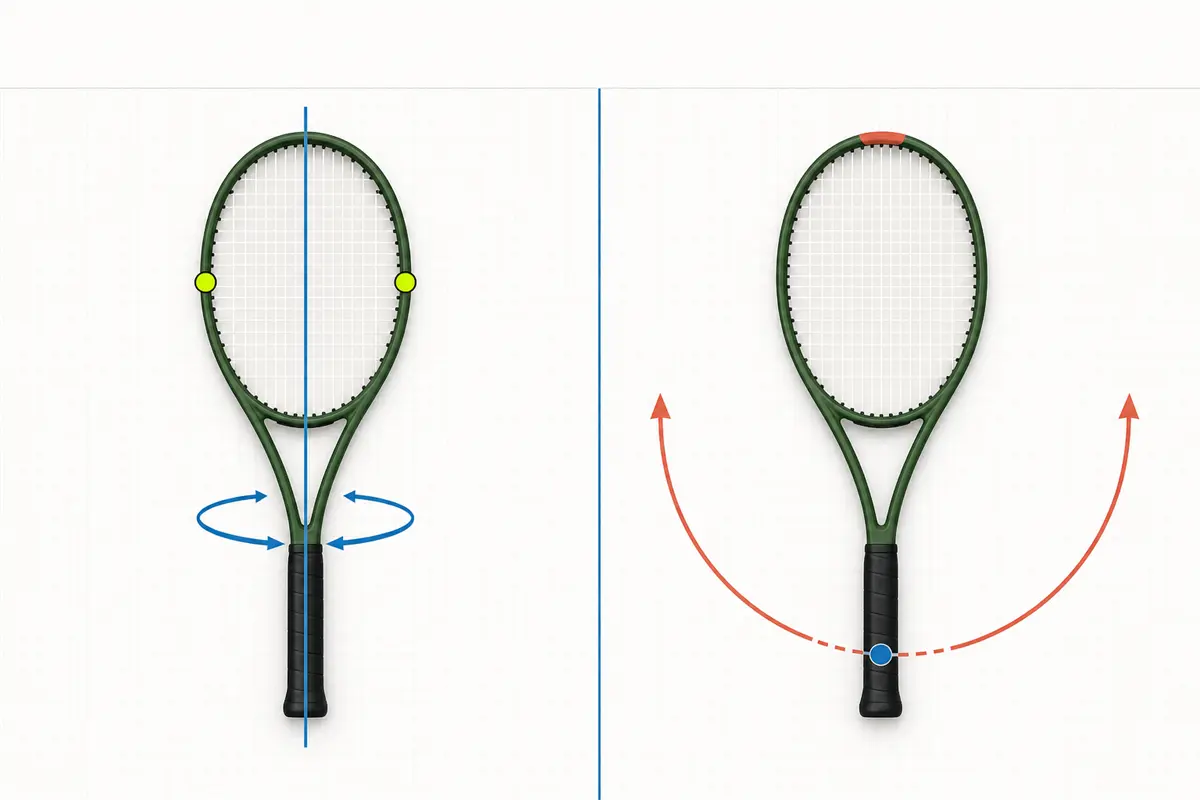
A racket can have high swing weight and low twistweight, or the reverse. The first number tells you how hard the racket is to move along the main path of the stroke. The second tells you how hard its face is to rotate around the handle. That is why “maneuverable” and “stable” are not automatic opposites.
High vs low twistweight: what changes?
There is no official industry scale, and different databases or devices do not always return identical numbers. As a practical reference for strung adult rackets, historical TWU data is often interpreted this way:
| Approximate twistweight | Typical response | Main advantage | Cost or risk |
|---|---|---|---|
| Low: below 14 | The head turns more when contact drifts to one side | Livelier feel and less resistance when changing face angle | Less stability and more loss of depth on lateral mishits |
| Medium: 14 to 15 | A compromise between stability and easy adjustment | Suits many club players | The result depends heavily on swing weight and head shape |
| High: above 15 | The string bed stays firmer on off-center contact | More forgiveness on returns, volleys, and defense | More resistance to face rotation and often more perimeter mass |
Treat those cutoffs as references, not grades. TennCom notes that its system can read more than one point lower than the TWU database. Compare numbers from the same lab and rackets measured in equivalent setups.
Higher is not automatically better. If you center the ball consistently and value a quick face, a moderate figure may be enough. If incoming pace turns the head on blocked returns or volleys, more twistweight starts to earn its keep.
What determines racket twistweight?
Three factors matter most:
- Lateral mass distribution. The farther each gram sits from the axis, the more it raises the moment of inertia.
- Head width and shape. Racket head size matters, but two 645 cm² (100 sq in) frames can have different widths and twistweights.
- The actual playing setup. Strings, bumper guard, and added weights all change the result. Measure the racket as you use it.
Tennis racket balance cannot predict twistweight by itself either. Balance measures mass distribution along the frame, not across it.
How to measure racket twistweight
The most practical method uses a swing-weight machine that can measure the racket in two orientations, or a device with a dedicated adapter. The Briffidi guide outlines this process:
- Leave the strings, overgrip, and accessories you normally play with in place.
- Measure swing weight several times with the string bed in the machine’s normal orientation.
- Rotate the racket 90°, with the string-bed plane parallel to the floor, and repeat. That result is the spinweight.
- Average each measurement group and subtract:
Twistweight = spinweight − swing weight
If average swing weight is 320.2 and spinweight is 334.6, estimated twistweight is 14.4 kg·cm².
Repetition matters. Small changes in mounting or oscillation can move the result. Simple-pendulum and bifilar-suspension methods can be accurate when the setup is controlled (Choppin et al., 2018). Without the right equipment, a specialist shop is more reliable than one improvised home reading.
How to increase twistweight without overdoing it
The most efficient adjustment is to add equal amounts of tungsten or lead tape on both sides of the hoop, near 3 and 9 o’clock. Start with 1 g (0.04 oz) per side, then test blocked returns, volleys, and stretched defensive shots. The lead-tape customization guide explains how to record a baseline and run an A/B test.
The calculation shows why that location works. If you add 2 g per side about 12 cm (4.7 in) from the axis:
ΔTW ≈ 2 × 0.002 kg × (12 cm)² = 0.58 kg·cm²
That is an estimate; the true distance and strip length change the result. The TWU customization worksheet calculates the effect from the amount of mass and its lateral position.
The trade-off is that this adjustment changes more than twistweight. Weight at 3 and 9 also raises static weight and swing weight, and it shifts balance. Mass at 12 o’clock adds far more swing weight but relatively little twistweight; mass in the handle has minimal effect on twistweight.
If you use lead, wash your hands after handling it, cover the tape, and keep it away from children. Tungsten avoids lead entirely. Lowering twistweight means removing perimeter mass or choosing another frame; adding weight to the handle does not reduce it.
How to choose the right twistweight for your game
Do not buy a number; test a response. Keep strings and tension constant, then compare the racket in situations that expose torsional instability:
- blocked returns against a hard first serve;
- volleys reached late or outside the center;
- defensive shots contacted away from the body.
If 1 g per side improves depth and direction without making the face feel slow, the original twistweight was probably low for your contact pattern. If the racket loses agility and your misses do not improve, take the weight back off. That reversible test tells you more than any universal threshold.
Frequently asked questions
Can you measure twistweight without a machine?
Yes, with a bifilar suspension and careful control of the setup and oscillation. The method is sensitive to error, so keep the same procedure for every comparison or use a specialist measurement service.
Do strings change racket twistweight?
Yes. Strings add mass across the string bed and increase the polar moment of inertia. Compare strung rackets with other strung rackets, ideally using similar string types and gauges.
What is the ideal tennis racket twistweight?
There is no universal value. Look for enough stability to support your off-center contact without making the face harder to reposition. The middle range is a sensible starting point; the court test makes the decision.
Keep learning
Turn this information into a better decision for your game
Explore more guides on the same topic or visit the complete archive to compare your options with context.
Continue reading
Related articles
Lead Tape on a Tennis Racket: Where to Put It and How Much to Use
Learn how lead or tungsten tape changes racket weight, balance, swingweight and the sweet spot, where to place it and how to test without overdoing it.

Extra Duty vs Regular Duty Tennis Balls: Which Court?
Learn when to use Extra Duty or Regular Duty tennis balls on hard courts, clay, indoor courts, and grass, plus when altitude matters more than felt.

Tennis Racket Types: Power, Control and Spin
What separates power, control and spin tennis rackets, which specs matter, and what to demo based on your swing and typical miss.