
Pro Stock Rackets: Do Pros Use What They Endorse?
Your favorite player appears with the latest paintjob, and a shop advertises the new generation as “their racket.” It is easy to assume the two frames are identical. Pros do not always compete with the exact racket they endorse, though. Some use a customized retail frame; others keep an older design beneath the new paint or receive a construction made specifically for the tour.
Players also make genuine switches to new models. The challenge is telling a change of equipment from a change of appearance. A good racket from a player’s endorsed range can still be different from the one they take into a match.
What a racket endorsement actually tells you
An endorsement associates a player’s image with a brand or product line. Phrases such as “endorsed by,” “recommended by” or “the racket of” describe that commercial relationship without necessarily identifying the mold, construction or adjustments the player uses.
Manufacturers acknowledge the distinction. In its 2023 announcement extending its partnership with Carlos Alcaraz, Babolat says its professionals may play with a customized or different model from the one shown. Wilson also notes that endorsed consumer models can have different specifications from the rackets pros use in matches.
The brand wants its product to be recognizable on television; the player needs equipment they trust in competition. Applying the latest cosmetics to a familiar base serves both interests. Product launches and equipment decisions can follow different schedules.
Paintjob, mold and customization are different things
A paintjob is the frame’s painted finish and graphics. In discussions about pro equipment, the term often describes a frame carrying the appearance of another model or generation. The visible finish can change while the structure stays the same.
| Part of the racket | What it describes | What it tells you |
|---|---|---|
| Paint and product name | Colors, graphics and the model being promoted | The commercial appearance |
| Mold | The external geometry of the head, throat and beam | Two frames can share a shape without sharing the same construction |
| Layup | How the material layers are arranged inside the frame | The outside shape cannot reveal the frame’s full response |
| Final setup | Weight, balance, swingweight, handle, strings and tension | The same base can be prepared for different needs |
HEAD’s account of racket manufacturing explains why shape and construction need to be separated. Pre-impregnated fiber is arranged in specific orientations before molding; drilling, finishing and painting come later. Fiber orientation affects how the frame behaves. Sharing a mold does not mean sharing the entire racket.
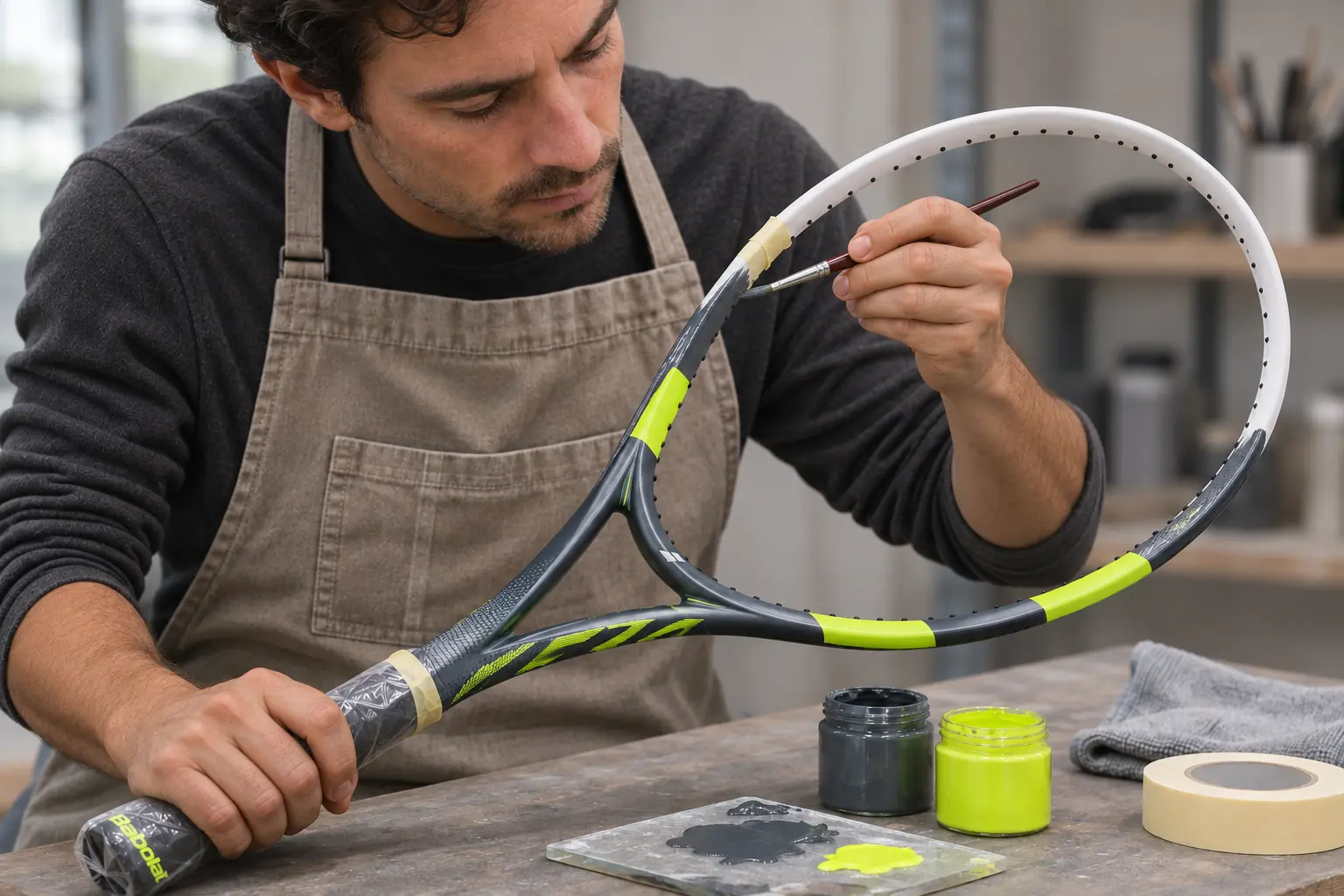
Matching total weight is not enough either. Two rackets weighing 330 g (about 11.6 oz) can distribute that mass differently and take different amounts of effort to accelerate. Swingweight and balance describe part of that difference.
Adding weight to a retail racket can bring some measurements closer to a pro’s. Its geometry and layup remain those of the frame you bought.
Why pros do not switch with every generation
A familiar racket gives a player a reference for how the ball comes off a blocked return, how much depth they get on the run and how their serve responds under pressure. Replacing that reference requires a benefit worth the adjustment.
If a new racket improves the serve but forces the player to recalibrate their return and backhand, the overall result may be worse. A promising response in a practice rally still has to earn their trust when facing break point. A product release is not enough reason to switch.
Eric Babolat described that preference for continuity in his April 2025 interview with AS. Players who are happy with their equipment tend to ask for small adjustments, usually working on them at the end of the season with their coach and technicians.
Changes can be substantial when they address a specific need. In a November 2020 interview with Tennisnerd, racket technician Roman Prokes described his work with Novak Djokovic and Andre Agassi. They tested different samples and arrived at a racket eight grams (about 0.28 oz) lighter, with an 18x19 pattern instead of 18x20 and a small increase in length. The aim was to make it easier to respond to a heavy ball without making the transition too difficult for Djokovic.
Those figures describe that project, not a measurement of his current racket. The useful lesson is the process: modifications were tested against a playing problem before being adopted.
Nadal also refined his equipment during a long relationship with the same brand. In its account published in 2020, Babolat describes adjustments to mass in the head and changes of string over his career. That evolution does not establish that he adopted every retail generation.
Keeping a design does not mean keeping the same physical racket. A player can receive newly manufactured frames built around an older geometry. How long they have used a design does not tell you when the racket in their hand was made.
Do any pros use current retail molds?
Manufacturers have described players adopting platforms that were in the retail range at the time. Dismissing every launch as new paint overlooks those cases. Establishing whether a player uses the exact latest mold in 2026 requires more recent, more precise evidence.
Gaël Monfils selected a retail platform in 2022. According to Decathlon, the Artengo TR960 Control Tour 18x20 was already in its range when he chose it, and they worked on a new cosmetic design for the partnership. The model selection is documented; whether his final match setup was identical to a shop-bought racket is a separate question.
Alcaraz also changed platforms. In the August 2023 announcement linked above, Babolat explained his move from the 100 sq in Pure Aero to the 98 sq in Pure Aero VS in search of more control. According to that account, he had played with the Pure Aero 98, presented as an update of the VS, since the 2022 US Open. This is the manufacturer’s explanation of that transition, accompanied by its warning that players may use different or customized models.
Other announcements offer less technical detail. In January 2025, Yonex presented Ben Shelton and Jessica Pegula with the latest EZONE rackets, without providing a physical comparison of the molds or describing their layups. The brand reports an adoption; the announcement does not establish what is beneath the paint.
These examples come from different dates and support different conclusions. None verifies the exact mold and layup those players use in October 2026. That would require identifying their match equipment and comparing it with the corresponding retail generation.
What is a pro stock racket?
Pro stock rackets exist: they are frames produced or prepared for tour players, although the term is also used for certain platforms intended for customization. There is no single recipe shared by every brand.
The base may come from a current retail model, retain an older geometry or have specific characteristics of its own. It is then prepared for the player. Pro stock describes its intended use or preparation; older mold, its geometry; paintjob, its appearance. All three can apply to one frame, but they mean different things.
Nor should you picture an untouched reproduction of a racket from twenty years ago. Racquet Quest explained in 2016 the difference between recovering a geometry using an older mold and reproducing the materials of that period. The shape can be retained without preserving the entire historical construction.
The same workshop documents unfinished pro stock or SMU frames, which it prepares by choosing length, weight, swingweight and handle components. Such a base still needs work before it is ready for competition. Its starting weight and finished weight are different things: the pro stock label does not mean every frame is heavier.
Can you buy pro stock rackets?
Some reach the public through specialist sellers, and manufacturers also offer certain frames directly. Wilson describes its Pro Labs collection as pro stock frames for advanced and professional players on the Blade 98 Pro product page linked earlier.

Buying a Pro Labs racket does not guarantee that you have reproduced a particular player’s racket. The version, construction and finished setup still matter. “Pro” or “Tour” in a model name can also be ordinary retail branding.
Before paying for a pro stock frame, ask the seller to identify the base frame and provide measured weight, balance, length and swingweight. Check whether those measurements include strings and accessories. If it is advertised as a player’s equipment, ask for documentation of its provenance too. Measured specifications and a verifiable origin are worth more than a player’s name in the listing.
Are they better than retail rackets?
A racket built for the tour can still be wrong for you. A setup made for someone else can demand more than you can sustain through a match, even if it is authentic.
For a club player, the purchase makes sense when it offers a particular geometry they already know, a response they have tried or a base for a defined customization project. If you still do not know why you are late on returns or leave your backhand short, start with a demo that helps you work that out. The pro stock label cannot answer those questions.
How to check a claim about “a pro’s racket”
Check three things when assessing a claim about a player’s equipment:
- What is being claimed, and when? An endorsement deal, adoption of a product family and a change of string pattern are different claims. A report from 2022 does not automatically identify the equipment used in 2026.
- What has been compared? Geometry, drilling and measurements tell you more than graphics. A different string pattern rules out identical frames; a matching pattern still does not establish an identical layup.
- Which setup is being described? The frame’s base is only part of the equipment. The handle, strings, tension, added weight and balance all matter in match play.
If the only evidence is a brand announcement, attribute the claim to the brand. The exact identity of the frame remains unverified.
What is worth copying from the pros?
Test changes with a specific goal. If your racket works, the new generation needs to improve something that matters to you: preparing on time for returns, maintaining depth in defense or controlling the ball when you accelerate.
If you know what you want to adjust, our guide to customizing a racket with added weight explains what changes depending on where you put it. If you are still working that out, start by identifying what your level and strokes require from a racket.
During the demo, use similar strings and tension, then return to the shots that prompted the change. Check whether you can still get the racket into position when rallies speed up and after you have been playing for a while. If the improvement you wanted does not appear, keeping your familiar setup is a reasonable choice.
This article is a desk analysis of manufacturer sources and technical testimony. We have not inspected or measured these players’ match rackets. Historical examples retain their dates and do not certify current setups.
Keep learning
Turn this information into a better decision for your game
Explore more guides on the same topic or visit the complete archive to compare your options with context.
Continue reading
Related articles

Tennis Racket Types: Power, Control and Spin
What separates power, control and spin tennis rackets, which specs matter, and what to demo based on your swing and typical miss.
Swing Weight in Tennis Rackets: What It Means
Learn what swing weight means, why equal-weight rackets can feel different, and how to choose or customize the right range.
How to Lace Tennis Shoes for Heel Slip and Pressure
Learn heel lock, diagonal and straight bar lacing with an interactive step-by-step guide. Includes the Berluti knot and when to reconsider shoe fit.