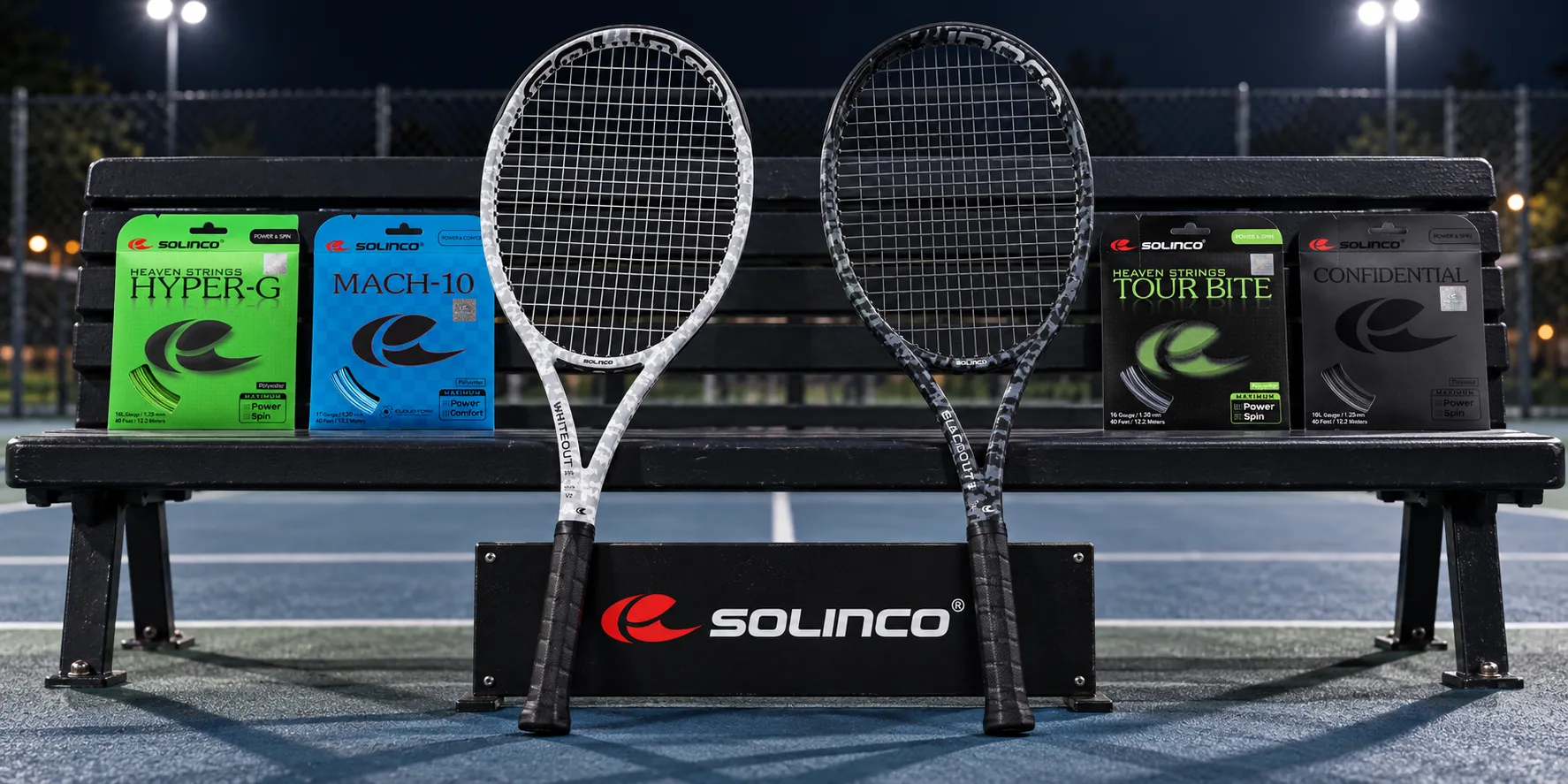
Solinco Rackets: Blackout, Whiteout or Prizm?
If your returns and defensive shots land short, start your Solinco demo with the Blackout V2 300. If you already find depth but your attacking shots run long, start with the Whiteout V2 305. For many intermediate and advanced players, that is the first useful split: Blackout offers more help with depth from a 100 sq in head; Whiteout aims for a more contained flight with a 98 sq in head and a thin beam.
The Prizm 115 answers a different problem. Its larger head, low static weight and extra length are aimed at players with a compact swing who need easier depth and more room for imperfect contact. Lighter, denser-pattern and extended Blackout and Whiteout models can change the choice, too. This is a buying guide based on Solinco specifications and published third-party tests, not our own playtest. Compare demos with similar strings, and pay particular attention to shots you contact late.
Which Solinco racket should you try first?
| Family | Starting model | Basic design | Most useful for | Main trade-off |
|---|---|---|---|---|
| Blackout V2 | 300 | 100 sq in, 300 g, 16×19, variable beam | Aggressive baseline play, defense and easier depth | Flat shots may fly long, especially when late |
| Whiteout V2 | 305 16×19 | 98 sq in, 305 g, 16×19, constant 21.7 mm beam | Full swings, all-court attack and directional control | Less margin on off-center contact |
| Whiteout V2 18×20 | 305 18×20 | 98 sq in, 305 g, dense string pattern | Penetrating shots from a player who supplies pace | Short balls if you cannot accelerate in time |
| Prizm | 115 | 115 sq in, 260 g, 27.5 in | Compact swings, doubles or a return to tennis | Slower handling than 260 g alone might suggest |
The family name is not enough. A standard Blackout 300 and a Blackout 110 differ in head size and length as well as weight. A Whiteout 290 asks something different of you than a 305 XTD 18×20. Check the full specifications before deciding from the paint or the name.
What Solinco model names and specs actually mean
The number gives you a clue, but not the whole specification:
- 300, 305, 290, 285, 265 or 245 are nominal unstrung weights in grams.
- 110 or 115 refer to head size in square inches.
- XTD means 27.5 in (69.9 cm) extended length for the V2 models discussed here.
- 16×19 and 18×20 describe the string pattern. A 16×19 often produces a higher launch; an 18×20 generally reins it in, though the actual spacing between strings matters too.
- V2 denotes the second generation. Some catalogs still list V1 stock, so confirm the generation before comparing prices or specifications.
The official weights below are unstrung. Strings, an overgrip and a dampener add mass and change balance and swingweight. Another half-inch of length also changes how the frame moves on preparation and returns; it does more than add reach.
Static weight alone will not tell you how much effort acceleration takes. Tennis Warehouse University measured a 317 swingweight and 66 RA stiffness on its strung Blackout 300 V2 sample; Tennis.com reported 328 swingweight and 64 RA for its Whiteout 305 V2 sample. These are different samples from different sources, not a controlled head-to-head test. They do show why a 5 g difference and the labels “power” and “control” cannot tell you which racket will let you prepare sooner.
Solinco Blackout V2: power and spin from a 100 sq in head
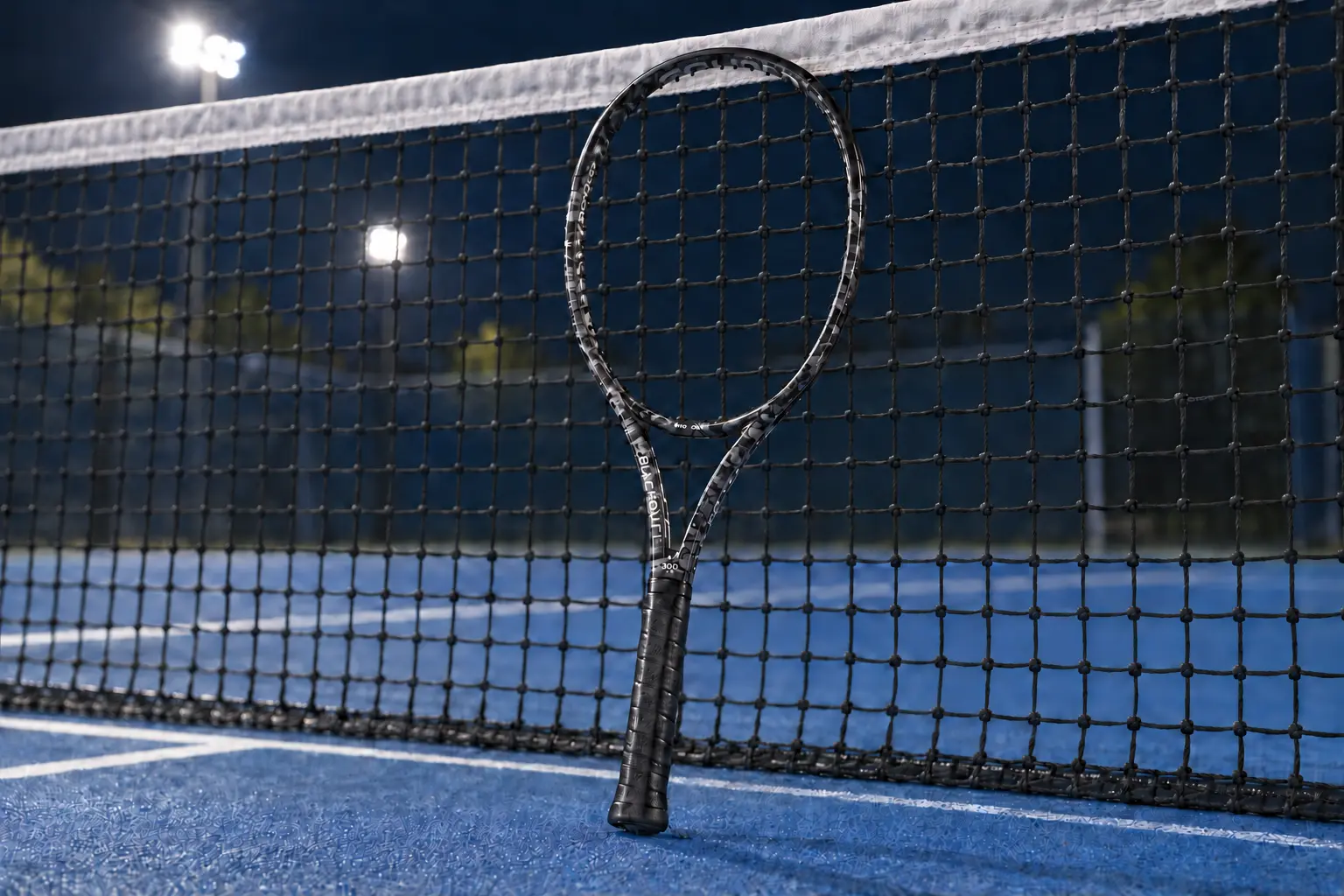
The Blackout V2 300 combines a 100 sq in head, 300 g unstrung weight, 16×19 pattern and a 23.5–26–23 mm variable beam. Solinco specifies foam in the head and a wider section near the throat. That describes the design intent; it does not establish whether the frame will be comfortable for your arm with your strings and tension.
Watch your first defensive ball in a point. If the Blackout lets you return it deep without abbreviating your preparation or forcing the arm, the extra launch may be useful. If your flat forehand already sails long, see whether you can control the trajectory without having to reshape your natural stroke just to keep it in.
Blackout V2 300, 285 and 300 XTD
The Blackout V2 300 is the starting point for a competitive adult. Tennis Warehouse playtesters found accessible power and spin, but one had trouble controlling depth on flatter shots. Include flat drives and returns in the demo, not just warm-up topspin forehands.
The Blackout V2 285 retains the head, length, pattern and beam, sheds 15 g (0.5 oz), and shifts the official balance from 315 to 330 mm. It may help someone who prepares late with the 300, but its more headward balance means weight alone cannot predict handling. Intermediate players, transitioning juniors and doubles players should also check whether blocked returns keep their direction on off-center contact.
The Blackout V2 300 XTD keeps the 300 g weight and extends the frame to 27.5 in. The added leverage may help serve and reach, but typically raises inertia and asks for more preparation room. Return first serves and handle body shots when you demo it; that is where the extra length may cost you.
| Model | Head | Unstrung weight | Official balance | Length | Pattern | Best reason to demo it |
|---|---|---|---|---|---|---|
| Blackout V2 300 | 100 sq in | 300 g (10.6 oz) | 315 mm | 27 in (68.6 cm) | 16×19 | Power and spin without giving up standard-length handling |
| Blackout V2 285 | 100 sq in | 285 g (10.1 oz) | 330 mm | 27 in (68.6 cm) | 16×19 | Less mass; check return stability and handling |
| Blackout V2 300 XTD | 100 sq in | 300 g (10.6 oz) | 315 mm | 27.5 in (69.9 cm) | 16×19 | Extra leverage on serve and extra reach |
| Blackout V2 265 | 100 sq in | 265 g (9.3 oz) | 335 mm | 27 in (68.6 cm) | 16×19 | Very low weight for a transitioning junior or adult |
| Blackout V2 110 | 110 sq in | 268 g (9.5 oz) | 340 mm | 27.5 in (69.9 cm) | 16×19 | More contact margin and depth from a shorter swing |
Those figures come from Solinco’s pages for the Blackout V2 285, Blackout V2 300 XTD, Blackout V2 265 and Blackout V2 110. The 26 in Blackout 245 is a junior racket; its 245 g weight does not make it an adult alternative to the 265.
Blackout V2 110: a bigger head, less mass and extra length
The Blackout V2 110 changes three variables at once: head size rises to 110 sq in, weight falls to 268 g and length increases to 27.5 in. Solinco also says this model does not have the foam core used in the main Blackout V2 frames. The bigger head offers more margin on off-center hits; its official 340 mm balance places weight farther toward the head than the Blackout 300.
Consider it for a compact swing, doubles or a return to the sport. Against a heavy ball, test blocked returns: does the racket keep your chosen direction without making you grip harder? That tells you more than a gentle rally with a 110 sq in frame.
Solinco Whiteout V2: control, with a choice of string patterns
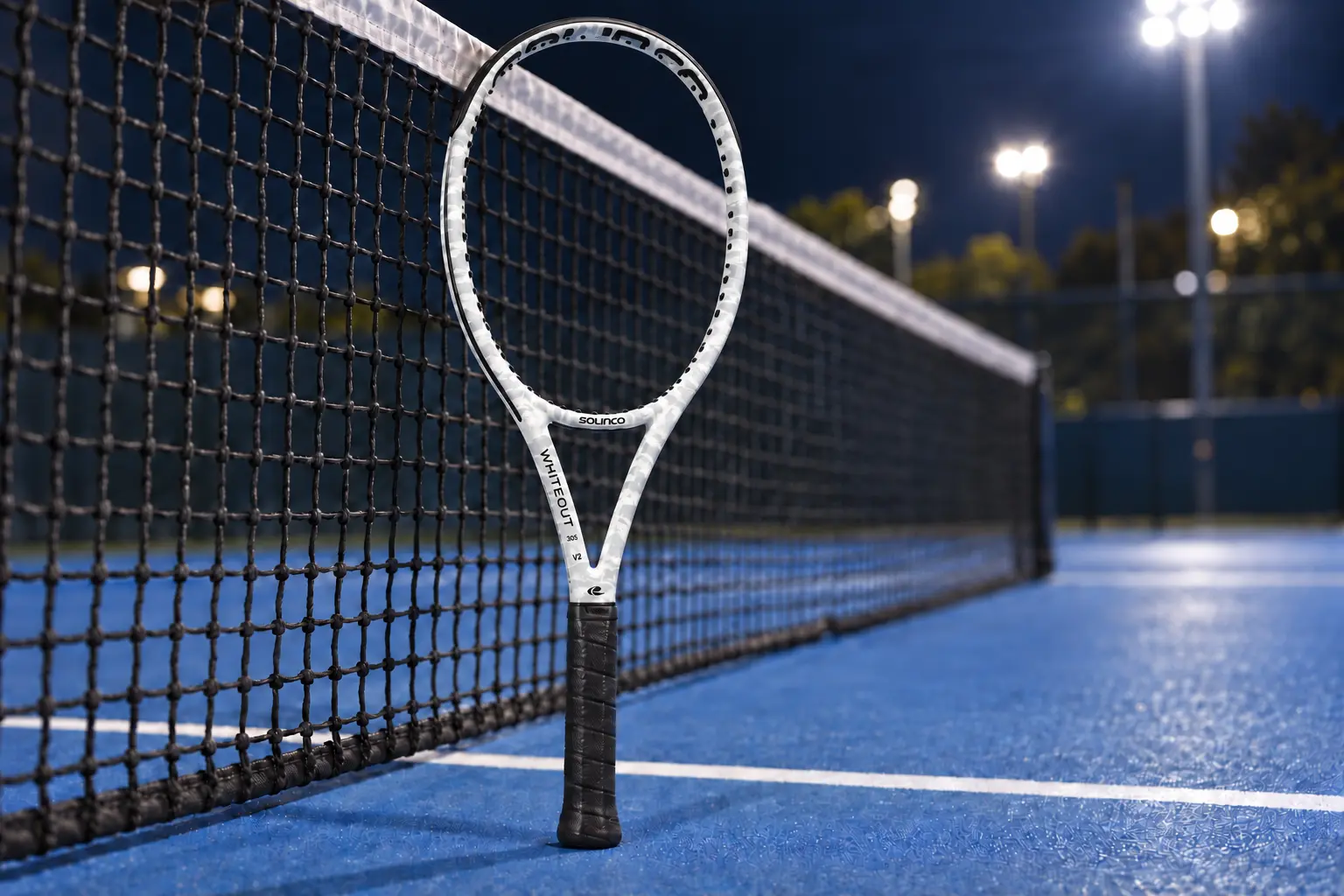
Whiteout V2 uses a 98 sq in head and a constant 21.7 mm beam. Solinco pitches it to players with fast swings who want to direct the ball precisely. The 305 models have foam in the head; the Whiteout V2 290 does not have Foam Tech Core.
A published Whiteout 305 V2 test reports more punch and stability than the first generation. That nuance matters: Whiteout remains Solinco’s control family, but the 305 is not a promise to give up all help with pace. Demo it if your depth is already reliable and the Blackout sends your attacking shots higher or farther than you want.
Whiteout V2 305: 16×19 or 18×20?
The Whiteout V2 305 16×19 is the first Whiteout variant to try. Its more open pattern will often launch higher than the 18×20, useful if you move between defense and topspin attack or your backhand loses net clearance on late contact.
The Whiteout V2 305 18×20 keeps the same head size, weight, length and beam but tightens the pattern. Solinco positions it for a lower, more penetrating trajectory. Tennis Warehouse University measured a 326 swingweight in its sample: controlling launch is only one part of the decision; you must also prepare on time with a frame of substantial inertia.
The 18×20 is worth trying if you already clear the net safely, create your own depth and want less dispersion when you accelerate. If defensive balls fall short or you start lifting your stroke just to compensate, go back to the 16×19 before abandoning the whole family.
Whiteout 290 and XTD: what changes?
The Whiteout V2 290 drops 15 g from the 305 but keeps the 98 sq in head. It may be a reasonable way into Whiteout for an intermediate player who is late with the 305. Lower weight does not give you the contact margin of a 100 sq in Blackout 285. Compare the two on returns and defensive backhands, where both compromises show up.
The Whiteout V2 305 XTD models extend to 27.5 in in both patterns. The 18×20 version combines a 98 sq in head, 305 g, a dense pattern and extra length. It is a specialized combination for someone who already generates racket-head speed and usually gets to contact early. More leverage on serve and more reach may be worthwhile, but returns and body balls demand more room. Compare the Whiteout V2 305 XTD 18×20 with the standard 305 18×20 to isolate the length change.
| Model | Head | Unstrung weight | Official balance | Length | Pattern | Best reason to demo it |
|---|---|---|---|---|---|---|
| Whiteout V2 305 | 98 sq in | 305 g (10.8 oz) | 320 mm | 27 in (68.6 cm) | 16×19 | Full swings and varied all-court play |
| Whiteout V2 305 18×20 | 98 sq in | 305 g (10.8 oz) | 325 mm | 27 in (68.6 cm) | 18×20 | A penetrating shot with a more contained launch |
| Whiteout V2 290 | 98 sq in | 290 g (10.2 oz) | 325 mm | 27 in (68.6 cm) | 16×19 | Less load while keeping a 98 sq in head |
| Whiteout V2 305 XTD | 98 sq in | 305 g (10.8 oz) | 320 mm | 27.5 in (69.9 cm) | 16×19 | Extra leverage without tightening the pattern |
| Whiteout V2 305 XTD 18×20 | 98 sq in | 305 g (10.8 oz) | 325 mm | 27.5 in (69.9 cm) | 18×20 | Advanced play with extra length and a dense pattern |
Official pages for the Whiteout V2 305, Whiteout V2 305 XTD and Whiteout V2 305 18×20 support these specifications. Published balance figures are unstrung. A retailer’s strung balance is a different state of the racket.
Solinco Prizm 115: easier depth, not a competitive control frame
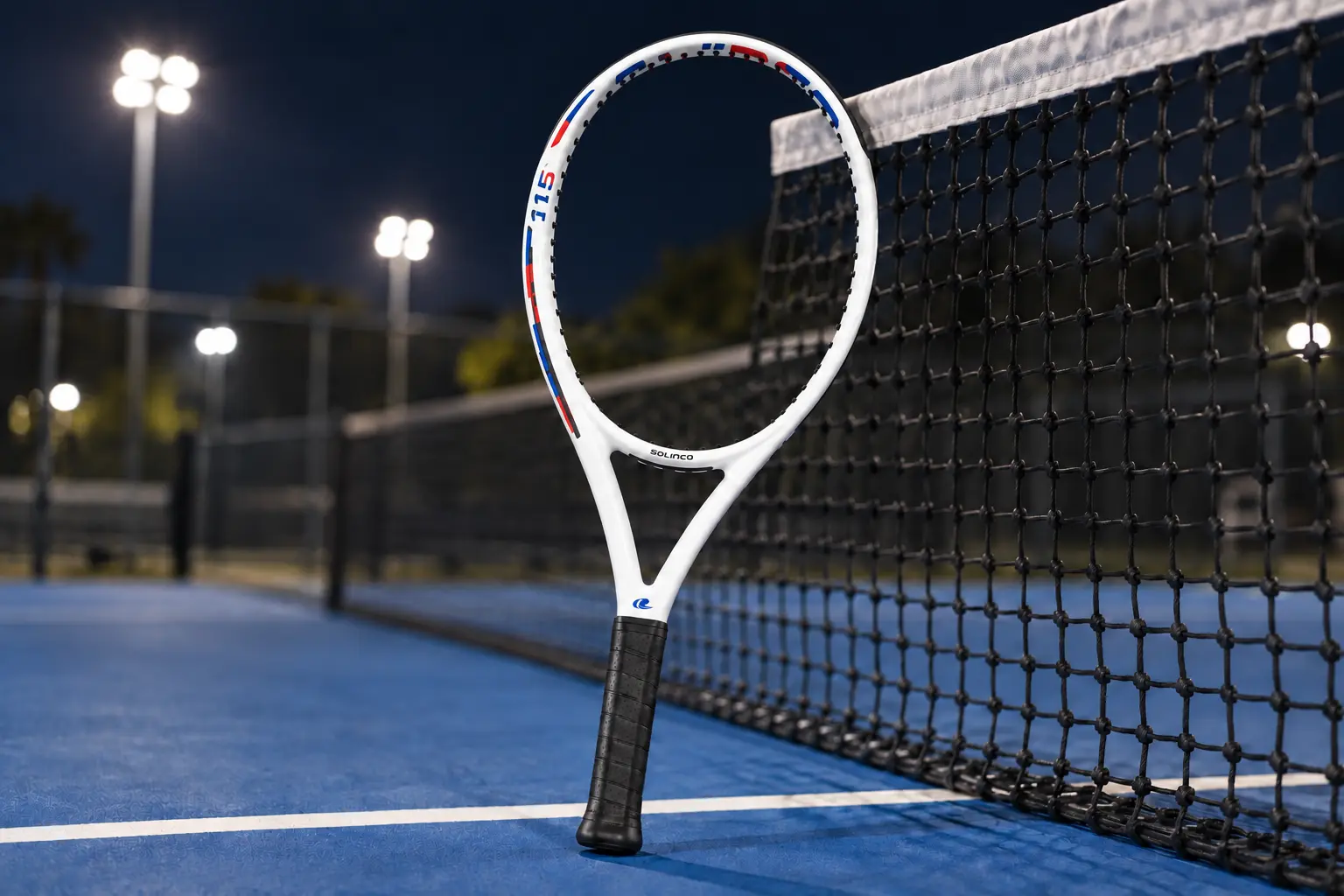
The official Prizm 115 page lists a 115 sq in head, 260 g weight, 350 mm balance, 27.5 in length, 16×19 pattern and wide 28–30–28 mm beam. Those numbers point to easier depth from a short swing and more area for imperfect contact.
It may suit an adult beginner, someone returning to tennis or a doubles player with compact strokes. If you already compete with full swings, have a specific reason to demo it: your shots fall short even when you prepare early, and you want to see whether a larger head solves that without undermining the rest of your game.
Despite its 260 g weight, the extra length and 350 mm balance may make the head slower to position on returns or close-to-the-body volleys. Compare it with the Blackout 110 and Blackout 285 in those situations. If Prizm improves rally depth but delays contact, that gain may not be enough.
What adding weight at the butt cap changes
Blackout and Whiteout accept Solinco’s Weight Control Module: interchangeable 5 g and 10 g plates in the butt cap. Adding mass there shifts balance toward the handle, so the head may seem easier to move even as total weight rises.
Use it to refine a racket that already works for you. Handle weight changes swingweight much less than weight at the hoop; nor does it put mass in the head if the racket twists on off-center contact. Our guides to racket balance and lead tape explain why placement matters.
A Whiteout 290 plus 10 g in the handle does not become a Whiteout 305. Total weight may be close, but mass distribution, foam and hoop inertia can still differ.
Match your most common miss to a Solinco demo
- Your ball lands short under pressure: try the Blackout V2 300; add the 285 if the 300 makes you prepare late.
- Your attacking shots fly long: begin with the Whiteout V2 305 16×19. Compare the 18×20 if you still need a lower flight.
- You hit flat and want direction: compare both Whiteout 305 patterns with the same string. Check defensive height and depth as well as set-up attacks.
- You want more serve leverage and reach: compare an XTD with its 27 in counterpart. Returns and body shots reveal the cost of the longer frame.
- Your swing has shortened or you are returning to tennis: compare Prizm 115 and Blackout 110. Add Blackout 285 if you still prepare in time with a 100 sq in head.
- You want less weight but face heavy balls: start at 285 g. Check off-center directional stability before dropping to 265 g.
If you do not yet know which weight and head size suit you, build a baseline before the demo. The 98 vs 100 sq in guide shows what contact margin you may give up moving from Blackout to Whiteout.
How to compare Blackout and Whiteout on court
Demo the Blackout V2 300 and Whiteout V2 305 16×19 with string type, gauge and tension as close as possible. Play points, and record what happens in four situations:
- a blocked return against a first serve;
- a running forehand from a defensive position;
- a set-up attacking shot at a small target;
- a second serve when fatigue sets in.
Stay with Blackout if it restores depth in the first two without adding long misses in attack. Choose Whiteout if you direct attacks and serves better without leaving too many short balls under pressure. Only then bring in a Whiteout 18×20 for lower launch or an XTD for more leverage. The shot that decides the purchase often comes when you are stretched or late, not in the first five minutes of hitting.
Keep learning
Turn this information into a better decision for your game
Explore more guides on the same topic or visit the complete archive to compare your options with context.
Continue reading
Related articles

Prince Rackets Guide: Tour, Phantom, Ripstick and More
Compare Prince Tour, Phantom, Ripstick, Ripcord and Beast rackets, understand O3, and choose the right family to demo for your game.

Dunlop Rackets Guide: CX, SX, FX or LX?
Compare Dunlop CX, SX, FX and LX rackets, understand Tour and LS versions, and decide which models to demo for your swing and game.

Tecnifibre Rackets: T-Fight, TF-40, Fire or Tempo?
Compare Tecnifibre rackets by power, control, weight and head size to find which T-Fight, TF-40, Fire or Tempo you should demo first.