US Open History: Records, Surfaces and Facts
The US Open dates to 1881. Almost nothing about that first tournament, however, looked like the event we know today: it had a different name, was not played in New York and did not admit professionals. The first U.S. National Championships took place on the grass courts of Newport Casino in Rhode Island. Two later changes completed the transformation. The Open Era began in 1968, and the move to hard courts at Flushing Meadows followed ten years later.
That is why “When did the US Open start?” has three useful answers: 1881 for the original championship, 1968 for the modern US Open, and 1978 for the Flushing Meadows era. Keeping those milestones separate also prevents us from comparing amateur-era records with modern ones as if the formats were identical. The figures below are current through the completed 2025 tournament.
US Open facts at a glance
| Question | Answer |
|---|---|
| When did it begin? | 1881; the women’s championship began in 1887 |
| When did it become the US Open? | 1968, when professionals joined amateurs in the draw |
| Where is it played? | USTA Billie Jean King National Tennis Center, Flushing Meadows, Queens, New York |
| What is the surface? | Hard court; Laykold since 2020 |
| Who won in 2025? | Carlos Alcaraz and Aryna Sabalenka in singles |
| Who are the latest American champions? | Andy Roddick in 2003 and Coco Gauff in 2023 |
| Who has the most singles titles? | Molla Bjurstedt Mallory with eight; the men’s record is seven |
| What do fans eat and drink there? | The Honey Deuce is the signature drink; lobster rolls and steak sandwiches are also fixtures |
The 2025 singles champions were Carlos Alcaraz and Aryna Sabalenka.
When and where did the US Open begin?
The tournament’s official history traces the men’s championship to 1881 and the grass courts at Newport Casino. It stayed there for 34 years. The women’s event followed a different path: it began at the Philadelphia Cricket Club in 1887 and was run separately for decades.
In 1915, the men’s championship moved to the West Side Tennis Club in Forest Hills, Queens. Philadelphia hosted it again from 1921 through 1923, but Forest Hills reclaimed the event from 1924 to 1977. The defining change came in 1968, when amateurs and professionals entered the same draw and the tournament adopted the name US Open. “Open” did not mean free admission for spectators; it described a competition open to both groups of players.
Tennis eventually outgrew Forest Hills. In 1978, the tournament crossed Queens and settled at a public complex in Flushing Meadows, built around a former New York World’s Fair site. It has been played ever since at the venue now named for Billie Jean King.
The short timeline looks like this:
- 1881: first men’s championship in Newport.
- 1887: the women’s championship begins.
- 1915: the move to Forest Hills.
- 1968: first Open Era tournament and first use of the US Open name.
- 1978: the move to Flushing Meadows and the beginning of the hard-court era.
- 1997: Arthur Ashe Stadium becomes the main court.
- 2020: Laykold replaces DecoTurf as the hard-court system.
The only Grand Slam played on three surfaces
The US Open is the only Grand Slam to have been contested on grass, clay and hard courts. These were more than visual changes: each surface rewarded different patterns of play.
| Period | Surface | Main venue |
|---|---|---|
| 1881-1974 | Grass | Newport, then Forest Hills |
| 1975-1977 | Har-Tru, American green clay | Forest Hills |
| 1978-present | Hard court | Flushing Meadows |
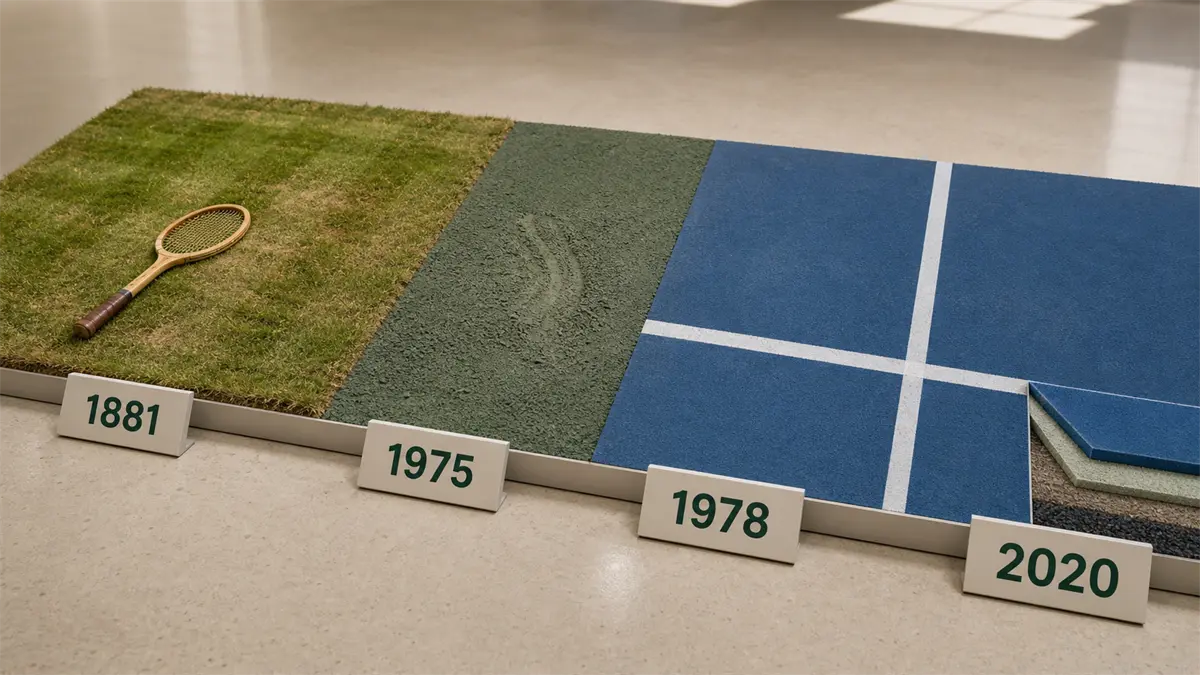
Since 2020, the courts have used Laykold, the surface system selected by the USTA. This was not a fourth surface. The event remained on hard courts while its acrylic system changed from DecoTurf to Laykold. Our complete guide to tennis court surfaces explains how grass, clay and hard courts affect bounce, pace and movement.
The sequence produced a one-of-a-kind record: Jimmy Connors is the only player to win the US Open on all three surfaces. He won on grass in 1974, green clay in 1976 and hard court in 1978, then added two more hard-court titles in 1982 and 1983. The tournament’s official year-by-year history confirms the sequence.
Who has won the most US Open singles titles?
Across the tournament’s full history, Molla Bjurstedt Mallory leads the singles list with eight titles. Richard Sears, Bill Larned and Bill Tilden share the men’s record with seven apiece. Restrict the count to the Open Era and the leaders change: Chris Evert and Serena Williams have six women’s titles, while Jimmy Connors, Pete Sampras and Roger Federer share the men’s record with five.
The 1968 dividing line matters because earlier formats demanded a different path to the trophy. Under the old men’s Challenge Round, the defending champion advanced directly to the next year’s final. Richard Sears’ streak is a good example of why seven consecutive titles then did not mean winning seven rounds in every edition, as it would today.
Most singles titles in the tournament’s full history
| Draw | Player | Titles |
|---|---|---|
| Women’s | Molla Bjurstedt Mallory | 8 |
| Men’s | Richard Sears | 7 |
| Men’s | Bill Larned | 7 |
| Men’s | Bill Tilden | 7 |
Mallory won her eight championships between 1915 and 1926. The US Open’s official championship records confirm both her mark and the three-way tie in the men’s draw.
Most singles titles in the Open Era
| Draw | Player | Titles |
|---|---|---|
| Women’s | Chris Evert | 6 |
| Women’s | Serena Williams | 6 |
| Men’s | Jimmy Connors | 5 |
| Men’s | Pete Sampras | 5 |
| Men’s | Roger Federer | 5 |
Through 2025, nobody had surpassed six women’s titles or five men’s titles in the Open Era. Federer won all five of his consecutively, from 2004 through 2008—the best men’s streak of the Open Era. Sears won seven straight from 1881 through 1887 under the older system.
If you combine singles, doubles and mixed doubles, the answer changes once more. Margaret Osborne duPont holds the women’s and overall record with 25 championships, while Bill Tilden leads the men with 16. Those totals span several events; they are not singles-title records.
When did an American last win the US Open?
The famous “American drought” applies only to the men’s draw. Andy Roddick in 2003 remains its most recent American singles champion. In the women’s draw, Coco Gauff won in 2023. Treating the two draws as one hides a 20-year difference.
| Draw | Latest American champion | Year | Final opponent |
|---|---|---|---|
| Men’s | Andy Roddick | 2003 | Juan Carlos Ferrero |
| Women’s | Coco Gauff | 2023 | Aryna Sabalenka |
Roddick won the 2003 final 6-3, 7-6(2), 6-3. After the 2025 tournament, the American men’s drought stood at 22 completed editions. Taylor Fritz reached the 2024 final but lost to Jannik Sinner, and no American ended the run in 2025. During that tournament, the official site still described Roddick as the last American man to win a Grand Slam.
Gauff came from behind to beat Sabalenka 2-6, 6-3, 6-2 in 2023. It was her first Grand Slam title and, through 2025, the latest American singles triumph in New York. Jessica Pegula reached the 2024 final and Amanda Anisimova the 2025 final, but both lost to Sabalenka. Gauff’s victory also made her the first American teenager to win the tournament since Serena Williams in 1999.
What do people eat at the US Open?
Wimbledon has strawberries and cream. The US Open has no single dish with that kind of history. Its food lineup changes each year and feels more like New York itself: stadium staples, celebrity chefs and several cuisines sharing the grounds.
It does have a drink: the Honey Deuce, the tournament’s signature cocktail. The recipe published by the US Open combines vodka, lemonade and raspberry liqueur, topped with three honeydew melon balls. The visual joke is the point—they look like tennis balls on a skewer.
Foods that return frequently include:
- Lobster rolls, the New England seafood sandwich.
- Steak sandwiches and burgers, with Pat LaFrieda a recurring name around the grounds.
- Hot dogs and concession food, the closest match to a classic American stadium meal.
- International options that rotate with each edition and reflect New York’s food culture.
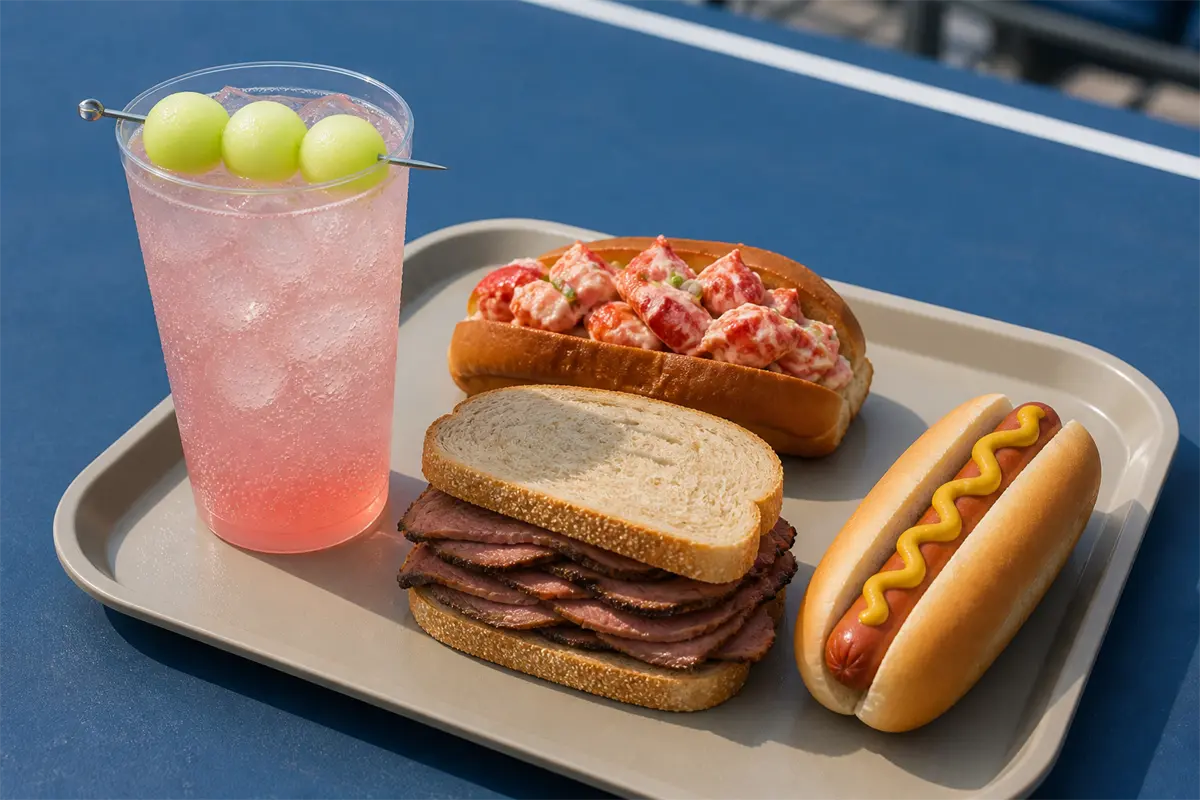
The Honey Deuce qualifies as a US Open tradition. The rest of the menu is intentionally fluid, so the official dining guide is the useful reference for any particular year.
Five facts that explain the US Open’s personality
It was the first Grand Slam to use a tiebreak
The US Open introduced the tiebreak in 1970 to prevent sets from continuing indefinitely. The original version was not today’s format: it was a nine-point, sudden-death tiebreak at 4-4. In 1975, it gave way to the win-by-two version. Our guide to why tennis uses tiebreaks explains how the rule changed both scoring and the pressure at the end of a set.
It introduced equal prize money in 1973
The US Open was the first Grand Slam to award equal prize money to its men’s and women’s champions. In 1973, John Newcombe and Margaret Court each received $25,000, according to the tournament’s official year-by-year history. The change followed pressure led by Billie Jean King and preceded equal prize money at the other majors by decades.
Arthur Ashe is the world’s largest purpose-built tennis stadium
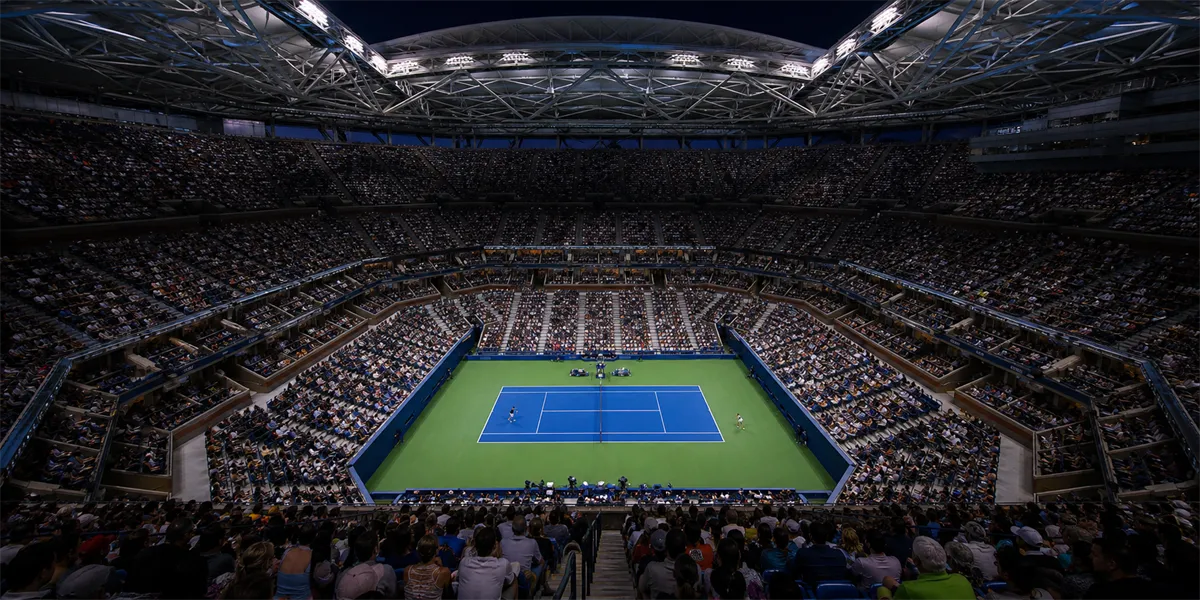
When its retractable roof opened in 2016, the tournament described Arthur Ashe Stadium as the world’s largest tennis arena, with 23,771 seats. Capacity can shift with current configurations and construction, but its sheer scale remains central to the experience. A night session there feels closer to a major New York event than to the hush of a traditional tennis club.
The stadium is now being modernized in a project scheduled for completion before the 2027 US Open. Capacity figures and hospitality spaces may therefore change between editions, although the tournament will continue throughout the work.
The youngest singles champions were still teenagers
Tracy Austin won the 1979 women’s title at 16 years, 8 months and 28 days. Pete Sampras was 19 years and 28 days old when he won the men’s title in 1990. Both records still stand in the tournament’s official table of youngest and oldest champions.
At the other end of the scale, Molla Mallory won in 1926 at age 42. In 2023, Novak Djokovic became the oldest Open Era men’s champion at 36 years, 3 months and 19 days.
New York nights are part of the show
The first US Open night match took place at Forest Hills in 1975. Under the lights at Flushing Meadows, however, the night session became part of the tournament’s identity. Fans arrive after work, matches can finish well after midnight, and the crowd is louder than at the other majors. Jimmy Connors harnessed that energy as well as anyone; decades later, the night session remains one of the event’s defining attractions.
The three dates worth remembering
When someone asks when the US Open began, the most useful answer is not a single date:
- 1881 marks the birth of the championship.
- 1968 marks the beginning of the modern US Open and the Open Era.
- 1978 marks the move to Flushing Meadows, hard courts and the New York personality we know today.
They are not competing answers but three layers of the same history. The championship was born in Newport, opened to professionals at Forest Hills and found the surface, stadium and nighttime atmosphere that now define it at Flushing Meadows.
Keep learning
Turn this information into a better decision for your game
Explore more guides on the same topic or visit the complete archive to compare your options with context.
Continue reading
Related articles
Tennis Rating Systems: UTR, NTRP and WTN
Tennis rating systems explained: what UTR, NTRP and World Tennis Number measure, why exact conversions fail and how to read your rating for fairer matches.
Tennis Grip Size: How to Measure It and Why It Matters
Complete guide to tennis grip size. Learn how to measure your correct size, how it affects play and injuries, and when to go bigger or smaller.
Racket Head Size: 98 vs 100 sq in — Which One Is Right for You?
Technical guide to tennis racket head sizes. Discover the real differences between 97, 98, and 100 sq in in control, power, spin, and sweet spot.